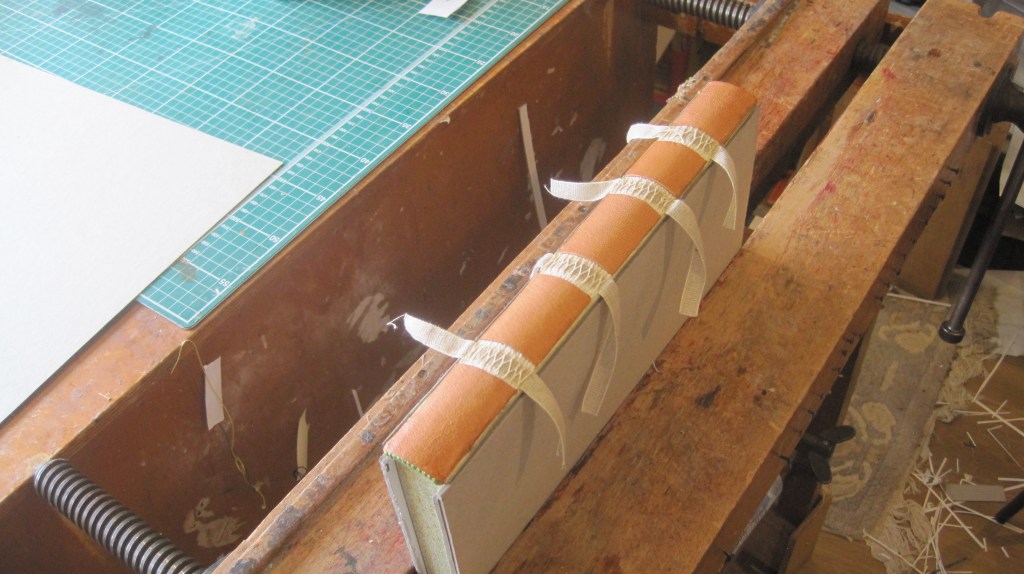
I started bookbinding as a hobby more than 40 years ago. I took evening classes at Leicester Polytechnic (which had recently taken over the Leicester School of Printing, along with its specialist bookbinding staff) in 1976 and continued for five years. Trevor Hickman was the tutor – sadly he died a couple of years ago – very highly respected by all his students. Over the next 25 years I gradually acquired all the tools, equipment and materials necessary to tackle any repair or new binding job, and I joined the UK-based Designer Bookbinders, and later the Society of Bookbinders. Their weekend courses and conferences were important to developing my skills. Initially I bound or repaired just my own books, but people began to ask me to do repairs at which , with practice, I became quite proficient. When I retired from full-time work I took on more repair work and now, fifteen years later, my work book has over 2000 entries, including some new bindings for clients. Now I would like to share some of the techniques and methods I have developed with other binders, however new they may be to the craft, and that is the chief aim of this Blog.
Author: therebindery
Began bookbinding as a hobby 45-plus years ago. Acquired some degree of skill through practice, courses and workshops. Acquired good range of equipment, tools and materials and set up home bindery. For the past 25 years I have undertaken all kinds of repair and binding work for booksellers and collectors. I live near Stroud in Gloucestershire, UK.
Yesterday I gave a talk at a meting of the Society of Bookbinders in Taunton. The theme was ‘Twenty bindings across fifty years’ – showing a progression from no skill, no tools and no design ideas to something at least satisfying.
Taunton is 75 miles away so I checked the traffic reports and was warned of possible delays on the Motorway, so I left in a bit of a hurry, taking three boxes of books but leaving one behind that contained three of my earliest bindings. Aaaaargh!! So this post is to fill in that gap.
The first binding I intended to show was to highlight the ‘no skills, no tools’ point:
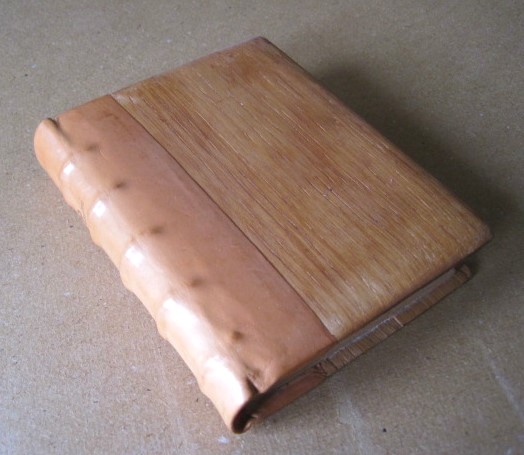
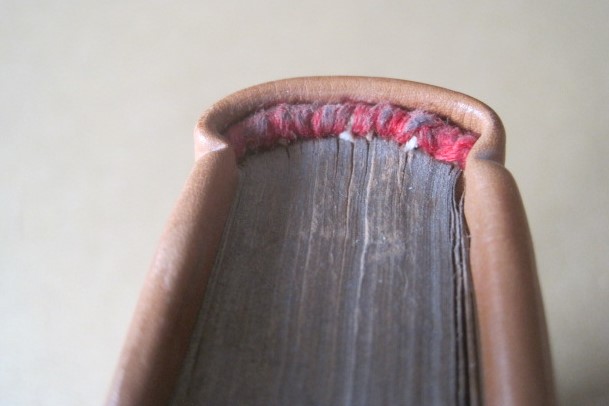
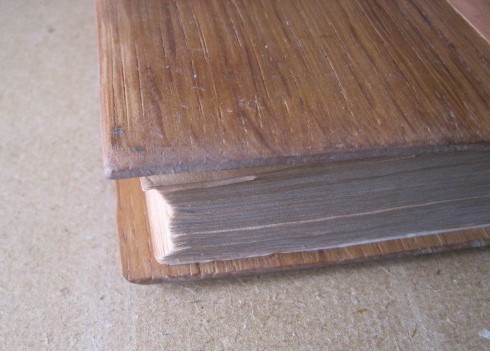
A small Book of Psalms, from the Temple Bible series, re-bound in a piece of plain calf over oak boards made with simple woodworking tools (handsaw, hand drill, rasp, sandpaper). Clumsy headband, ‘squares’ not even. But it does work as a readable book.
Next, an attempt at decoration without any tools at all:
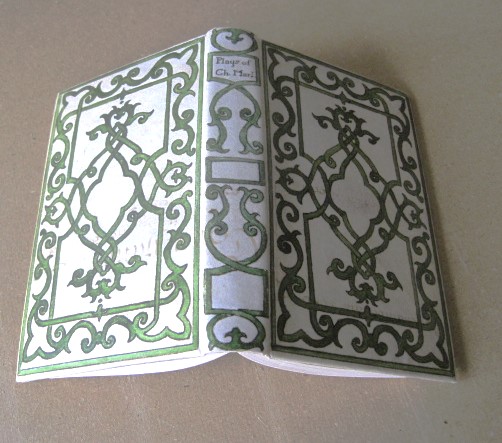
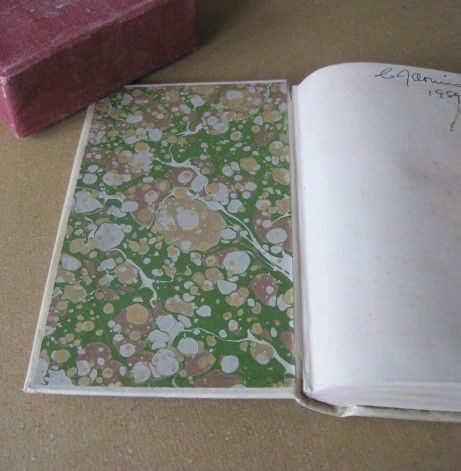
A copy of the World’s Classics edition of the Plays of Christopher Marlowe that I had at school. Original covers re-covered in 1979 in a piece of parchment from a discarded deed. The decoration is copied from an auction catalogue image, drawn in black ink and coloured with gouache watercolour. The marbled paper lining to the covers is not right for the date of the plays. At the time I was very pleased with it.
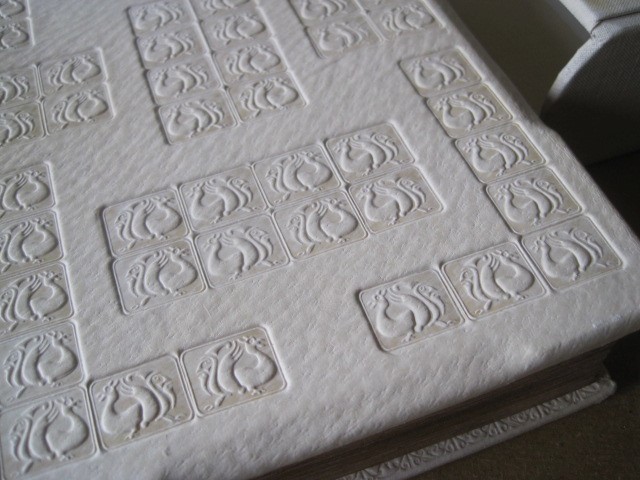
It was five years before I bought my first finishing tools: a pair of ‘grotesque’ stamps made by P & S for me from an image from Gibson’s ‘Early Oxford Bindings’. I used them to decorate the tawed pigskin covers of a copy of Beowulf. Partly bevelled boards, raised double bands, sewn headbands. Matching slipcase in cream bookcloth. I liked it at the time, and I still do. The binding was done in 1980, five years after I started to learn the craft.
Those three books should have been the first part of my talk. Those who heard the rest can now see it here.
Simple re-backs of cloth-bound books with damaged/ torn/missing spines are bread and butter work for most hand binders.
Here are a couple of useful tips.
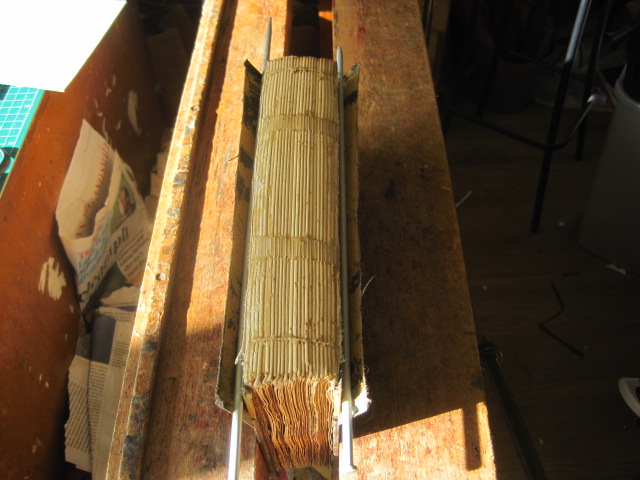
You have cleaned the old linings off the back of the text block and re-shaped it. Next you are going to glue a strip of cotton fabric over the back, 25mm wider than the back, so as to have hinges to secure the boards firmly.
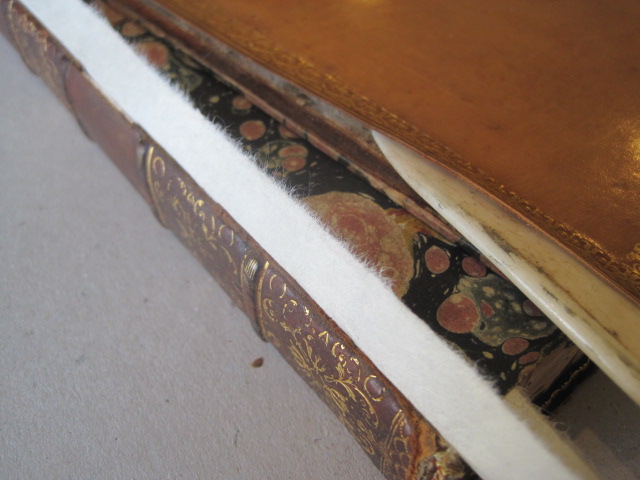
Hold the pre-lifted flaps of the covers away from the back with a couple of old knitting needles to avoid getting glue on them at this stage.
Glue the back and tap and rub the cotton fabric into the backs of the sections of text with an old nailbrush, finally rubbing up and down. This ensures the fabric is worked right into all the corrugations of the back.
Then you glue a strip of strong Kraft paper over the fabric.
Also rubbed down with the nailbrush. The Kraft paper strip is a couple of mm short at top and bottom – you don’t want to see the top/bottom edge when the book is finished.
The text block is now firm and tight, but opens easily.
Occasionally the combination of damage from age and the original binding methods produce a nearly impossible challenge. Here is an example:
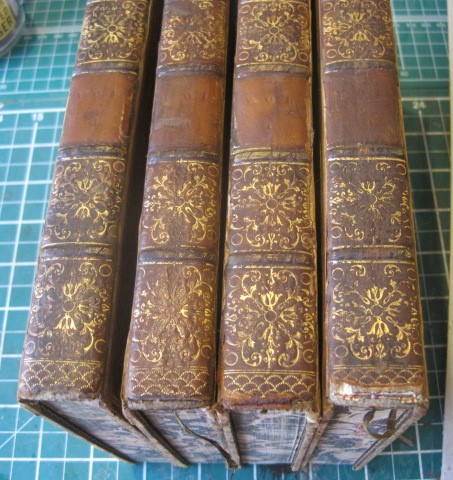
Four volumes of a rare edition of an account of touring through Italy in 1802. All spine labels were missing and all the covers (yes, all eight) were detached. The tight backs were still very decorative but the leather was dry and fragile and there was no possibility of removing them so as to re-attach the covers in the normal way, with new leather joints.
About thirty years ago Don Etherington in the US devised a compromise method, using repair tissue only. With one minor variation that is what I did.
First remove the endpapers. You want every bit if possible, so ease the endpaper up from the next leaf (usually a blank but possibly a half-title) by running the top of your fingernail under it to break the paste joint and gently pulling it away from the backing joint.
The new hinge for each cover is made by gluing a strip of strong Japanese tissue (I use Kozu paper, about 35 gsm) under the endpaper and then over the cover and under a flap of the cover leather.
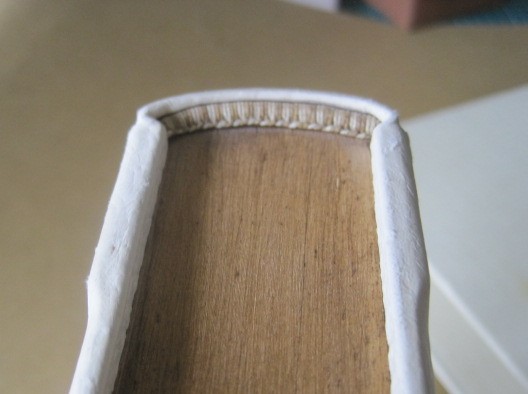
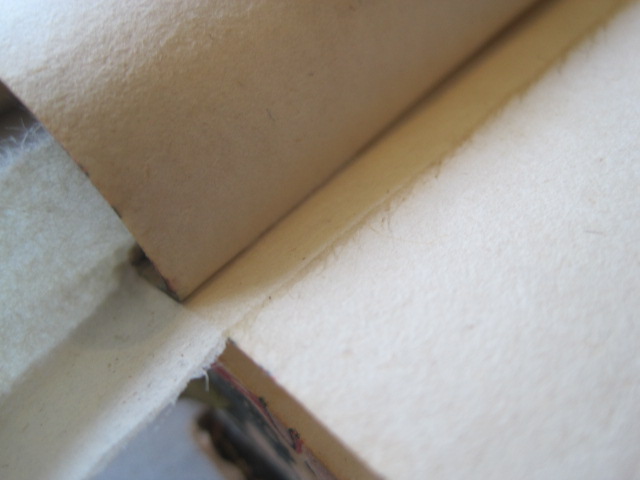
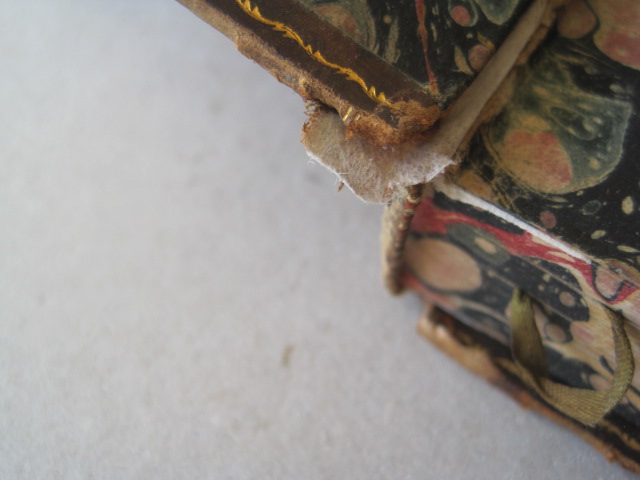
The Kozu paper, about one inch wide, is glued on to the leaf under the endpaper which is then replaced, flush up to the backing jointNotice the frayed edge of the tissue strip – this helps to conceal the edge after the repair is complete. The strip of Kozu is torn off after wetting the line of ‘cut’ with a fine brush or the point of a wetted bone folder. The lifted flap of cover leather is shown.
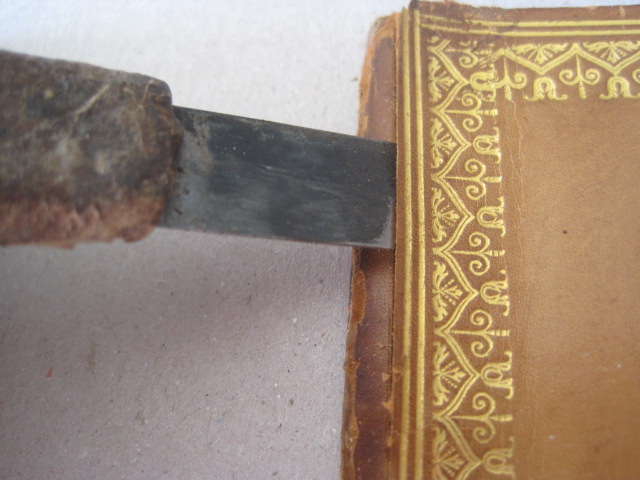
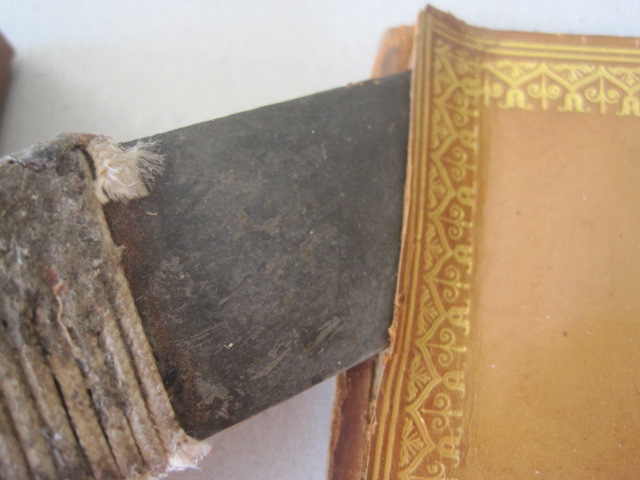
Lifting the flap of cover leather is easy if it is done in three separate actions. First cut along the outer edge of a gold or blind line with a sharp scalpel. Second, use that cut line to chisel under the line with a small lifting knife.
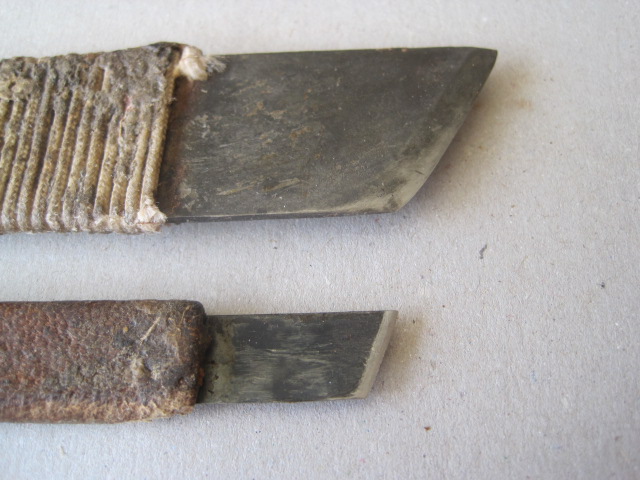
Please note – I am left-handed. The action is to push the lifting knife into the first cut at an angle of not less than 30 degrees, away from you and upwards. This will ensure the knife goes into the board under the leather.The wider lifting knife, at the same 30 degree angle easily lifts enough for the tissue to go under – again pushing with a chisel action into and up the line of cut.These two tools are the key to this repair procedure (and to many others in repair work). the smaller one is about 10mm wide and is made from a standard hacksaw blade. Most bookbinding suppliers stock them. Mine is wrapped in leather for comfort. The larger one is also made from an old hacksaw blade, but in this case an industrial one, about 35mm wide. Also wrapped for comfort. I have had both for over 30 years. The knife is flat on the underside and the ground bevel is at an angle of about 20 degrees.
The next step is to colour the flap of tissue to match the cover leather. I use acrylic paint rather that spirit stain – it’s easier to get the shade right.
This shows the tissue painted and loosely tucked under the flap of cover leather. In fact the shade is not quite right so another coat will be applied until the match is correct. Better to start too light and then darken.
When the colour match is right, roughen the surface of the narrow strip of cover leather against the edge of the board so as to get a good adhesion when the tissue flap in glued down. If that narrow strip is badly decayed, remove it and replace it with a strip of thin card as shown on previous posts.
Coloured tissue hinge glued under the lifted cover leather and nipped in the press.
The tissue is trimmed flush against the edges of the end paper but a small flap is left at top and bottom of the cover board.
The flap is pasted and smoothed up over the edge of the cover board, giving a neat finish.
Next, check inside the joint. If the inside of the tissue hinge is very visible, cover it with another strip of the same tissue.
And colour it to simulate the marble effect.
If the coloured strip looks a bit ‘bright’, dull it down with a finger wiped in surface dust – Bernard Middleton used to use dust from he top of the door into his bindery..
Finally make new labels for the title and volume panels on the spine. There is an earlier post about making labels.
A good polish and the books are ready to return to the client.
I should add that this was a repair, not a restoration. Two headcaps are still missing and some of the corners bumped and worn. But the set is readable and can stand on the shelf securely.
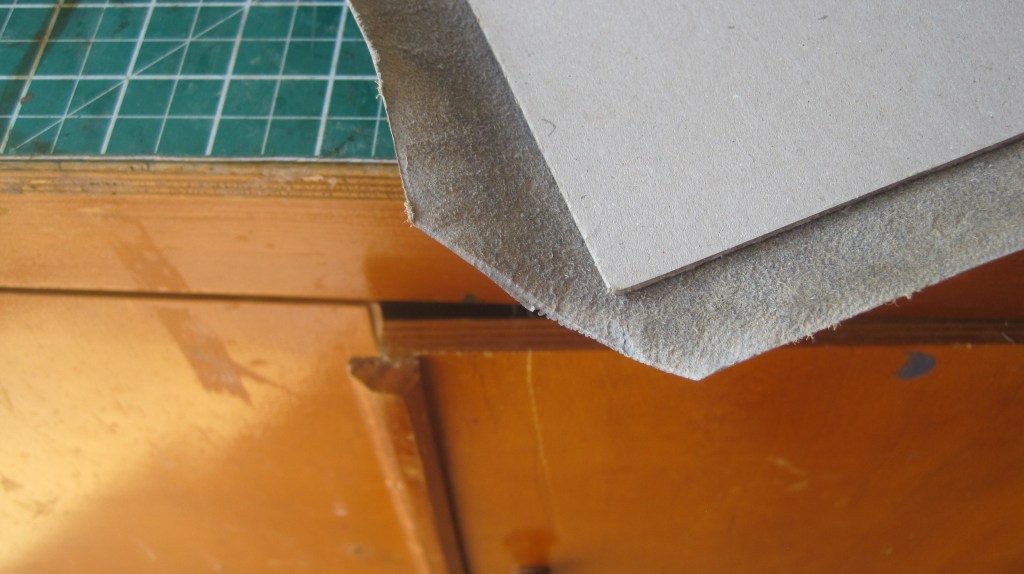
After blocking the title on the spine the book is covered. The spine is attached to the hollow on the back of the text with a mixture of paste and glue so the fine adjustment can be made to position it accurately. Before the sides are put in place the corners of the leather must be prepared so as to give a neat finish (see earlier post ‘It was going so well’)
A small arc of leather is scooped out enabling the turned corner to be pressed flat
Now for some more heresy. The traditional way to ‘put down’ the sides is to dampen the outer surface, apply two coats of paste to the flesh side, allow it to soak in and then smooth the leather over the sides, turning in the head and tail and forming the headcaps as a continuous process. This approach, sanctified by centuries of use, has at least two hazards:
First, the damp leather is very susceptible to surface marking from finger nails, however neatly trimmed, and any tool used for smoothing or shaping;
Second, because the texture of the leather naturally varies depending on its original position on the body of the animal – back, sides, belly, leg – it will stretch differently when smoothed, resulting in uneven shrinkage as the leather dries. This produces uneven warping of the dried covers which has to be corrected afterwards by paper linings. It doesn’t matter how carefully the cover boards have been made, in two layers with paper linings to each, the warping can still vary.
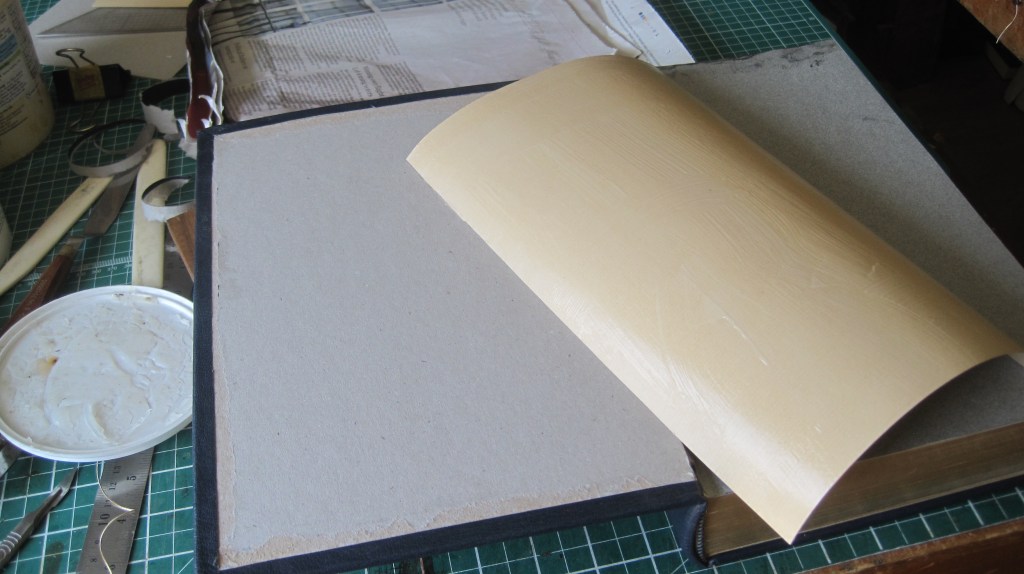
My heretical solution for this book (remember the spine has already been glued in place) is not to damp the leather on the surface and to apply glue, not paste, direct to each cover board, separately. The loose leather is then smoothed down and given a quick nip, between clean boards, in the press. When the glue has dried, say ten minutes, the head and tail can be turned in and the headcaps and corners formed, but in this case with paste not glue so that the leather is malleable.
The boards will still warp outwards a little, but evenly, and this is corrected by the board linings after trimming out the inside of each.
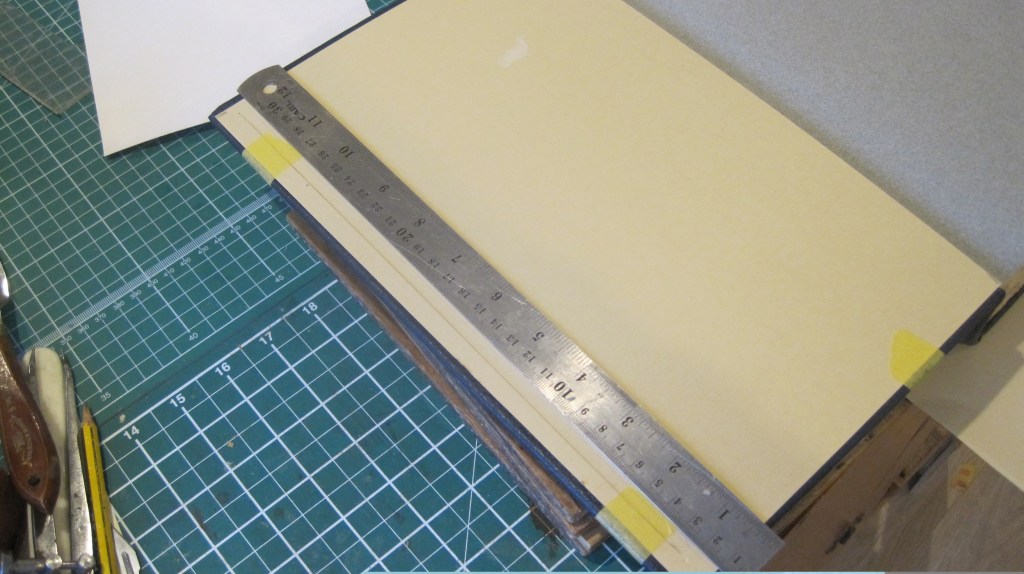
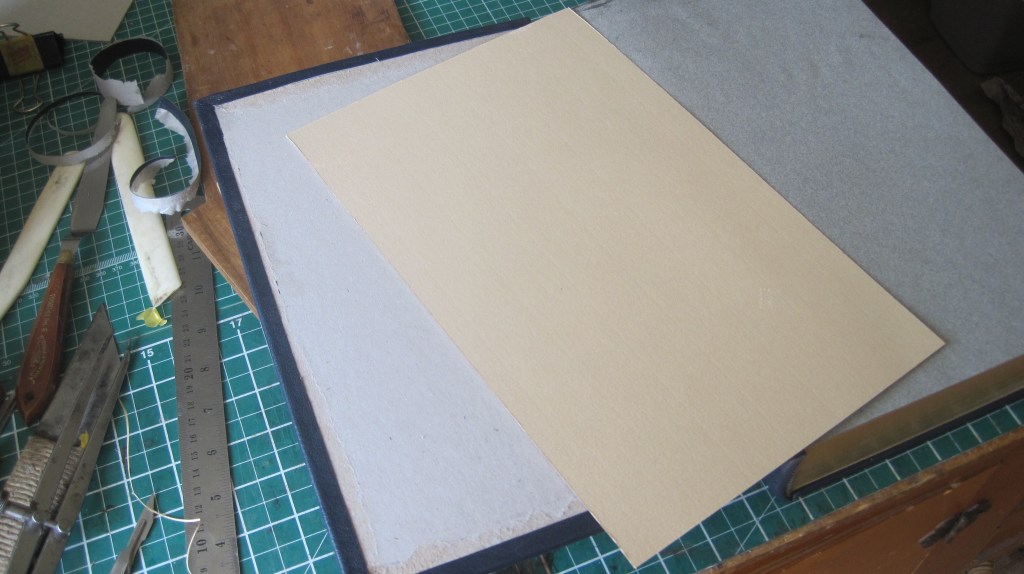
Thin card, close to the thickness of the turned-in leather, is taped to the inside and cut through with a sharp scalpel so as ro go through the turn-in leather as well.When the cut edges of the turn-ins are removed the piece of card will fit exactly. It is wise to trim a bare millimetre from the hinge edge to accommodate the expansion when pasted – see below:The card is pasted and naturally curves (so long as you chose a piece with the grain going up-and-down!) and is pressed in place and allowed to dry. It will draw any curve of the cover back from concave to slightly convex.
And then the covers are ready for decoration. As stated in the previous post I will use the same title block for the front cover as was used on the binding for that client a few years ago. The block is fixed to the heated chase which is raised to accommodate the thickness of the book. The book is positioned with low-tack tape and stamped. A good impression first time is important as there might be a slight movement a second time which will spoil the sharpness of the image. This time it worked fine:
Now the freehand ‘waves’ decoration can be applied.
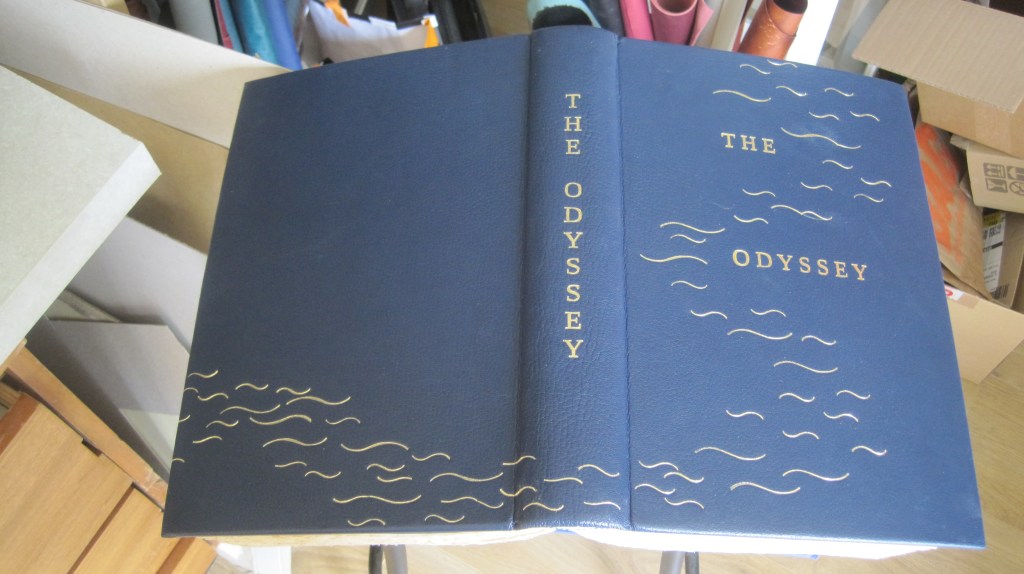
This is as far I have got today – I will extend the design across the base of the spine and on to the back next.
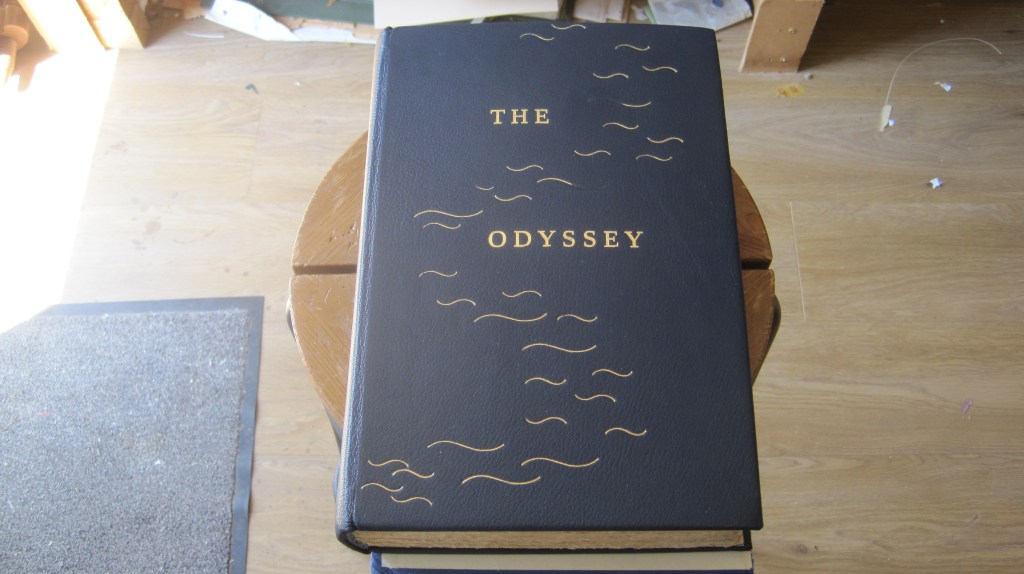
And here is the result:
It is tempting to keep adding, but I think that’s enough.
Six years ago I posted the first part of the work on my own copy of the 1931 Limited Editions Club ‘Iliad’ (see ‘It was going so well…’). I still have the book, but I also have its companion volume of ‘The Odyssey’ and I have finally got round to re-binding it – like the Iliad it had a plain cloth binding that in no way does justice to the quality of the printing and the paper.
In fact a couple of years ago I bound another copy of the same edition of the Odyssey for a client who was pleased with the design I put on it:
The covers are plain blue buckram cloth. The simple design suggests a circuitous sea journey. The titles were blocked.
I will use the same design idea for my copy but for the covers I have a good piece of dark blue morocco goatskin and I will use the same blocks for the spine and cover titles.
Now for a bit of heresy: surely a ‘fine’ binding must be hand lettered? Nonsense! First of all it is fiendishly difficult to hand letter vertically and to achieve an even depth of impression – important with gold work as uneven impressions reflect light differently. But a metal block gives perfect spacing and perfectly even depth.
There is still a challenge, though. You can block on to a flat cover, so long as your blocking press can be raised high enough to take the thickness of the book – my old Mackay press certainly can – but how to block on a curved spine?
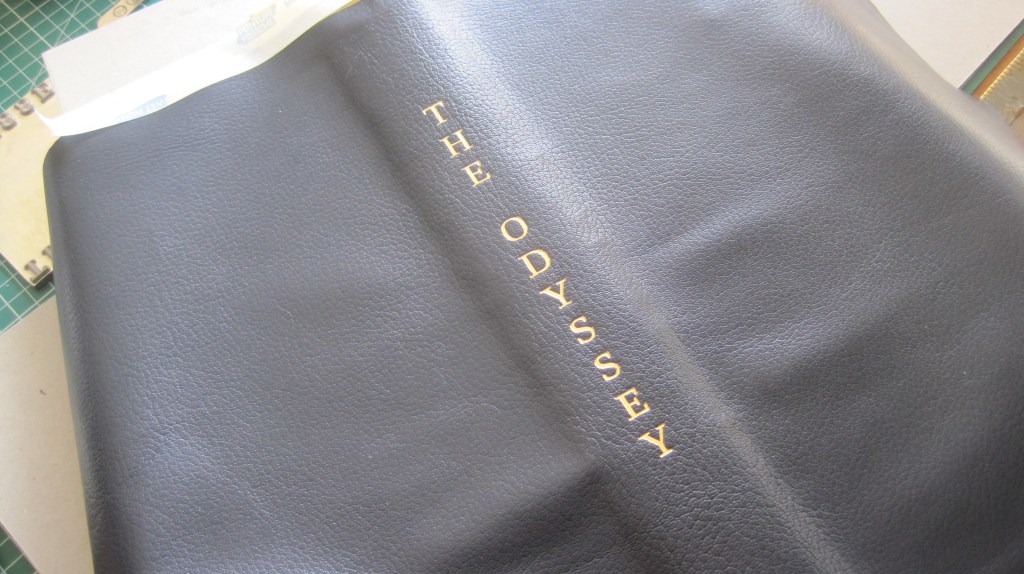
The answer is to block the spine before covering the book. It takes care to position the impression exactly in the vertical centre, and there has to be a firm lining to the leather so as to get a sharp impression from the block.
Carbon impression with centre line markedCentre line of the lined covering leather with a nick exactly in the middle at top of the turn-in edge (both top and bottom). The leather is turned over and taped down to align with the centre line on the carbon impression.
The result is sharp, perfectly aligned, and ready for covering.
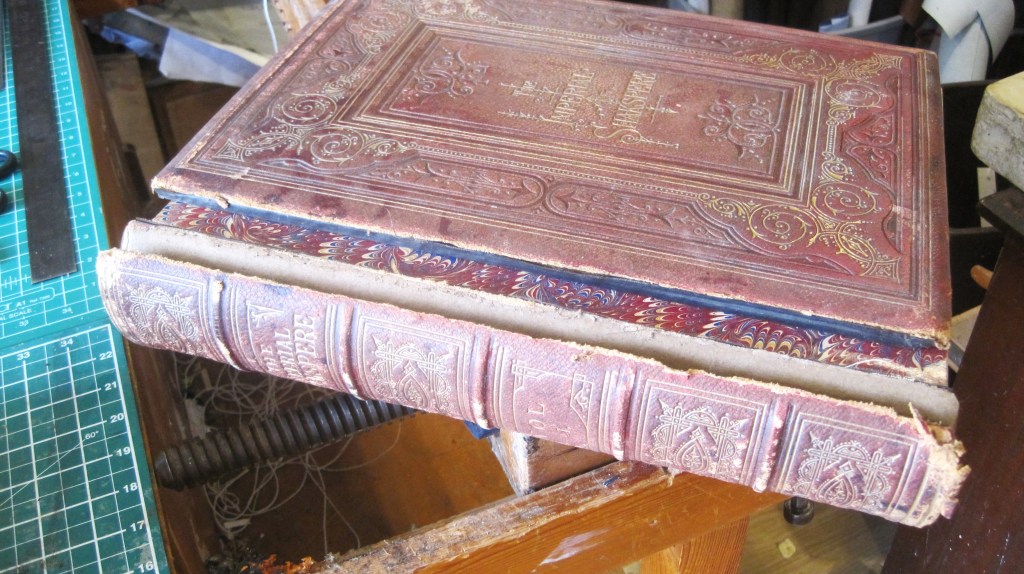
I realise it is well over a year since my last post, for which I should apologise. But the truth is that nothing much has happened in my bindery recently that merits broadcasting to the world. Still plenty of work, I’m pleased to say, but all of it has been the usual ‘bread-and-butter’ stuff: cloth or leather re-backs, slip cases and the occasional fitted box or treasured family bible. A recent unwelcome arrival is the two volume ‘Imperial Shakspere’ (sic) weighing in at about 10 kilos and with three of the four boards detached.
I’ll use the method set out in the ‘When big is definitely not beautiful’ post.
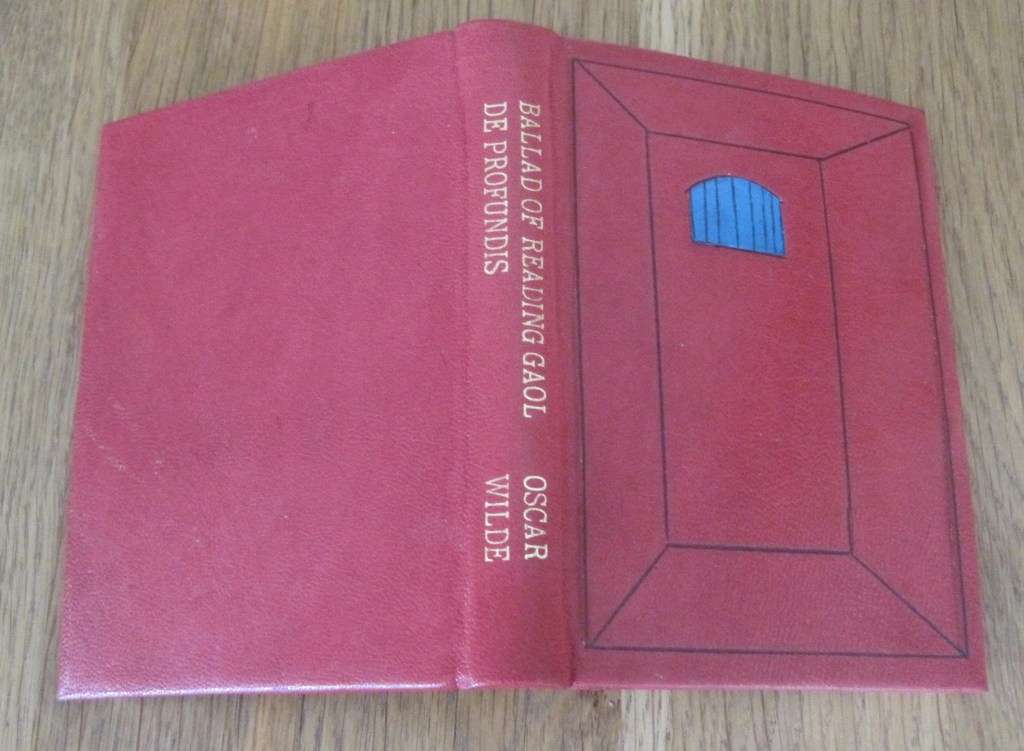
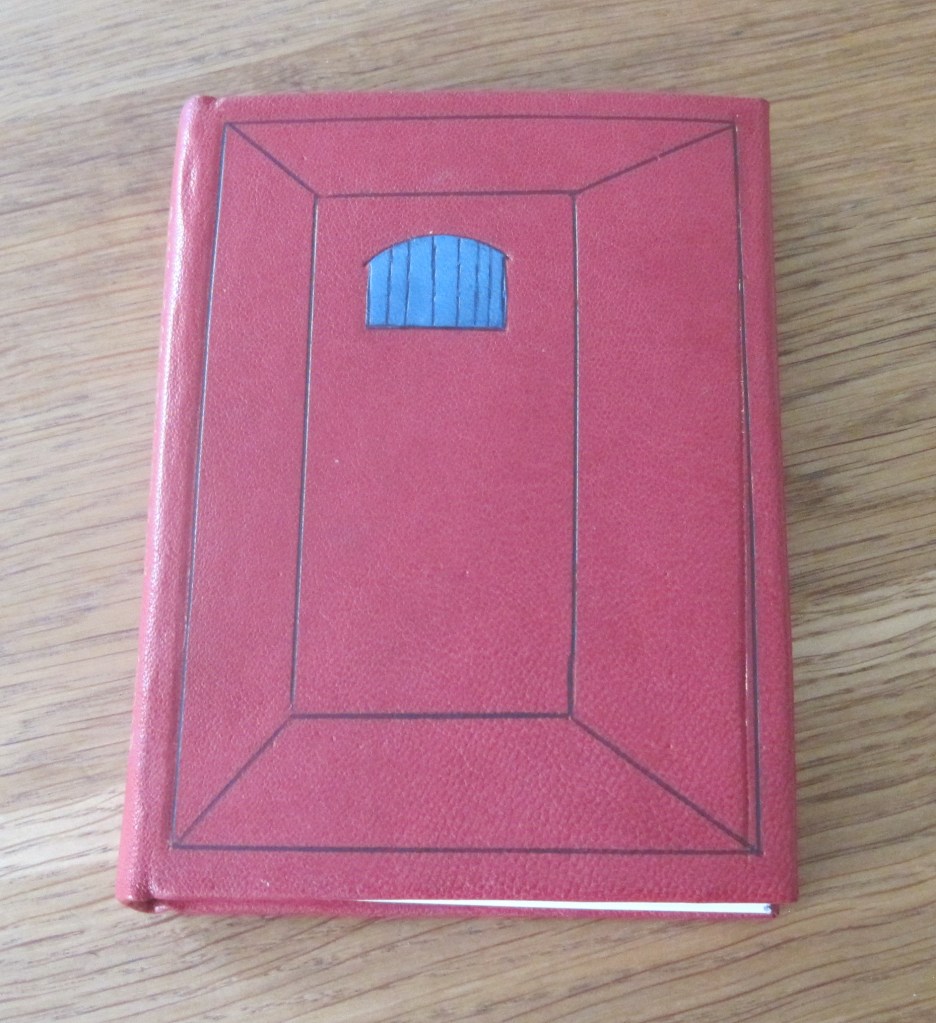
However, one recent job is perhaps worth describing: an existing customer decided she would like her copy of the little Tauchnitz edition of Oscar Wilde’s ‘Ballad of Reading Gaol’ rebound in full leather, leaving the design to me. I thought about it and settled on a simple, naive semi-pictorial design that could have been produced by a prisoner in the prison workshop, utilising the line in the poem ‘that little tent of blue that prisoners call the sky’.
I sent it off and there was a longish silence. I checked she had got it. Yes, but she really didn’t like it. I mean, REALLY.
So I asked her to send it back and I took the covers off, rebound the book in classic late nineteenth century gilt and returned it to her.
Then I bought another copy of the same edition and put my covers on it. It lives on the shelf of my own bindings. And I love it!
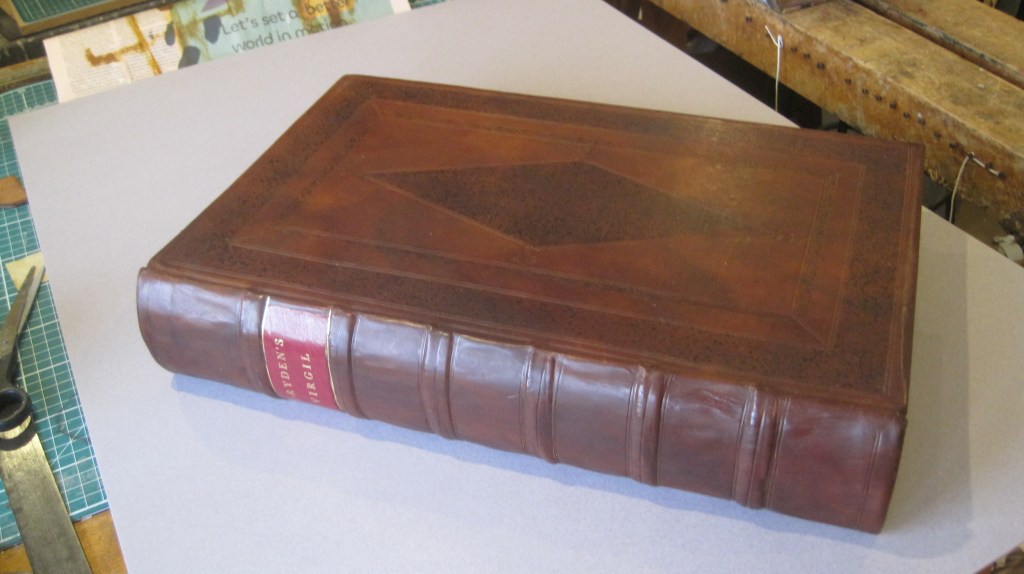
A recent job on a large folio printed in 1692 required a complete new binding:
The classic sprinkled panel design includes a repeated double-line fillet and a foliage roll.
Getting the corners neat and sharp is difficult, but there is an old trick for achieving a sharp square or mitred join at the corners:
Tape an old double-edge razor blade either at the end of the double line or across the corner of a mitre and the impression of the fillet or roll will end exactly at the edge of the blade.
Simple!
A Catalogue of Treasures – part II
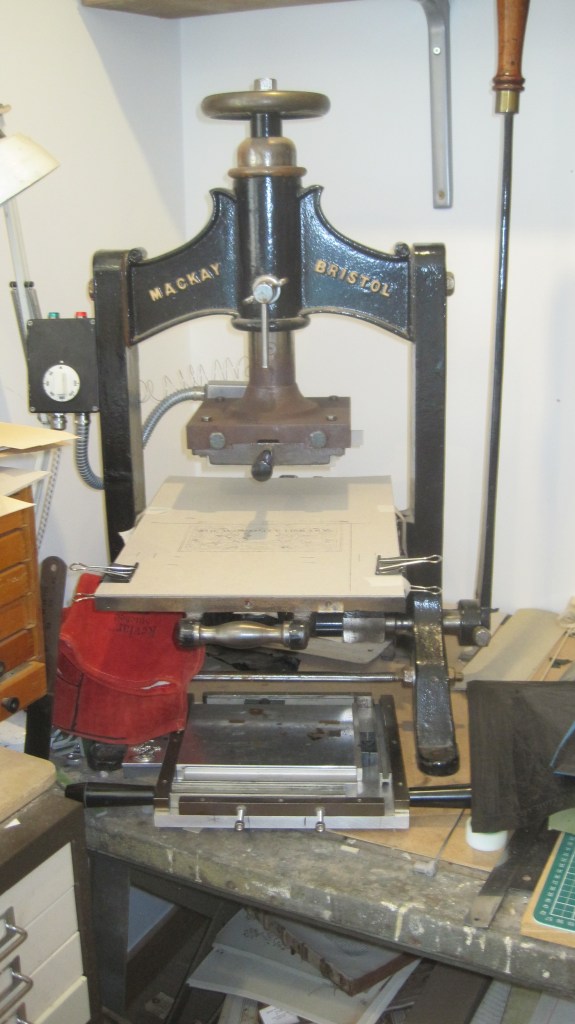
Having settled on a design the first step was to block the title on the front cover. I am fortunate to have an old Mackay blocking press, acquired at the auction of the contents of the bindery of a retiring bookbinder in Hereford more than 20 years ago. Not only does it have a large ‘chase’ (the frame in which letters or blocks are held for impressing on leather or cloth covers) but the ‘head’ can be raised or lowered to accommodate a variety of thicknesses of book.
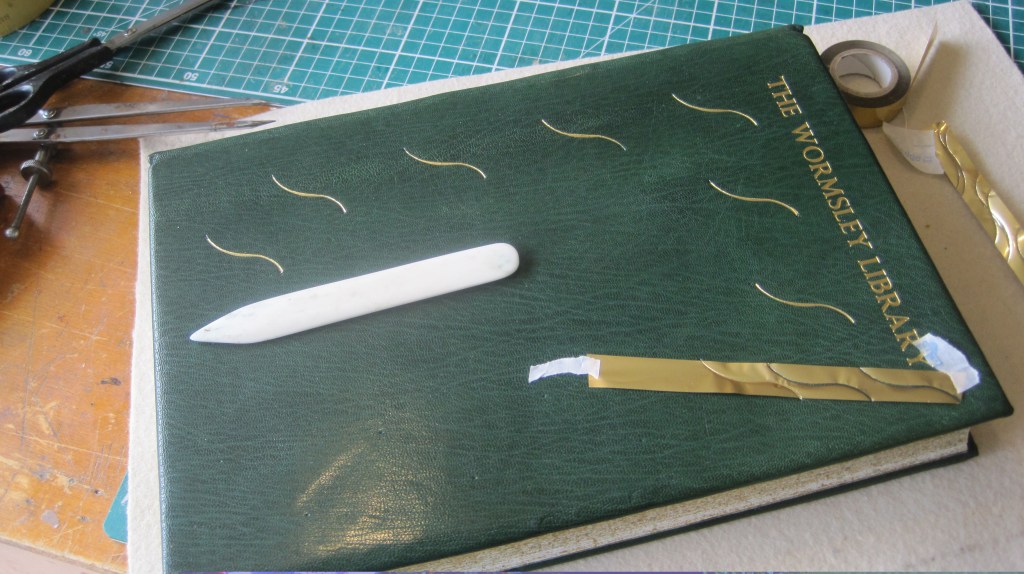
I have some 36-point Times Roman brass type which fills the width of the design nicely so with that stamped through gold foil the rest of the design can be set out:
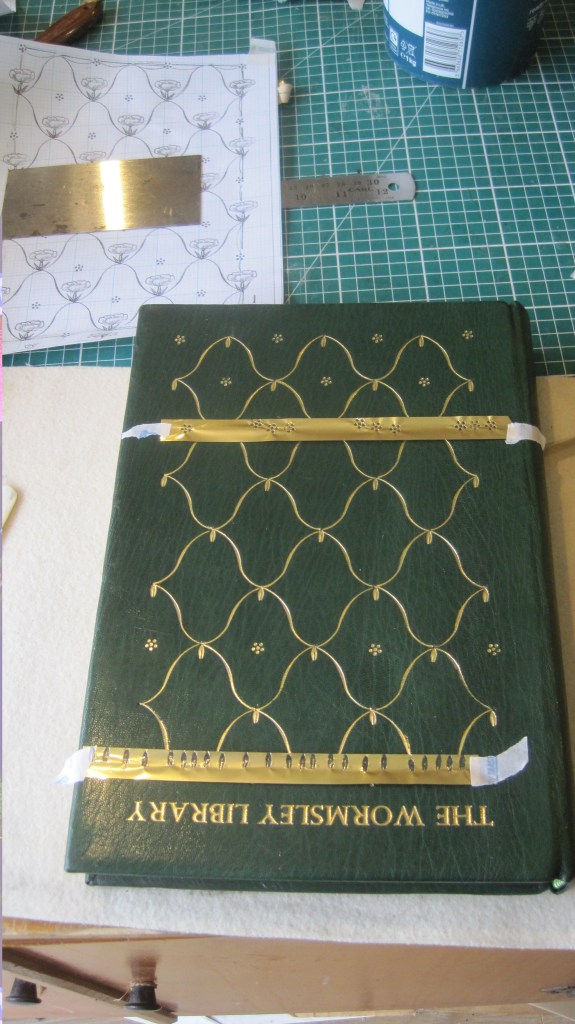
starting with the curved lines. The position of each is marked with the point of a bone folder through the paper design. The complete shape looks pretty good. Then the small tools can be added before the important flower head tooling.
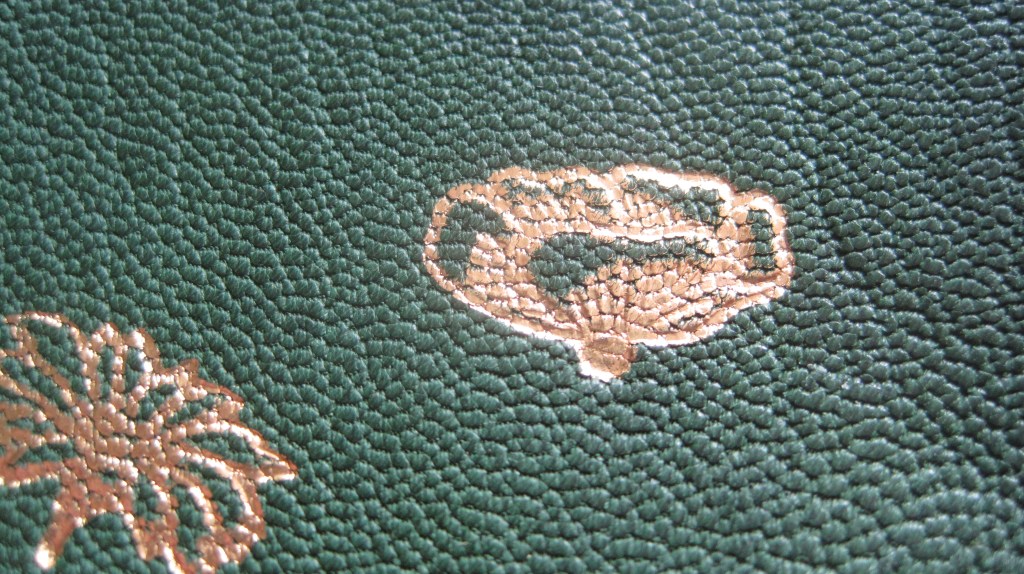
But that presented a problem as the chosen tool was too detailed to make a clear impression on grainy morocco leather:
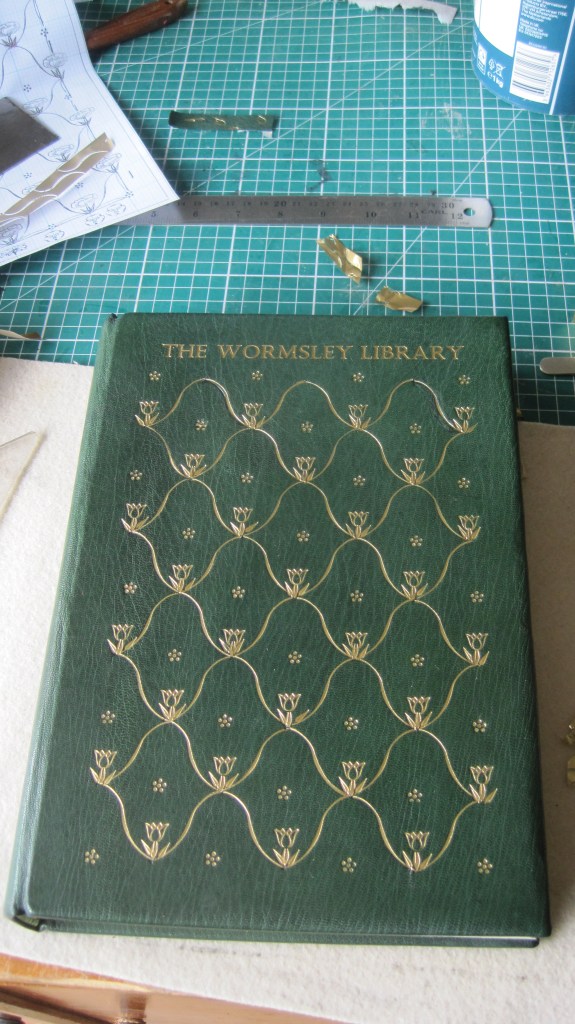
A possible alternative tool, bottom left of the picture above, is just too wide to fit in to the framework of curved lines. So the best available tool was used – one has to be prepared to adapt designs in the light of both the tools available and the characteristics of the materials used. Another adaptation was to leave out the short straight lines around the edge of the design – I decided they just were not necessary. So the final result is this:
And it goes on the shelf next to the Cobden-Sanderson binding shown in the first part.
First, I’m sorry it has been more than a year since my last post. Some medical things, not unconnected with my age (now 83), have taken up a fair bit of time. Now all resolved.
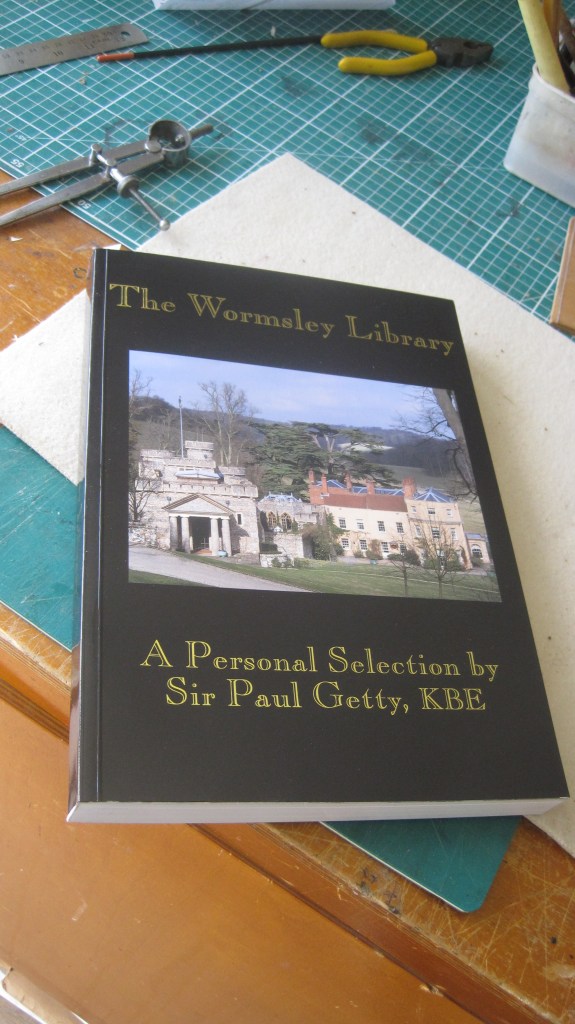
But I wasn’t sure of such a good outcome for a while so I focussed on clearing up a backlog of projects that have been tucked away in cupboards in the bindery – as mentioned in one of the earlier posts – in some cases for years. One such project is to put a worthy binding on one of my two copies of the Catalogue of the exhibition of treasures from Sir Paul Getty’s Wormsley Library that was mounted at the Pierpont Morgan Library in New York in 1999. The Wormsley Library is an astonishing flint and stone addition to the main house on the Getty Buckinghamshire estate, in the style of a medieval castle. It is not open to the public but I have been fortunate enough to visit it on several occasions over the past 20-odd years. The Pierpont Morgan Exhibition comprised 106 items chosen by Sir Paul himself, ranging from a sheet of vellum written out in the middle of the 7th century, probably in Northumberland, to a calligraphic manuscript of Under Milk Wood completed in 1978. Most of the books chosen are in exceptional bindings, which is why I treasure the catalogue myself.
I have a lot of catalogues of either auction sales or exhibitions and I have bound a few in the past, both to preserve and to dignify them.
This is one of my two copies of the famous 1958 Baltimore Museum of Art exhibition catalogue illustrating the history of bookbinding from 525 AD to 1950. The design is a rather obvious pastiche of French binding of the mid-16th century.
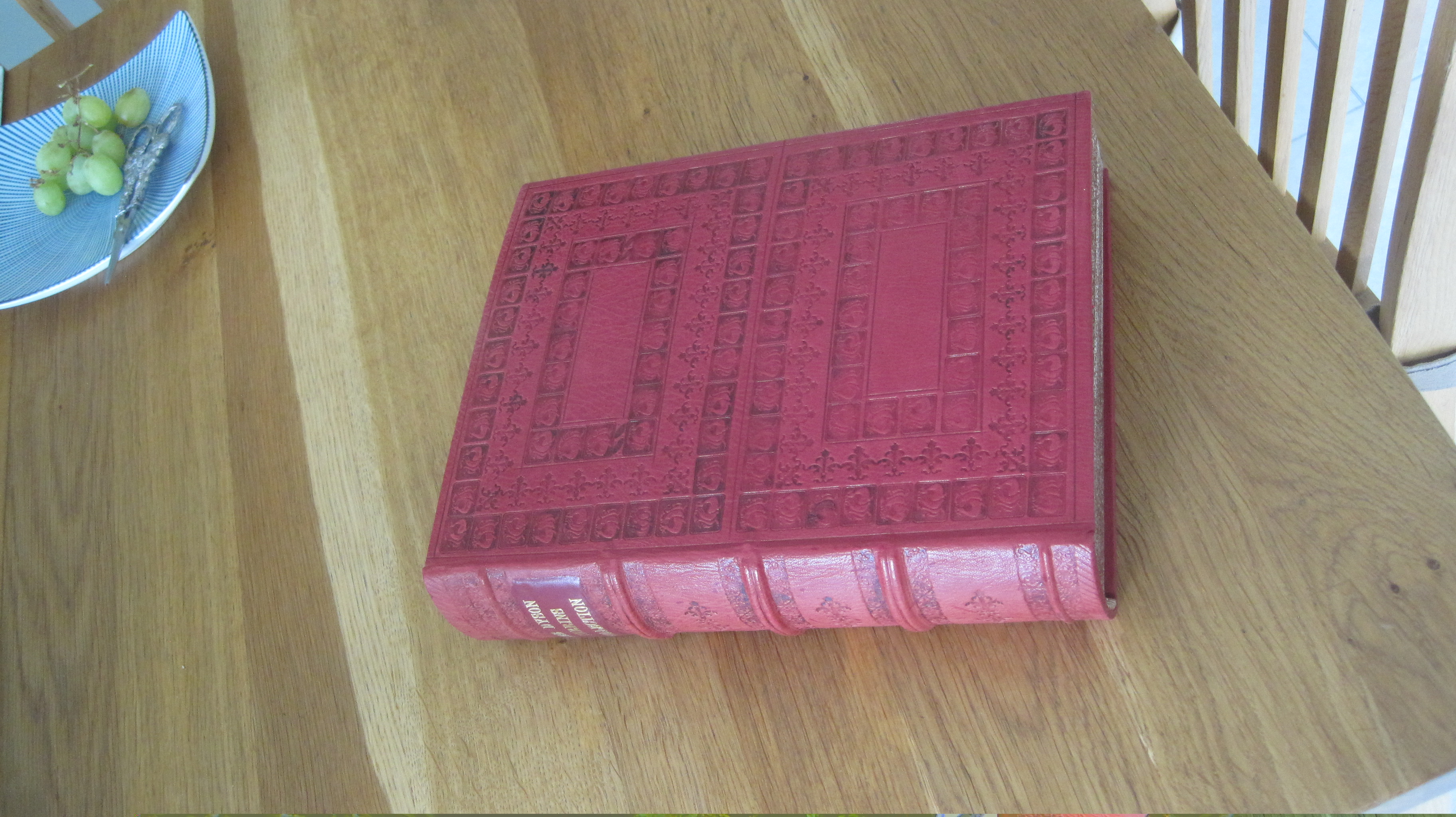
About 30 years ago I used a newly-acquired pair of medieval stamps to decorate a binding of the three Sotheby’s catalogues of their sales of the medieval manuscripts collected by C. W. Dyson Perrins, of Worcestershire sauce fame, that took place in 1958, 1959 and 1960. I rather over did it!
The boards are wooden and the edges sprinkled dark brown.
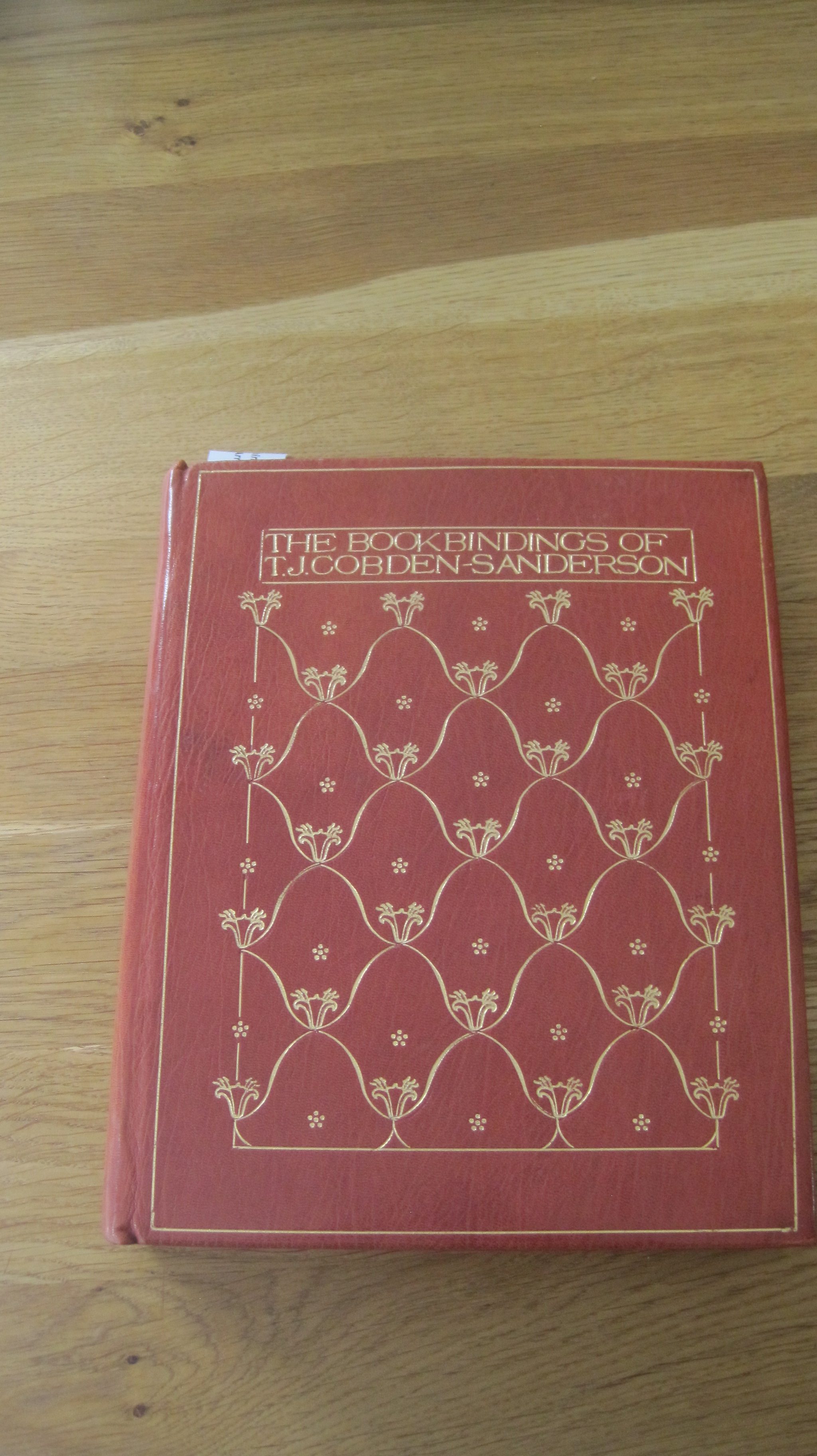
I have been interested in Cobden-Sanderson’s work for many years and acquired Miriam Tidcombe’s authoritative study of his bindings when it was published in 1984. About ten years ago I got round to re-binding it.
I had been lucky to find the flower tool in a job-lot bought at auction some 20 years ago and a bit of research proved that it was identical to one of Cobden-Sanderson’s own tools, both made by Knights and Cottrell around 1900. The long s-shape gouges are the same as used on the French renaissance-style binding above.
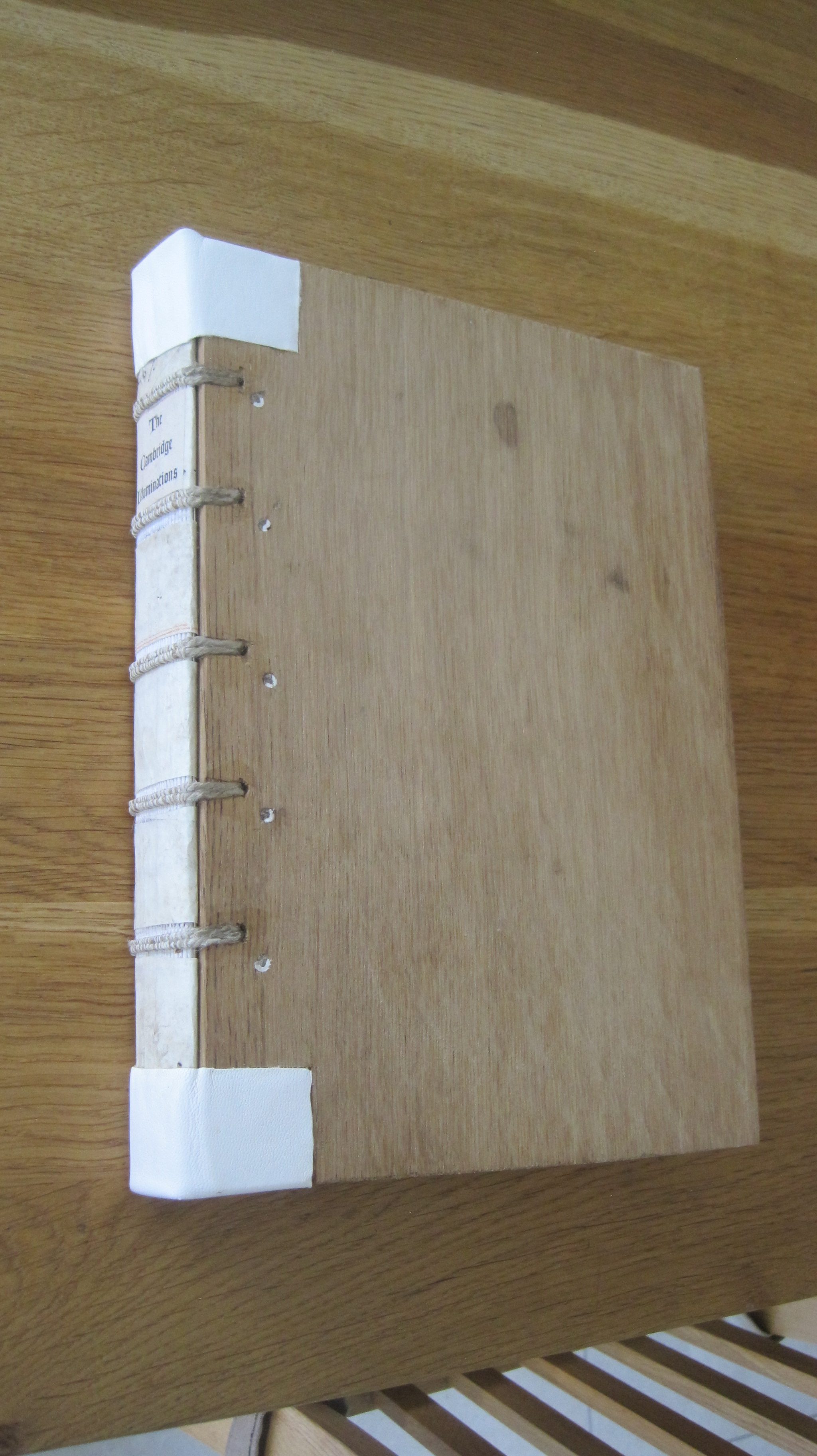
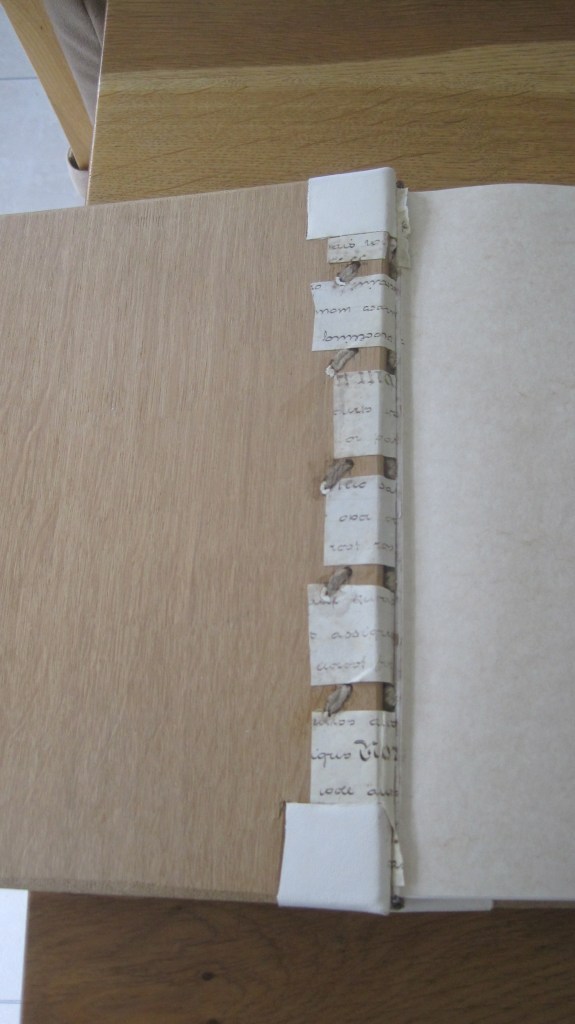
Another fine catalogue that was well worth binding properly is of the exhibition of illuminated manuscripts in Cambridge libraries put on at the Fitzwilliam Museum in 2005. In this case I bound it in oak boards with the spine and insides of the boards exposed. I have used this to demonstrate medieval binding techniques in a couple of illustrated talks.
But now for the Wormsley project: The text was in octavo sections which were carefully pulled from the adhesive flat spine and re-sewn on four tapes. The edges were ploughed and rounded and backed, then sprinkled in two colours and endbands sewn on, also two colours. The spaces between the tapes on the spine were filled with leather, pared at the side edges. That gives a very flexible spine, suitable for the rather heavy art paper pages to fall open easily.
Boards were made of two thicknesses of 2mm greyboard, each lined with paper and then cushioned all round. They will be attached by insetting the tapes on the inside of the boards which will be anchored firmly by the infill card after covering with the leather.
I have a nice piece of dark green morocco which will take gold tooling very well.
But first I need to work out a design. I think the Cobden-Sanderson design worked well, but I no longer have the flower tool that it was based on. But I have another, so this is the plan at present:
Today I finished rebinding a large early 18th century folio in full calf with the covers decorated in the Cambridge Panel style.
I rather like the fact that the book is entitled ‘Athenae Oxonienses’ (a compendium of authors who were members of Oxford University) and yet its original binding was in the so-called Cambridge Panel design.
Setting out the design is easy if you follow these steps:
measure the width of the cover from hinge to foredge,
divide that measure by 11
make the outer frame two-elevenths wide all round
make the inner frame also two-elevenths wide all round
the middle panel will then be three-elevenths wide.
These proportions will work for any size book. It is traditional for the middle panel panel to be quite heavily sprinkled with a dark dye, for the middle frame to be left clear and the outer frame to be lightly sprinkled.
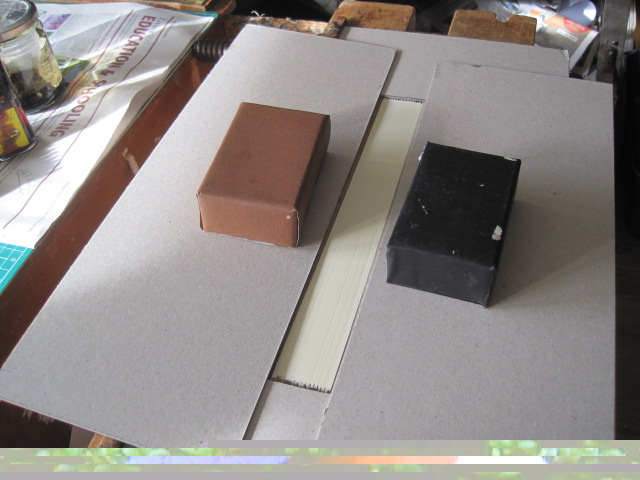
The outer frame is exactly the size of the cover board and the inner frame and middle panel are cut out of it, according to the measurements set out above.
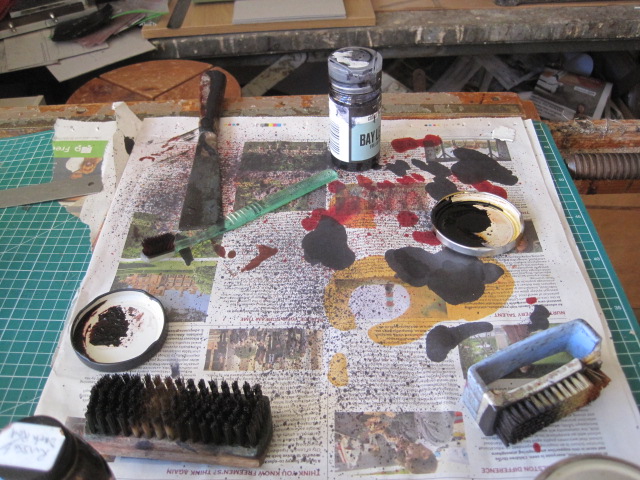
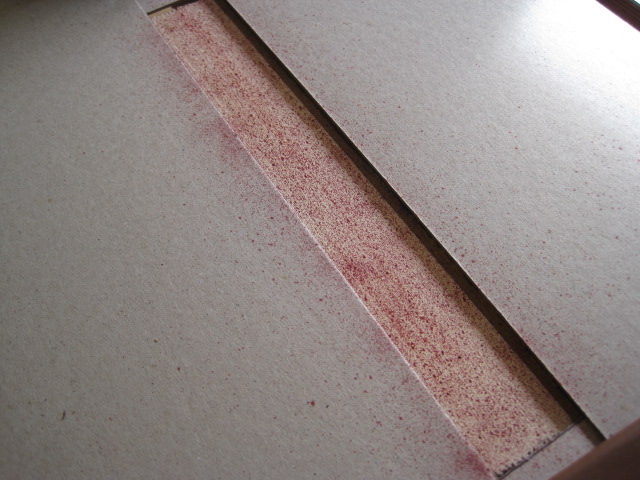
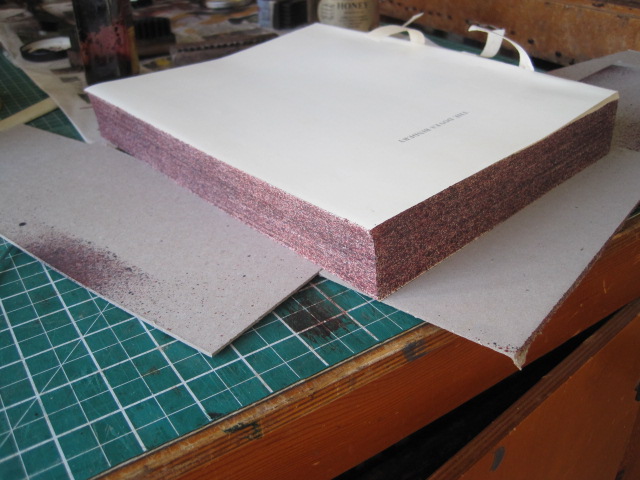
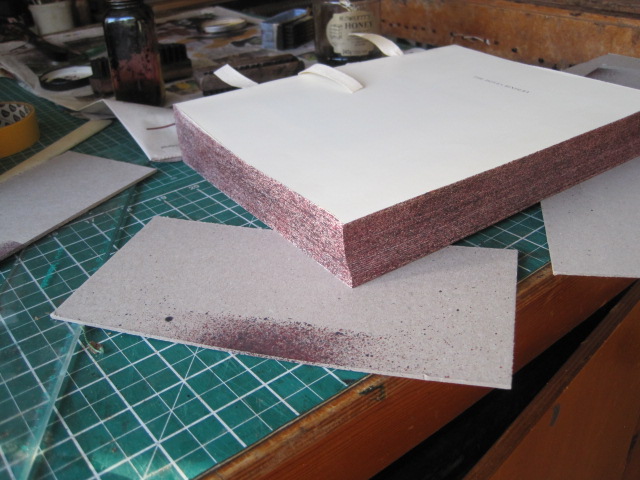
The sprinkling starts with all three pieces of card placed on the cover. The two middle ones are held in place with a weight and the outer frame removed. The spine is masked off with masking tape and the outer exposed frame is lightly sprinkled. The best sprinkling is with a good old-fashioned bristle nail brush: the brush is dipped in a shallow dish of spirit stain (not watercolour ink which I have found to fade quite quickly) and then most of the stain is tapped off on to waste paper. The brush is repeatedly struck gently across the edge of an old knife, towards the area to be covered and both brush and knife moved around steadily so as to give even coverage. Next replace the outer frame and remove the middle panel . This area should be sprinkled more heavily.
The blind tooling should be done with quite hot tools on dry calf, but if done on goat leather it should be lightly damped first.
The fillet lines and decorative roll look best on the un-sprinkled middle panel, except the lines around the outer edgeIt doesn’t matter that the double blind lines cross at the corner – they always did ‘back in the day’
Finally, a light treatment with wax polish.
A second binding, finished a few days ago has plain covers but a decorative spine. This was at the request of the owner so as to replicate what was there originally, now very much faded and decayed.
The corner and centre tools are not identical to the originals, but correctly echo the date of publication. Gold tooling on an old book always looks too bright, but I don’t like the idea of dulling it down with weak stain or ‘dirty’ paste.