
Now that I have stopped taking on outside work I can get on with the half-dozen jobs tucked away in a cabinet in the Bindery, some started a dozen years ago.
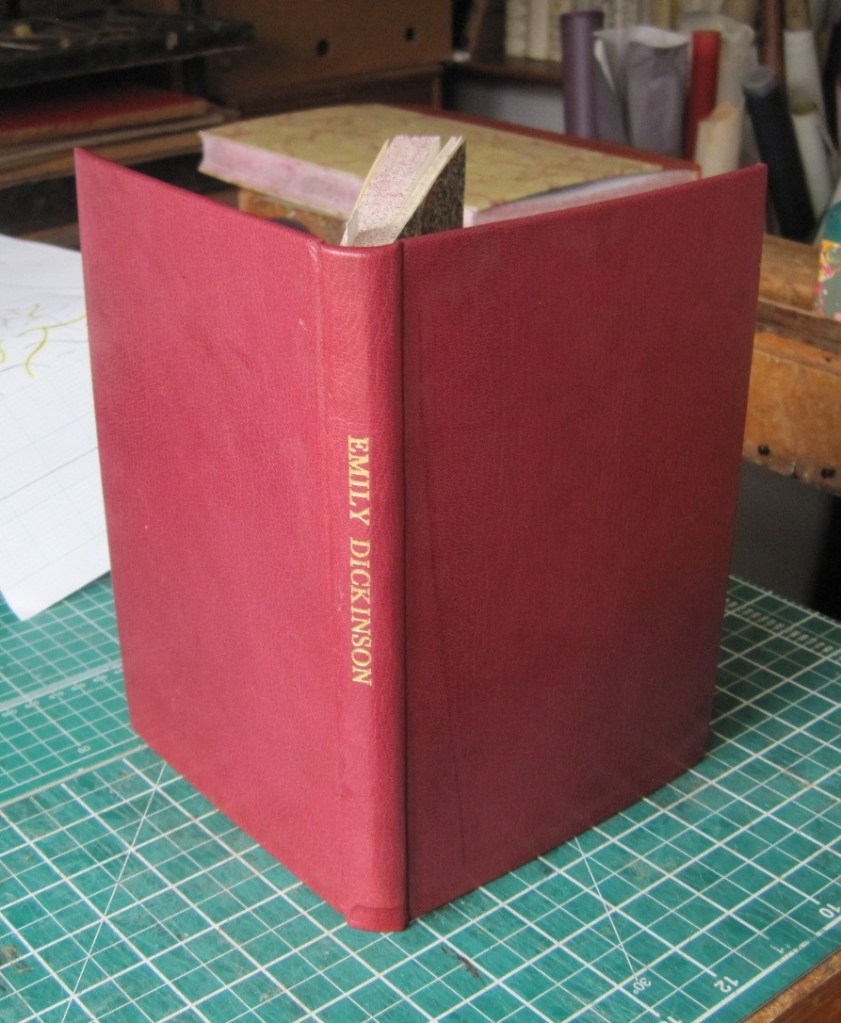
One of these is the unfinished binding of the 2016 Folio Society edition of a selection of poems by Emily Dickinson. I had received the book in sections, perhaps for a competition, and had got as far as sewing on tapes, trimming, sprinkling the edges, attaching marbled endpapers, headbanding, and attaching the boards. I had also selected a nice piece of dark red goatskin. But the work stopped there, I guess nearly ten years ago.
Emily Dickinson composed hundreds of short poems during 50-odd years as a recluse in her house in Amhurst, Massachusetts, right up to her death in 1886. She has been described as the finest American poet, but I think that’s pretty overstated. Her work is fragmented, enigmatic, sometimes almost mystic and often dark and confusing.
A traditional late-nineteenth decorative style would be quite wrong. I decided to keep a smooth spine just with her name on it. So the first step was to stamp the title on the spine (off the book) and cover the boards with the selected piece of leather.
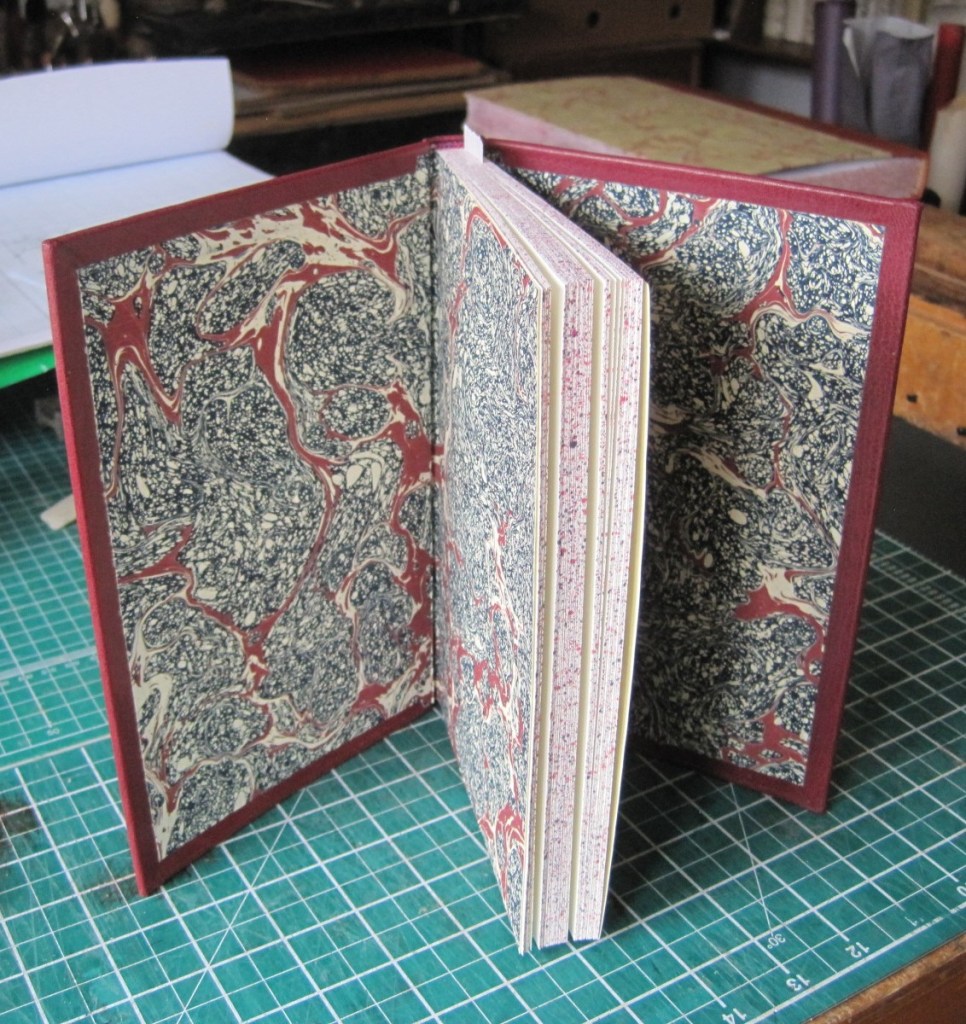
The endpapers I had previously chosen already suggest turmoil.
So for the cover design I wanted something that suggested conflict and uncertainty. I have said many times in these blogs that the binder has to work within the constraints of the tools available. For this job there is no question of commissioning special tools but I do have a small range of ‘s’ curves which can be arranged in a jumbled way to convey conflict, and if some are gilt and some black the good/bad, dark/light themes of much of the poetry are echoed. After a couple of attempts I came up with this:
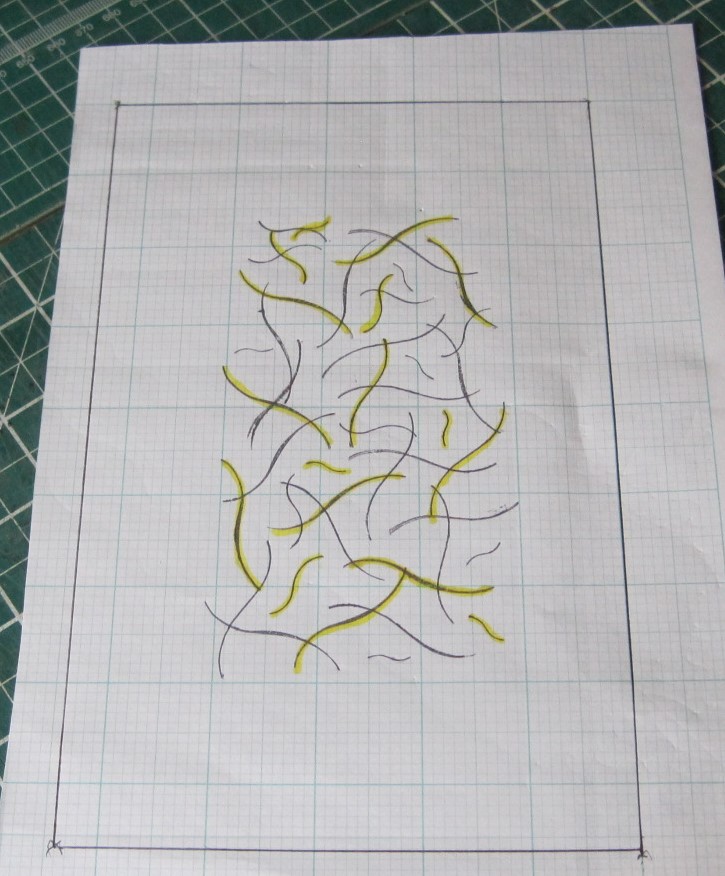
I think it will work, but the only way to find out is to do it – short of making a whole dummy cover with the same leather and completing all the tooling. Frankly, not justifiable. But of course, had the job been for a paying customer a complete trial maquette would be necessary, and the cost thereof built in to the final bill.
So now I will prepare for the tooling on the front cover. First, the gold stamps. I don’t use gold leaf any more as I find that with the right procedure good quality gold foil produces perfectly acceptable results. With foil the challenge is accurate sighting of the position of each impression. With gold leaf there is a clear and precise guide for the heated tool from the gold leaf being partly impressed into the glaired blind guide impression. Gold foil can’t do that, but there is an simple alternative which is to fix the piece of foil in the desired position and make a first impression through the design on thin paper, lift the paper and tool again in the mark made.
So first I position the design on paper on the cover and fix it with low-tack tape. Then strips of foil are placed under the paper to be secured, also with low tack tape, exactly where gilt impressions are to be made:
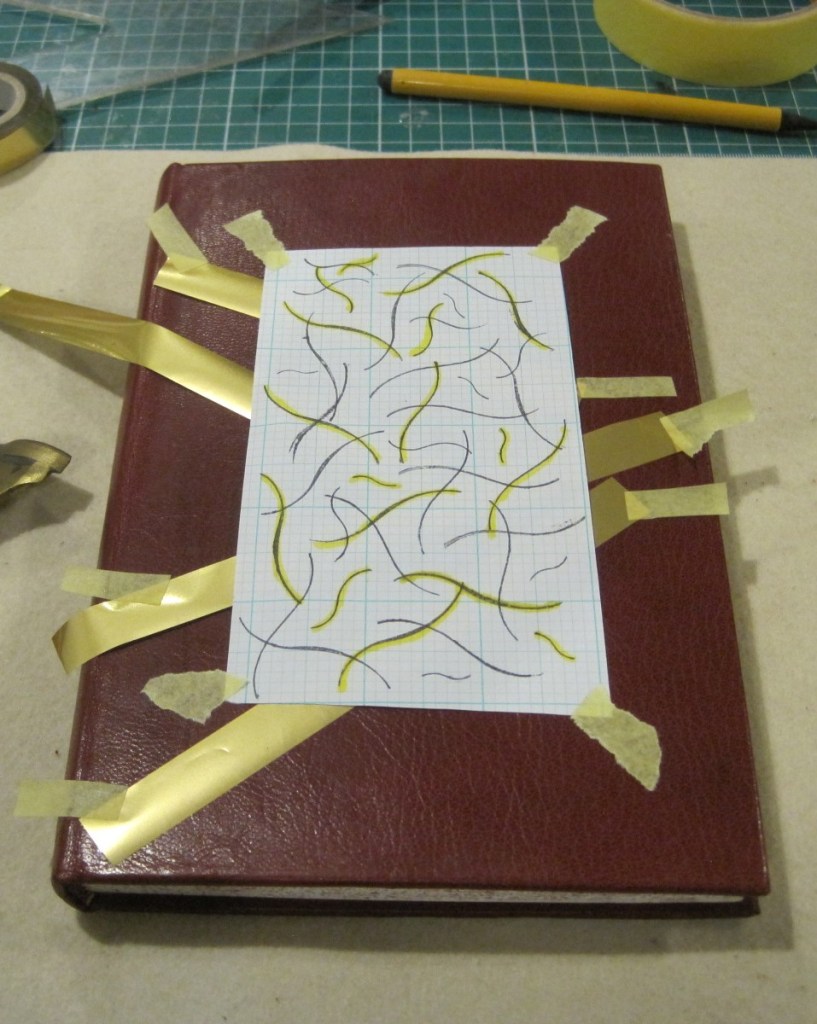
Here, four large stamps can be placed through the paper over the fixed strips of foil, the paper is then lifted but with the top two corners still secure and sharp impressions can de made with a heated tool. The paper is then replaced exactly as before, new strips of foil are fixed in new positions and the process repeated.
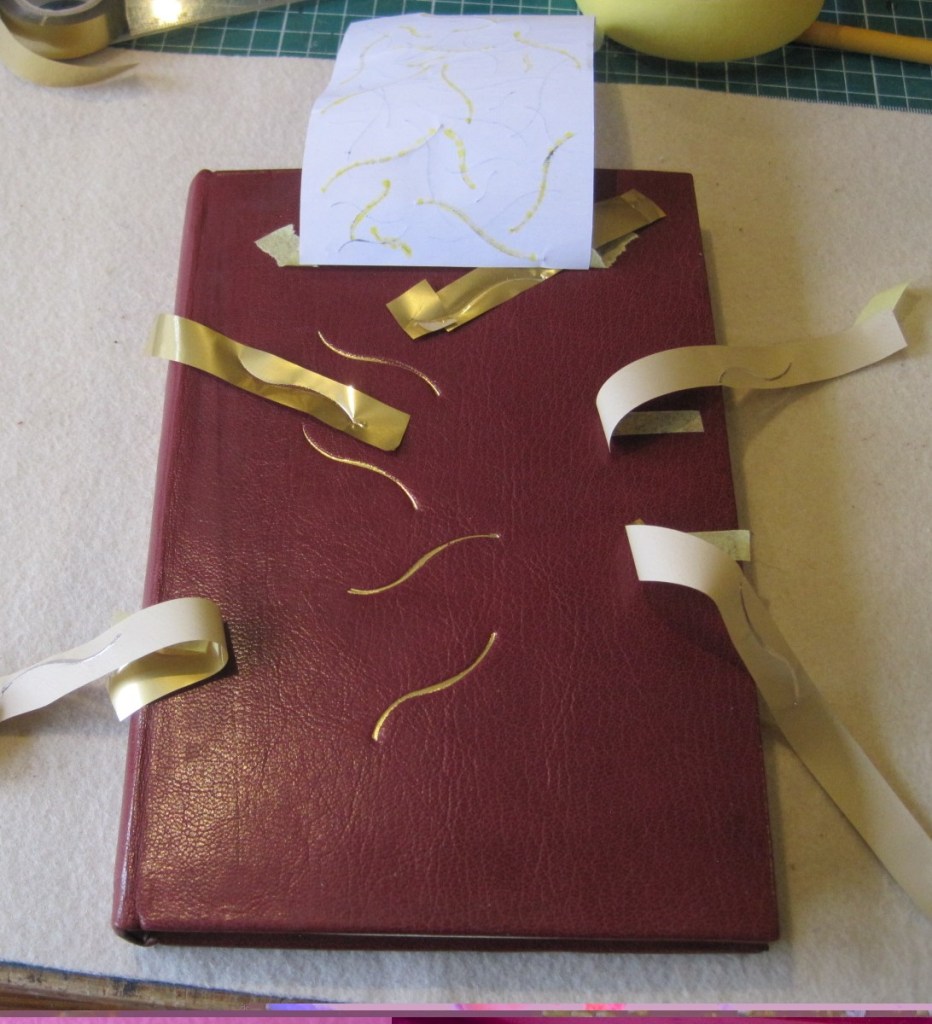
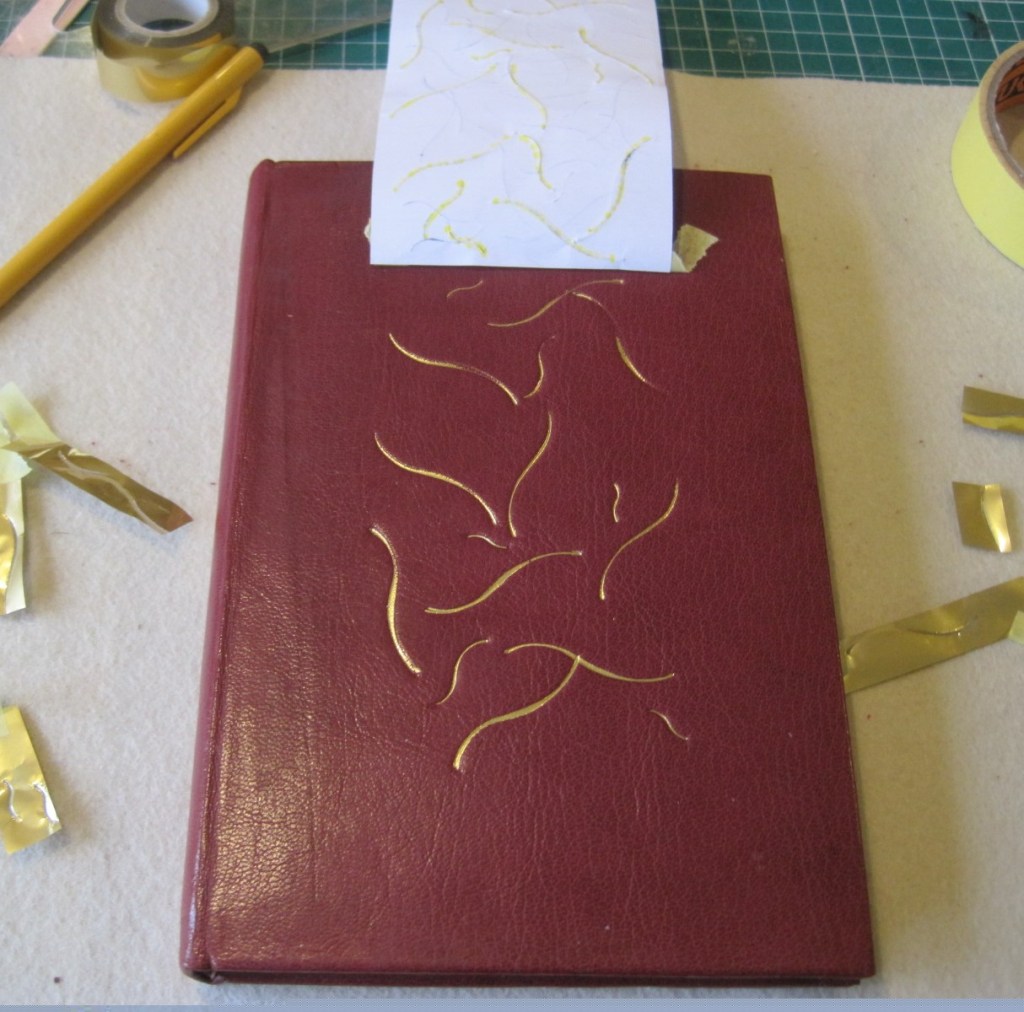
The two bits of tape at the top of the pattern are kept in place throughout so that when it is folded back down it is in exctly the same position.
Now the black lines can be tooled blind through the pattern and filled in with Indian ink. And the design is complete.
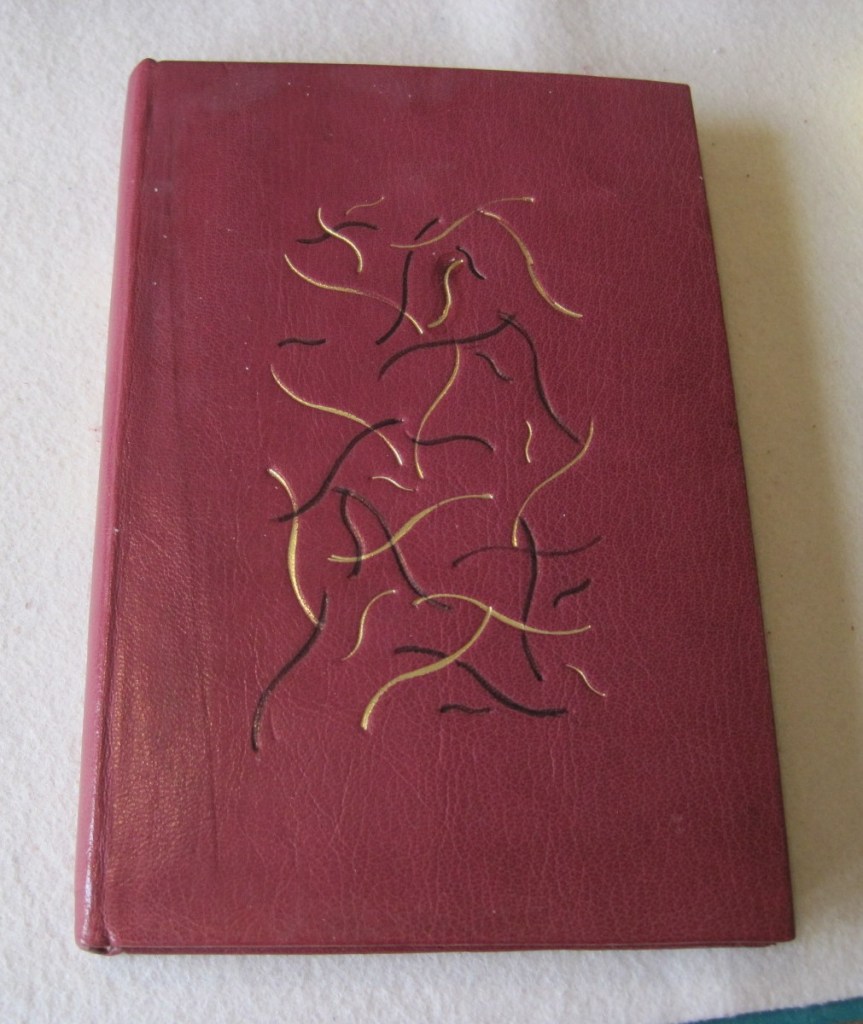
Echoes of Edgar Mansfield perhaps? Anyway, I think it conveys something of the poet’s struggle to make sense of her world. This stanza says it all, I think:
“I felt a cleaving in my mind – As if my brain had split – I tried to match it – seam by seam – But could not make them fit.”

