Altering a Luttrell Psalter

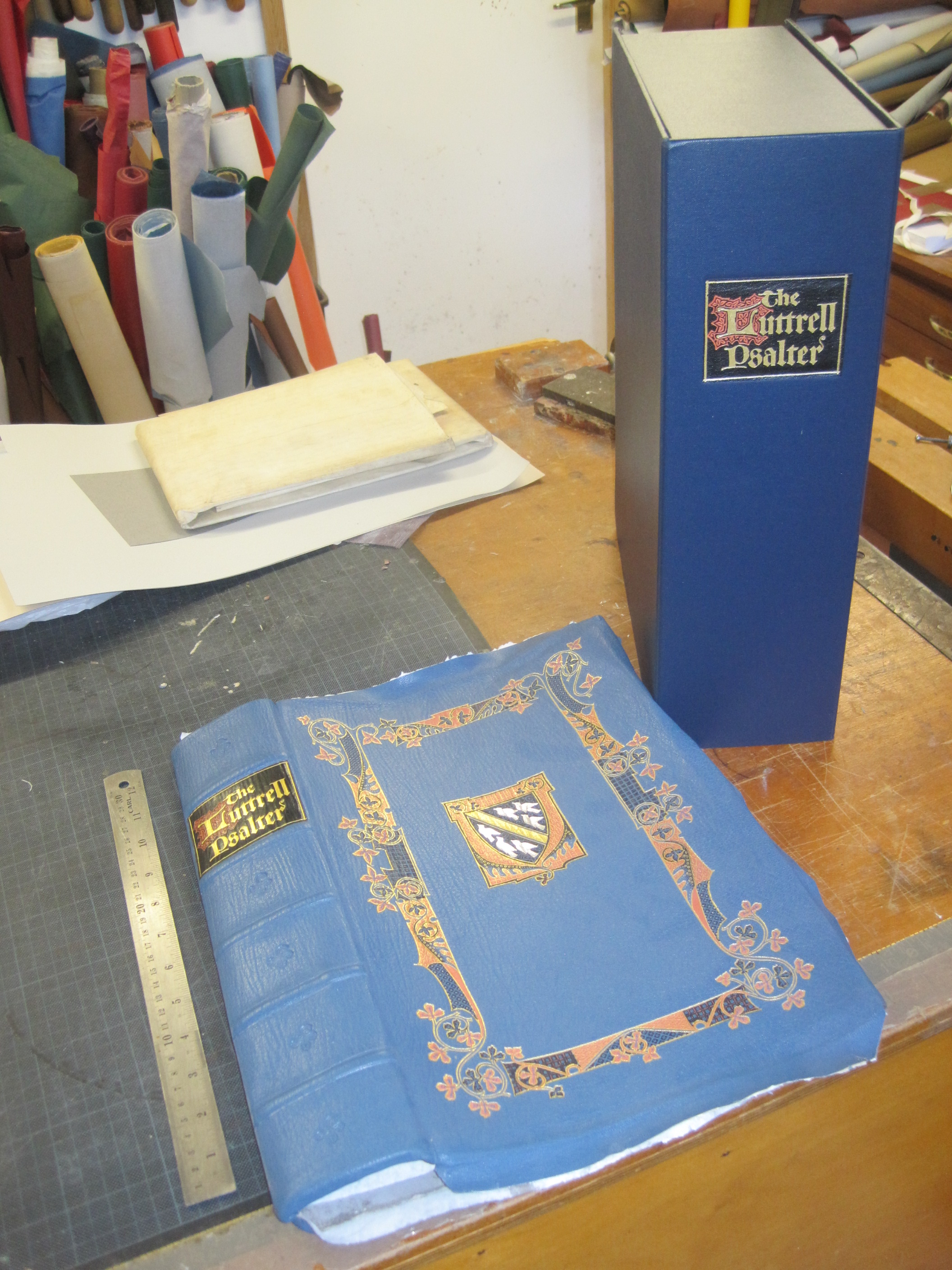
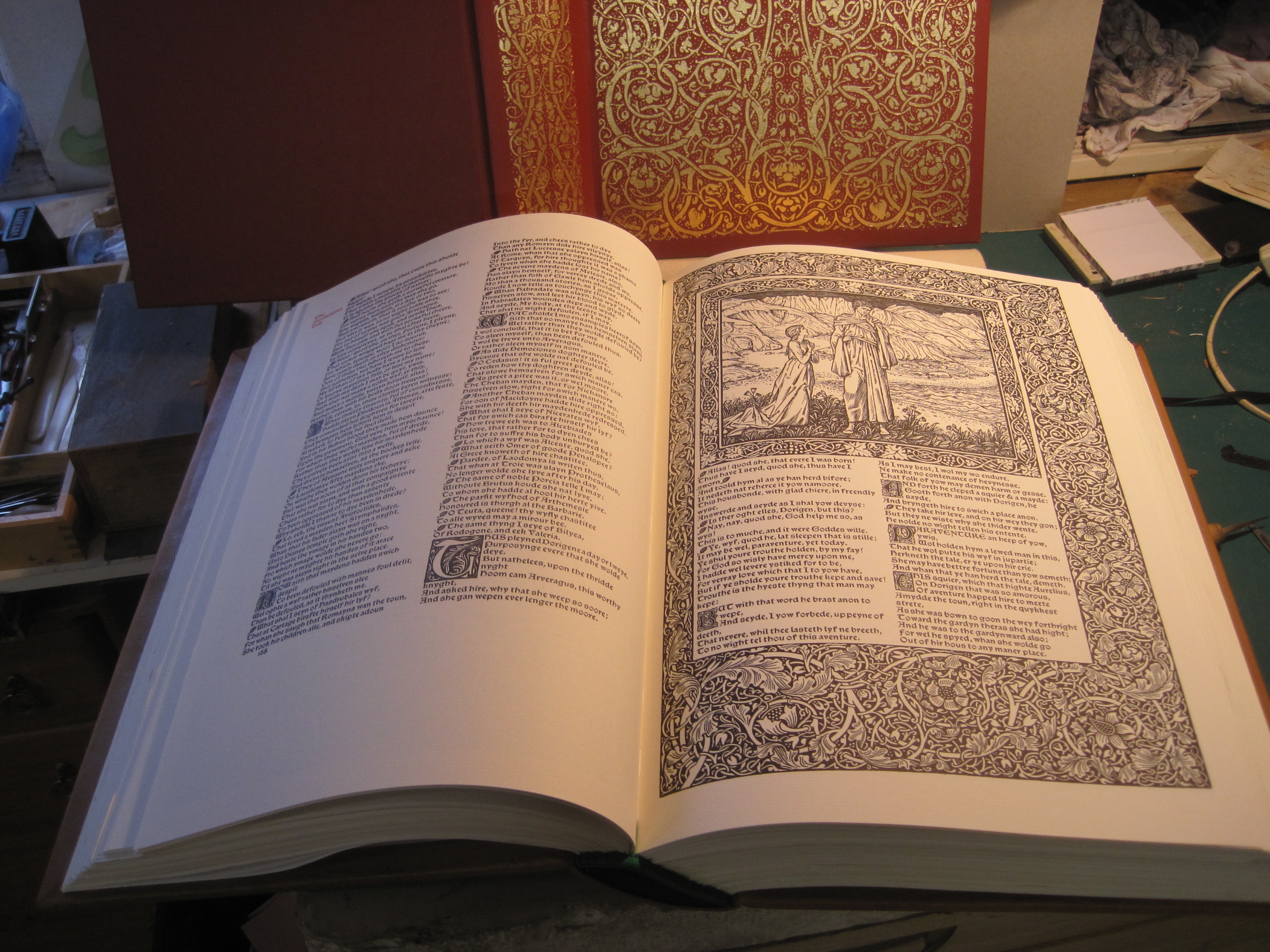
Not THE Luttrell Psalter, of course, but one of the 1480 facsimiles printed for the Folio Society in 2006. I should say straight away that in every respect bar one the book is admirable – exceptional photography of the original in the British Library, excellent scholarly commentary in a separate volume by Michelle P Brown, all contained in a well-made drop-back box. The binding of the facsimile leaves by Smith Settle is strong and sound.

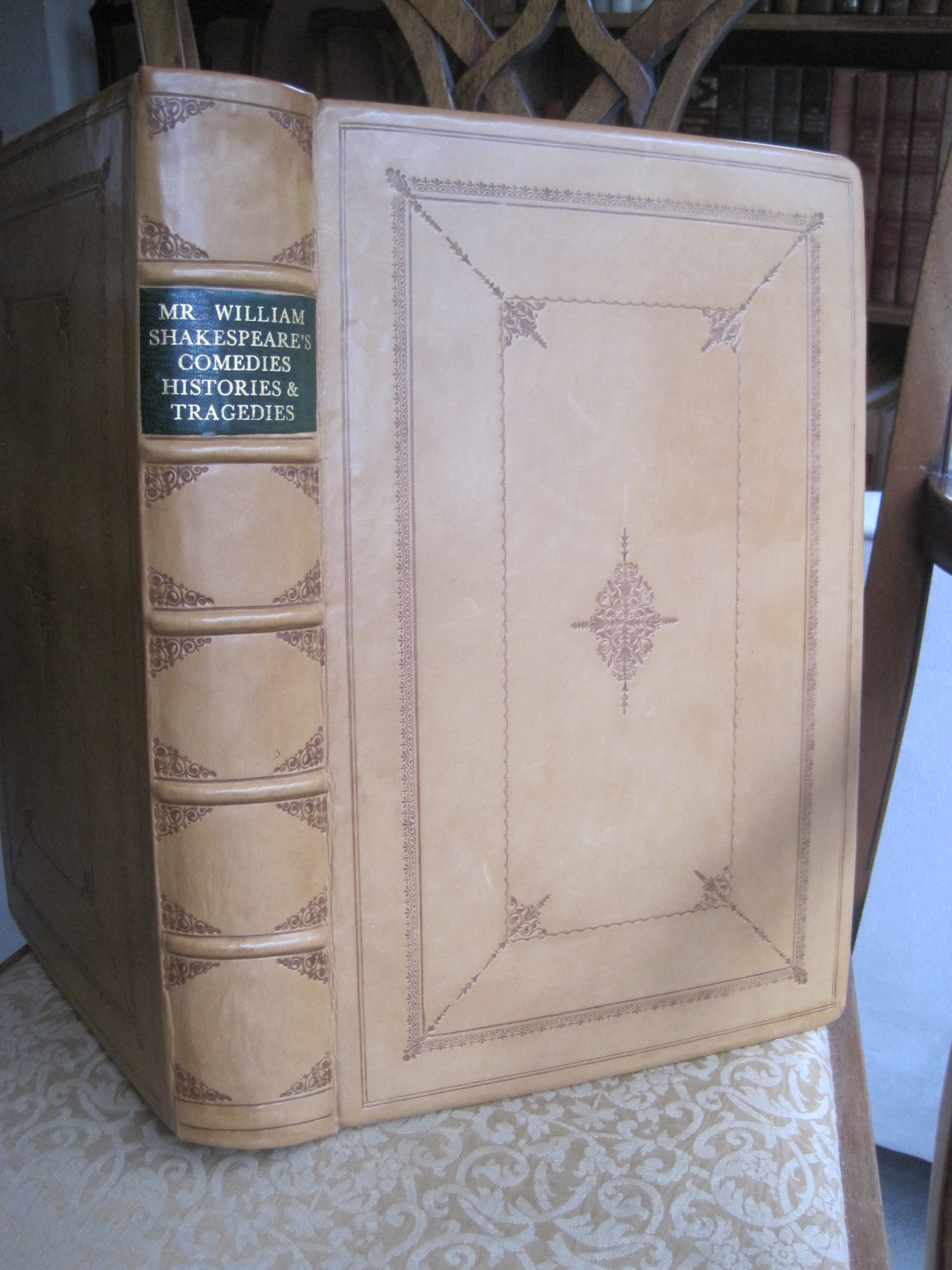
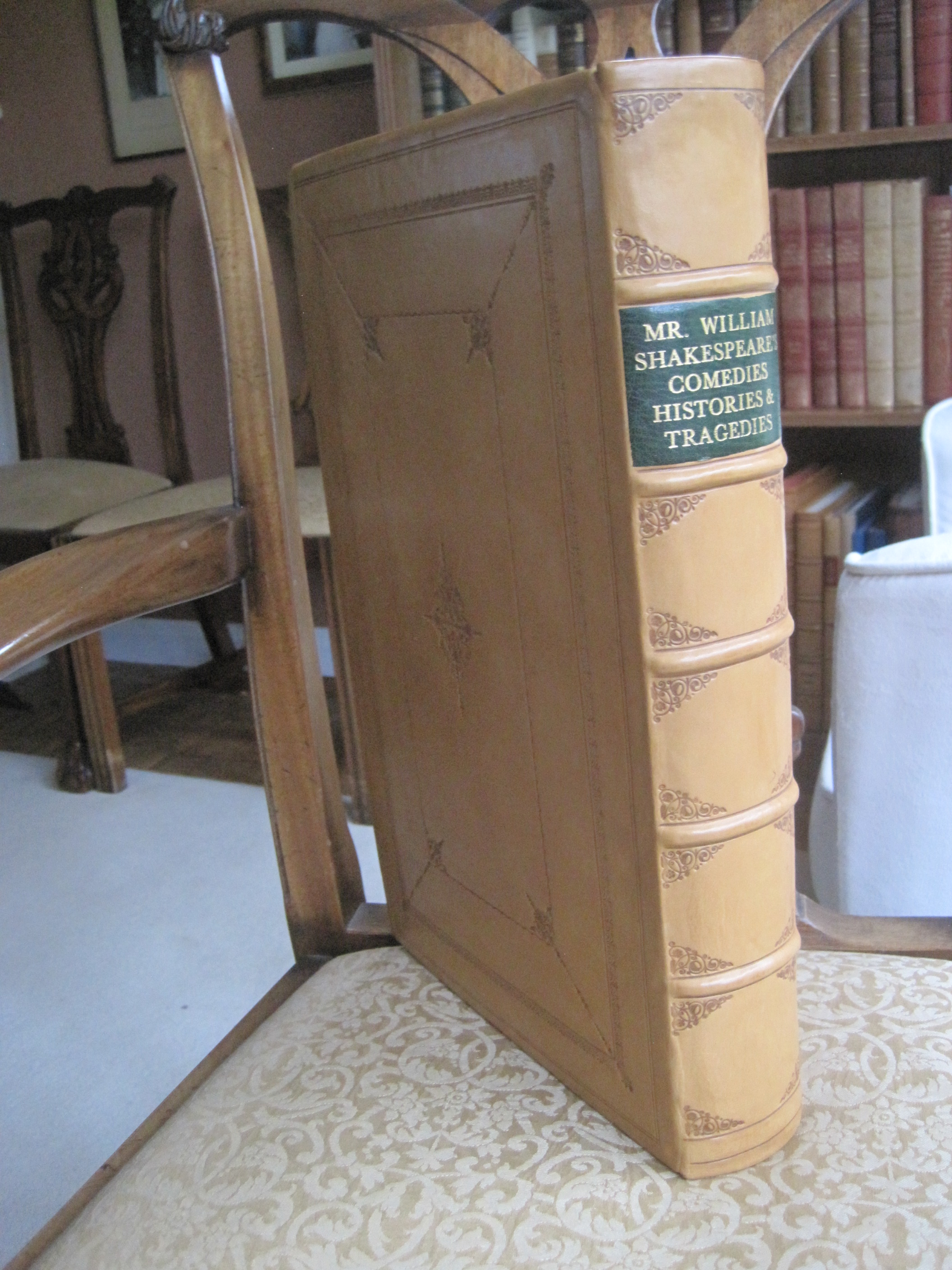
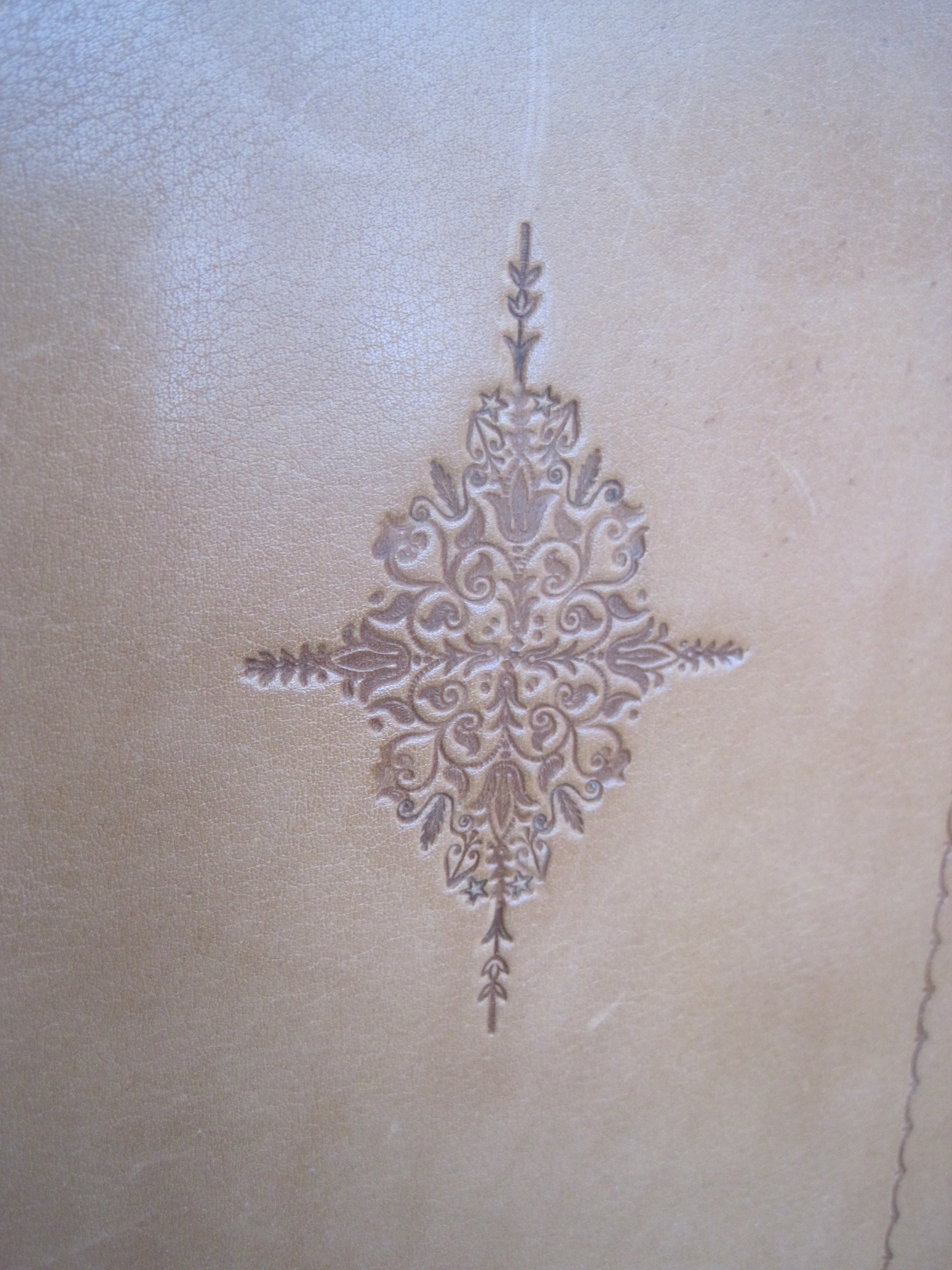
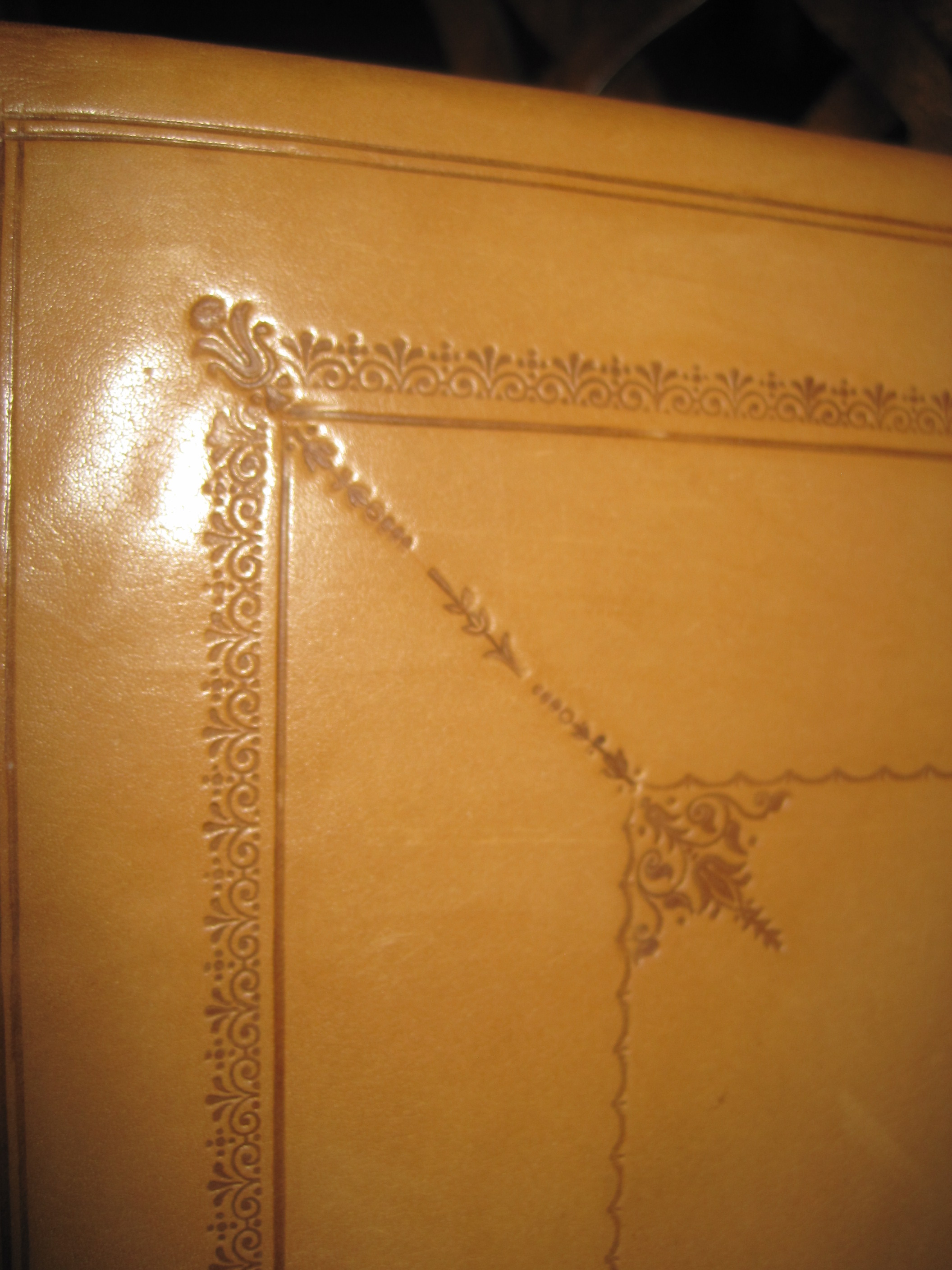
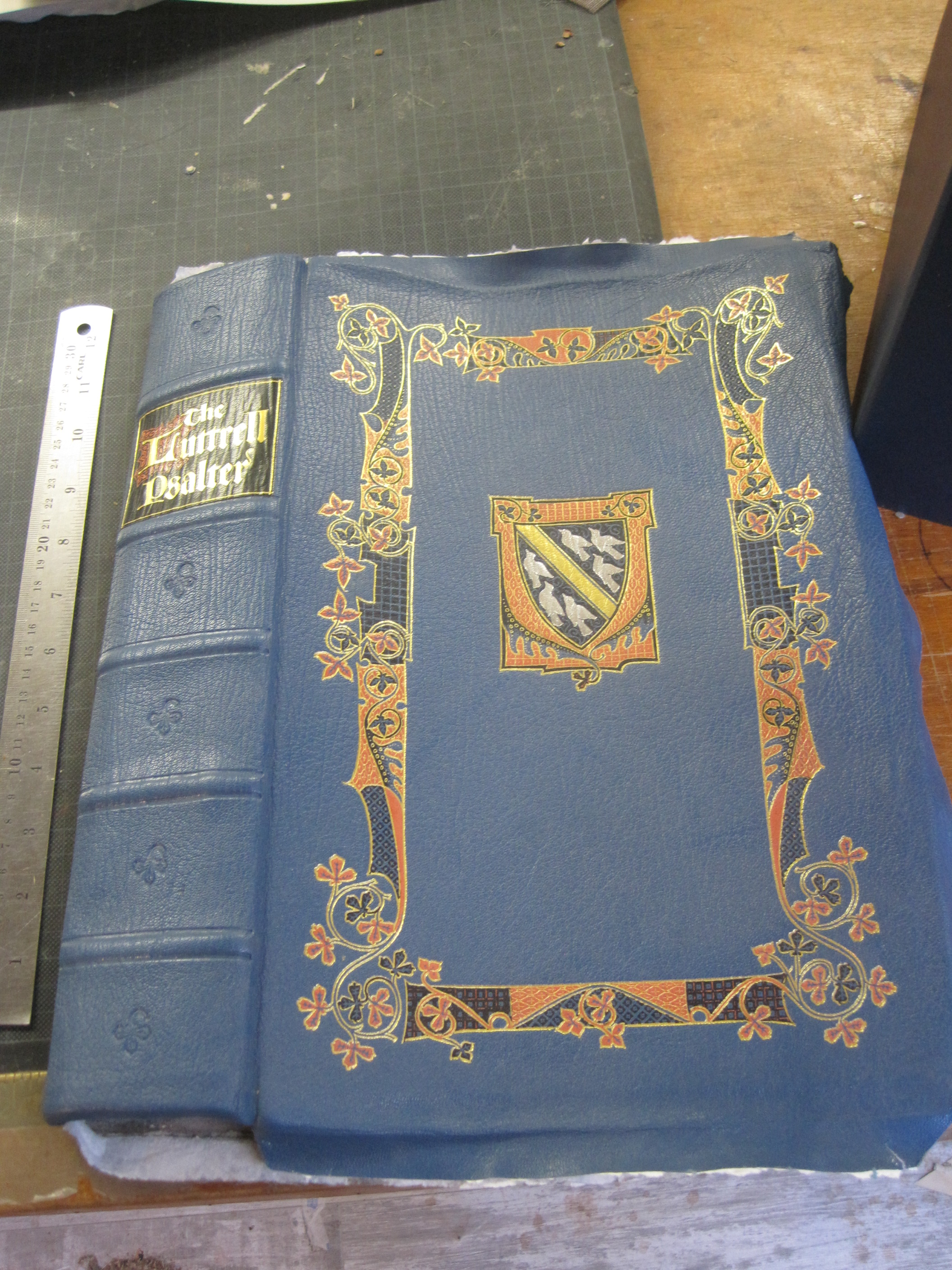
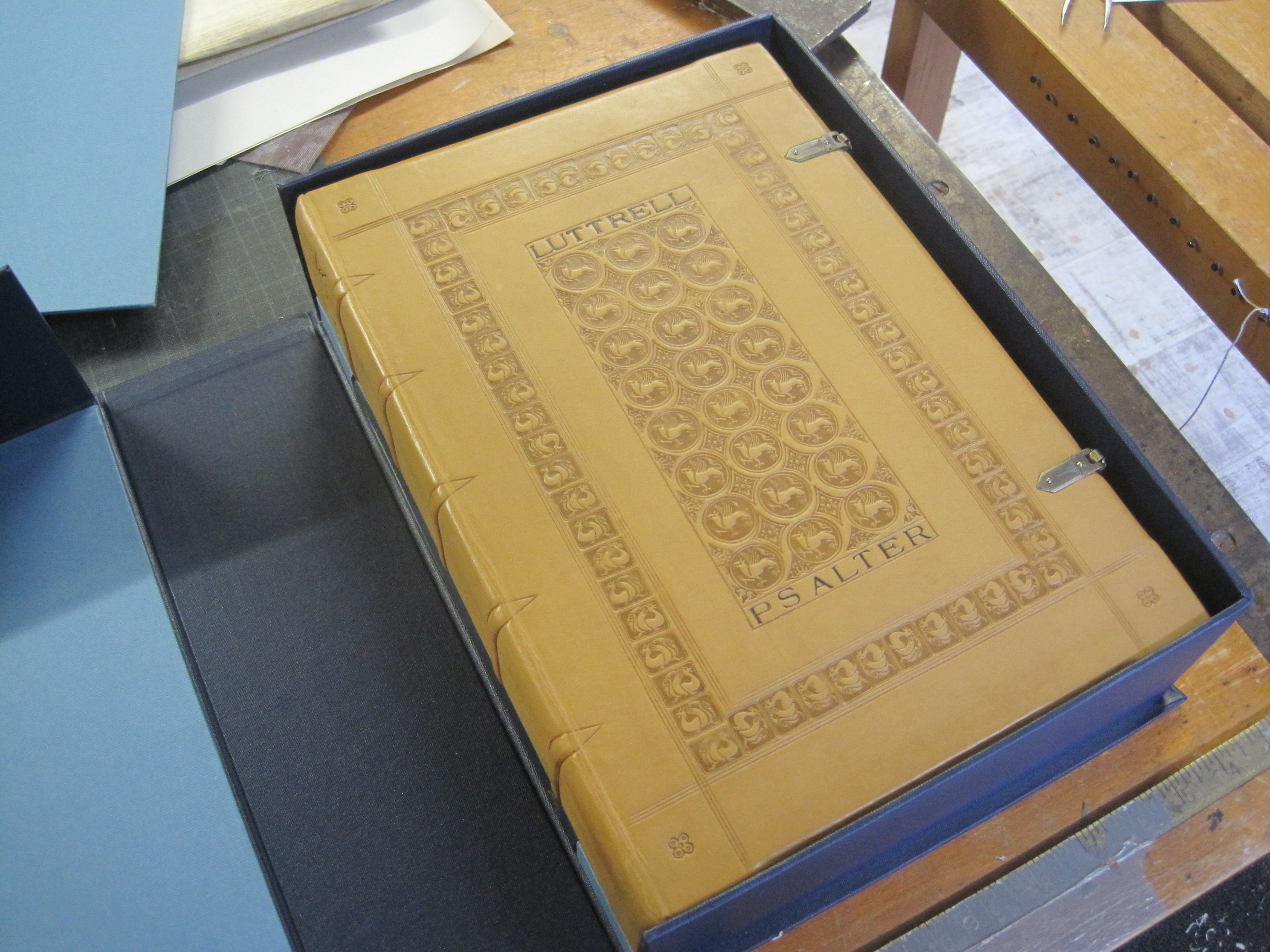
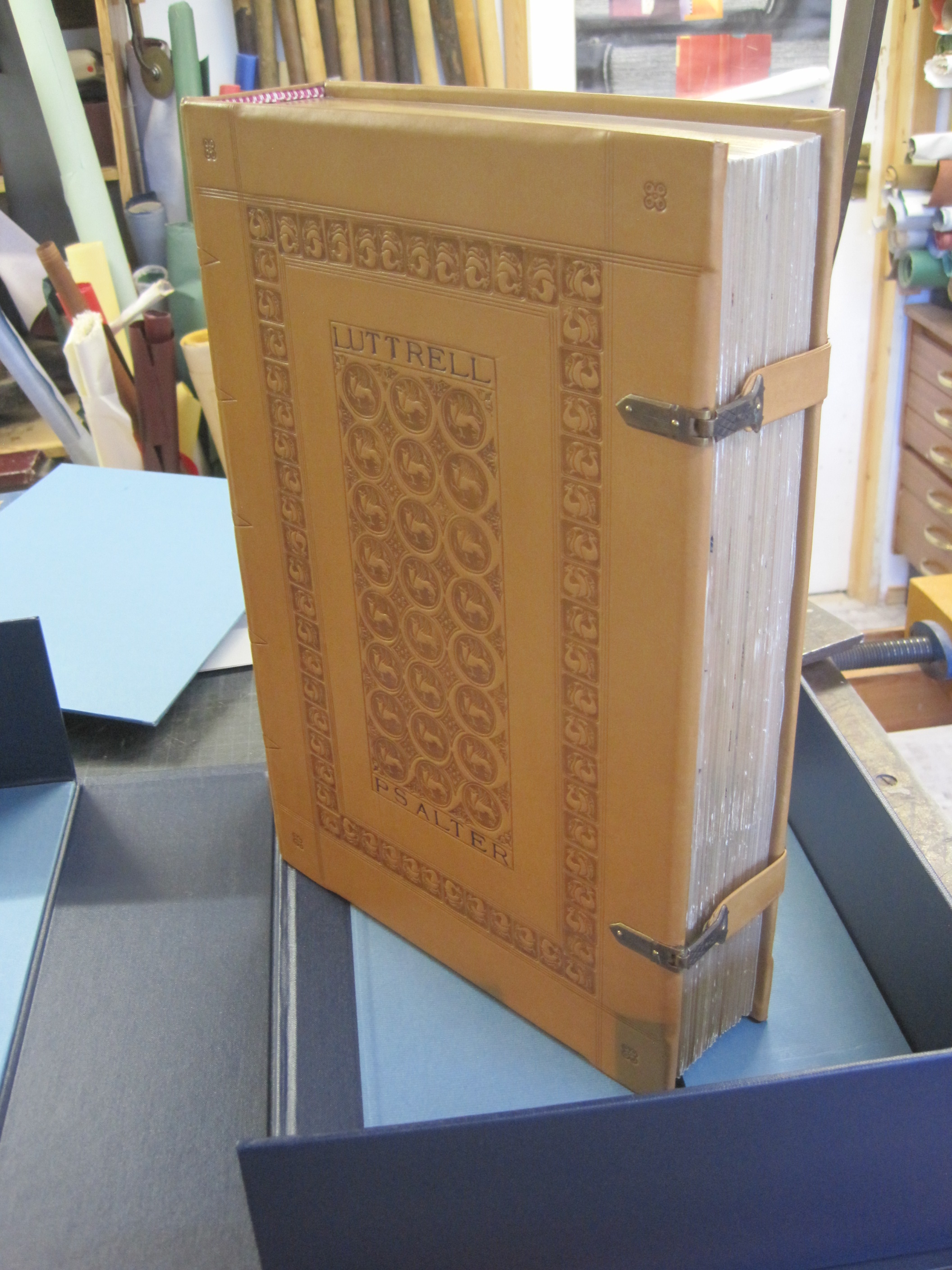
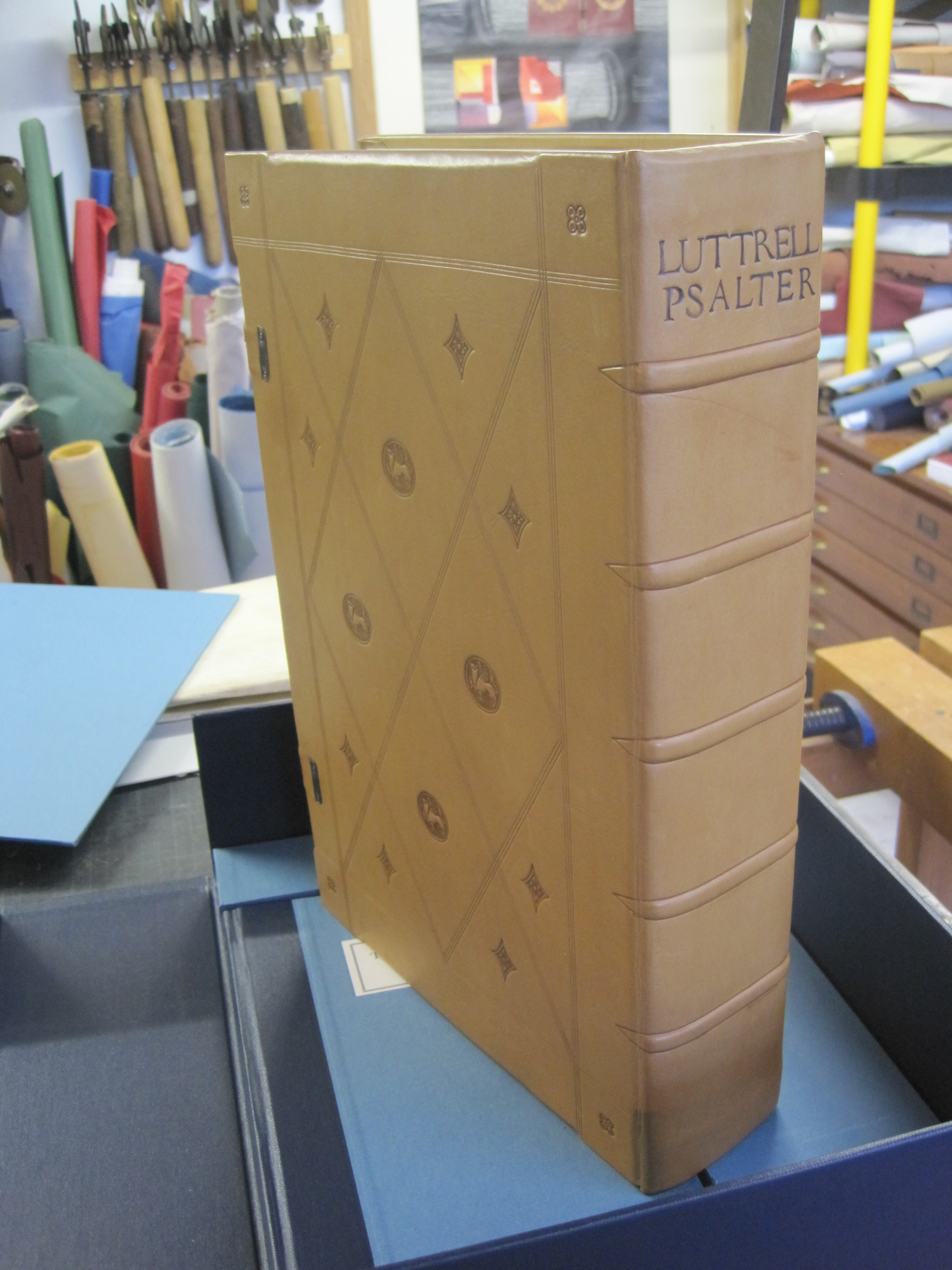
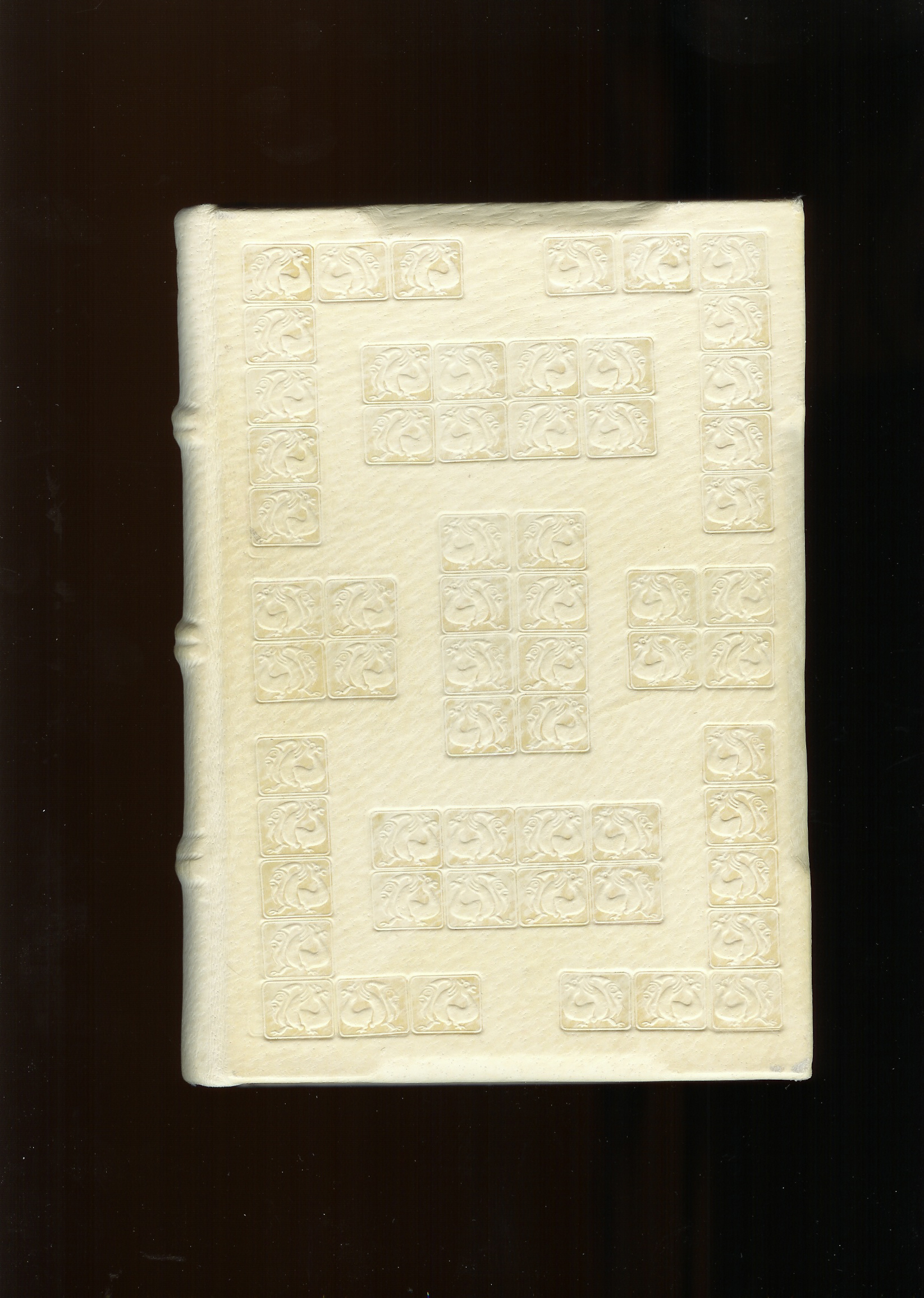
But I simply hate the design of the cover – bright blue morocco stamped with a gaudy imitation of medieval manuscript border decoration. So I determined to do better myself, using materials and decoration much more suited to the original, dating as it does from about 1340. Here are some ‘before and after’ pictures: the new binding is plain calf with blind tooling. The clasps are by Muller of Nussdorf, Germany (expensive, but very authentic copies of originals), the endpapers are real parchment.

Cover and box as issued in 2006.
Just not good taste!
I hope you agree this is better.
Different decoration on the back – common at the period.
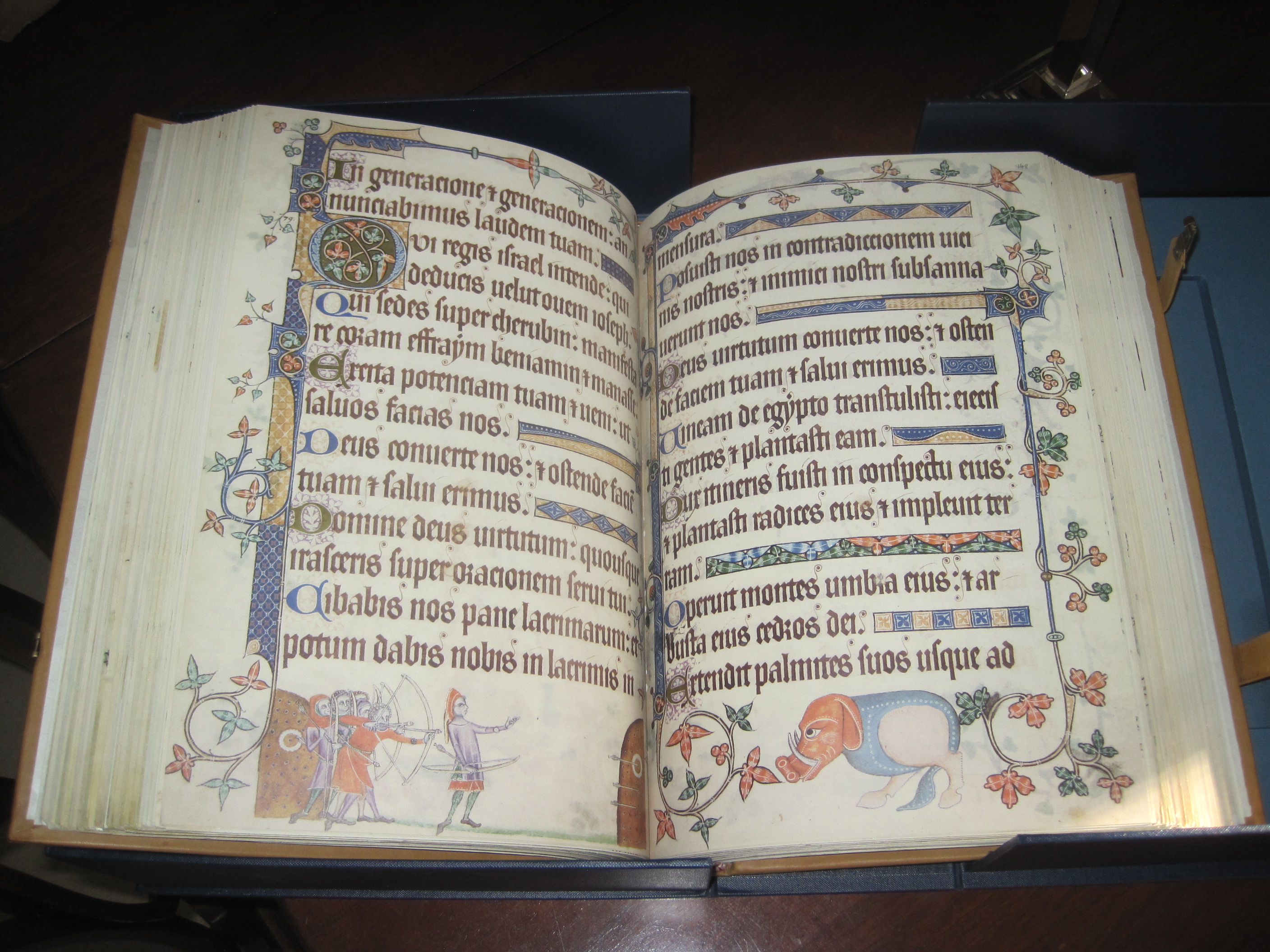
And, of course, the amazing contents – 309 leaves of exquisite workmanship, reproduced on a very good vellum-finish paper.

Please share this post, or the whole blog, with others.

More to come!

More thoughts on re-binding

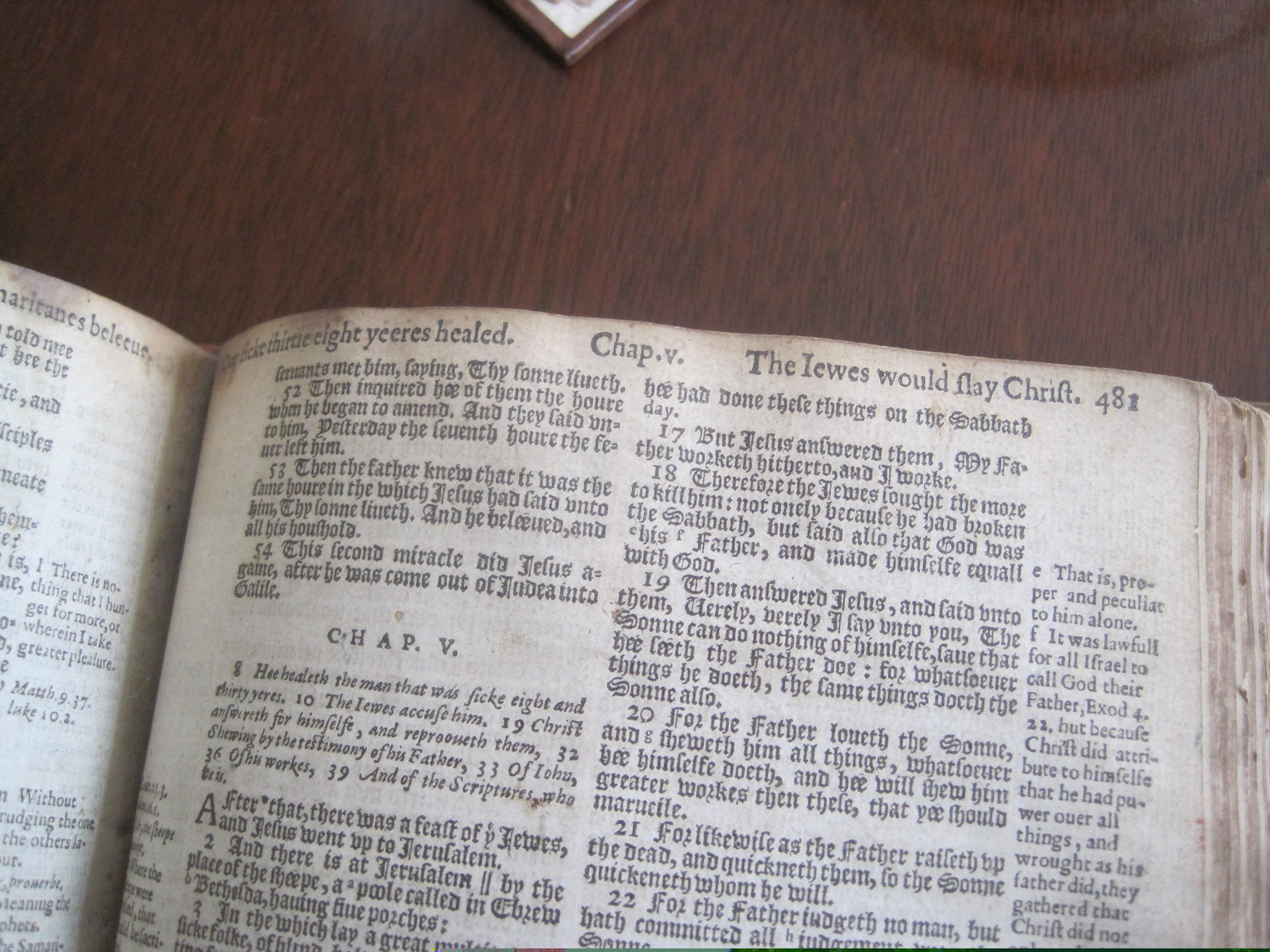
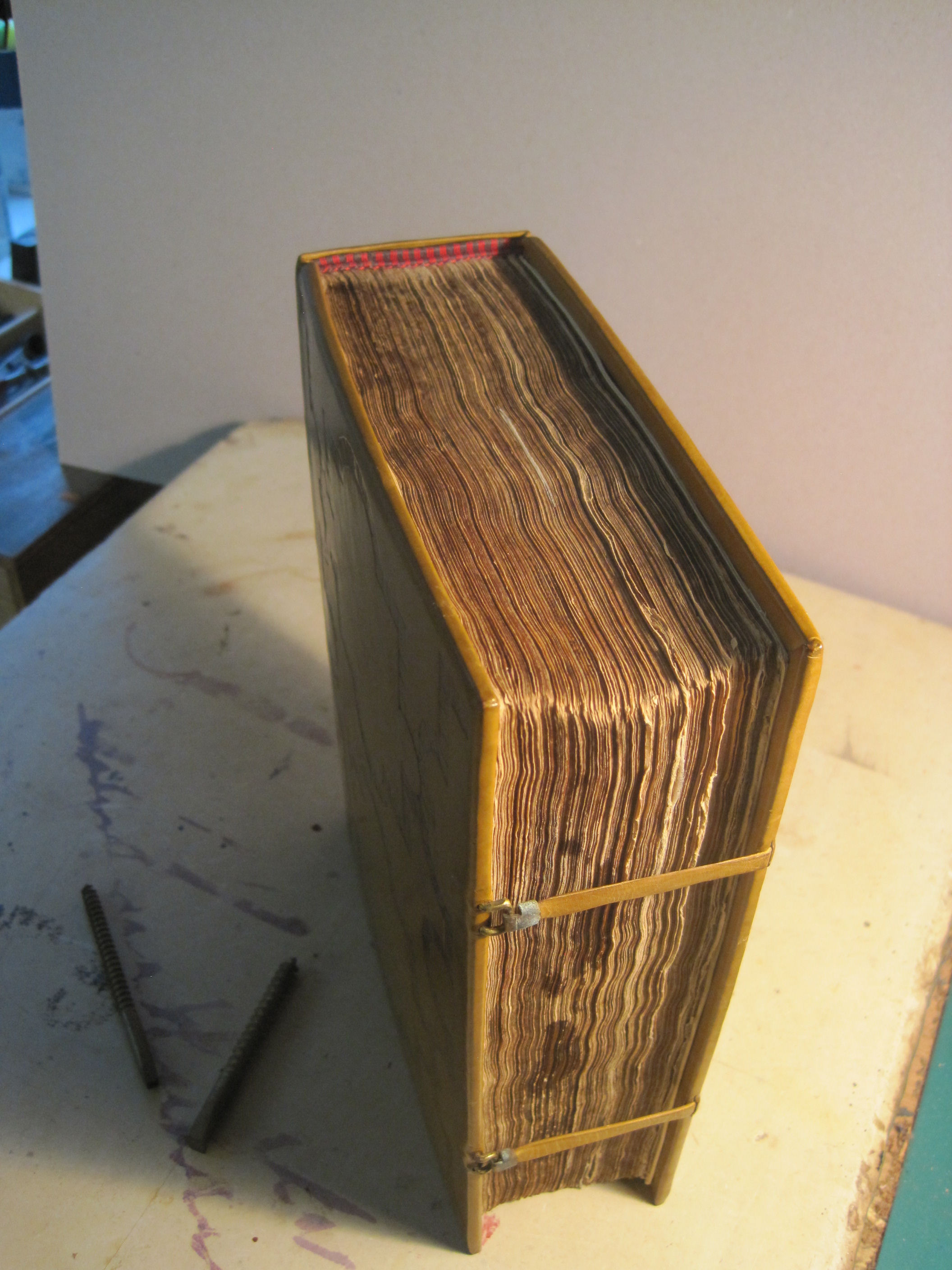
The Breeches Bible I mentioned last week had been re-bound at least once before I bought it, as you can see from this picture:

Top margin almost gone.

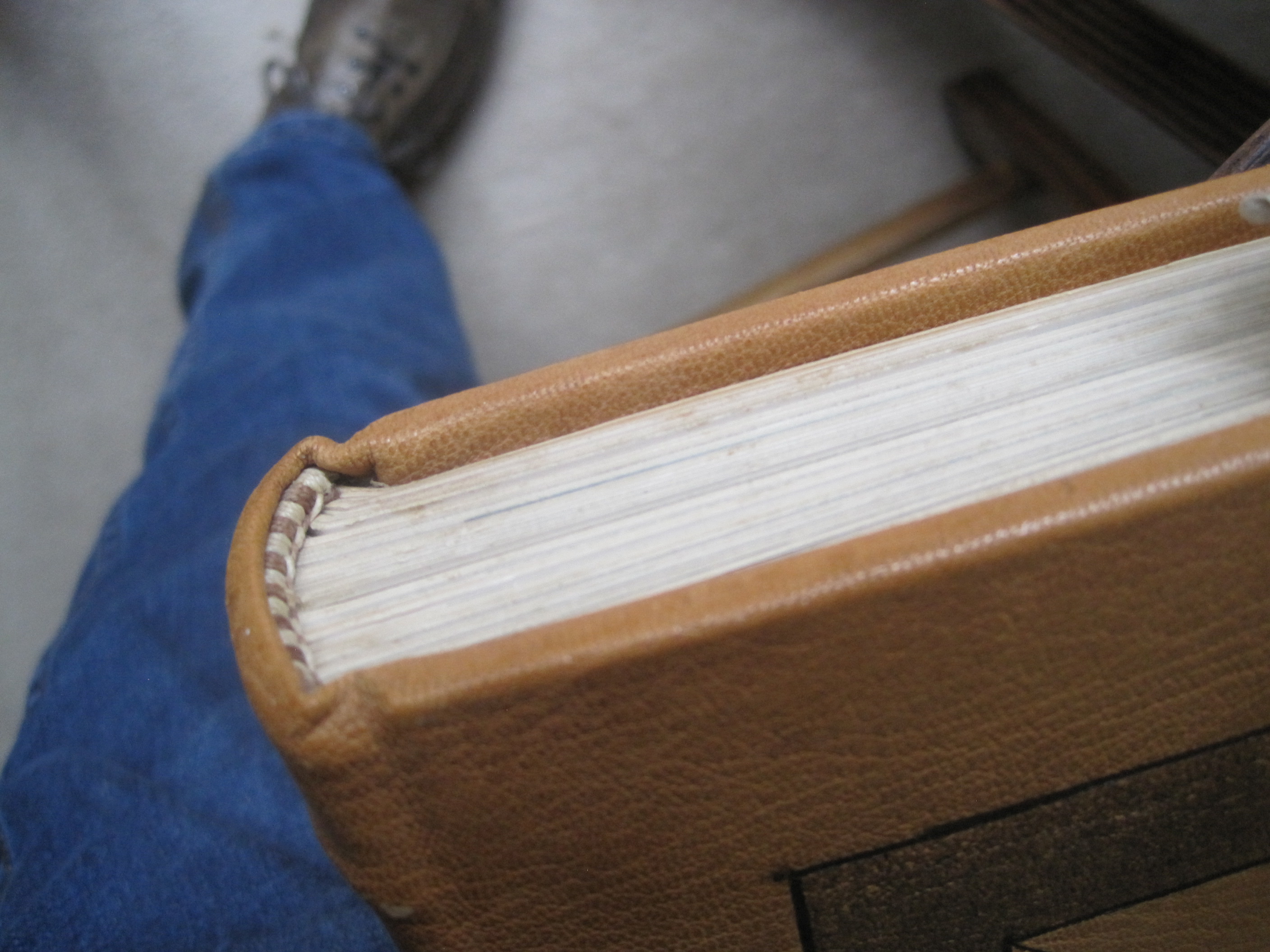
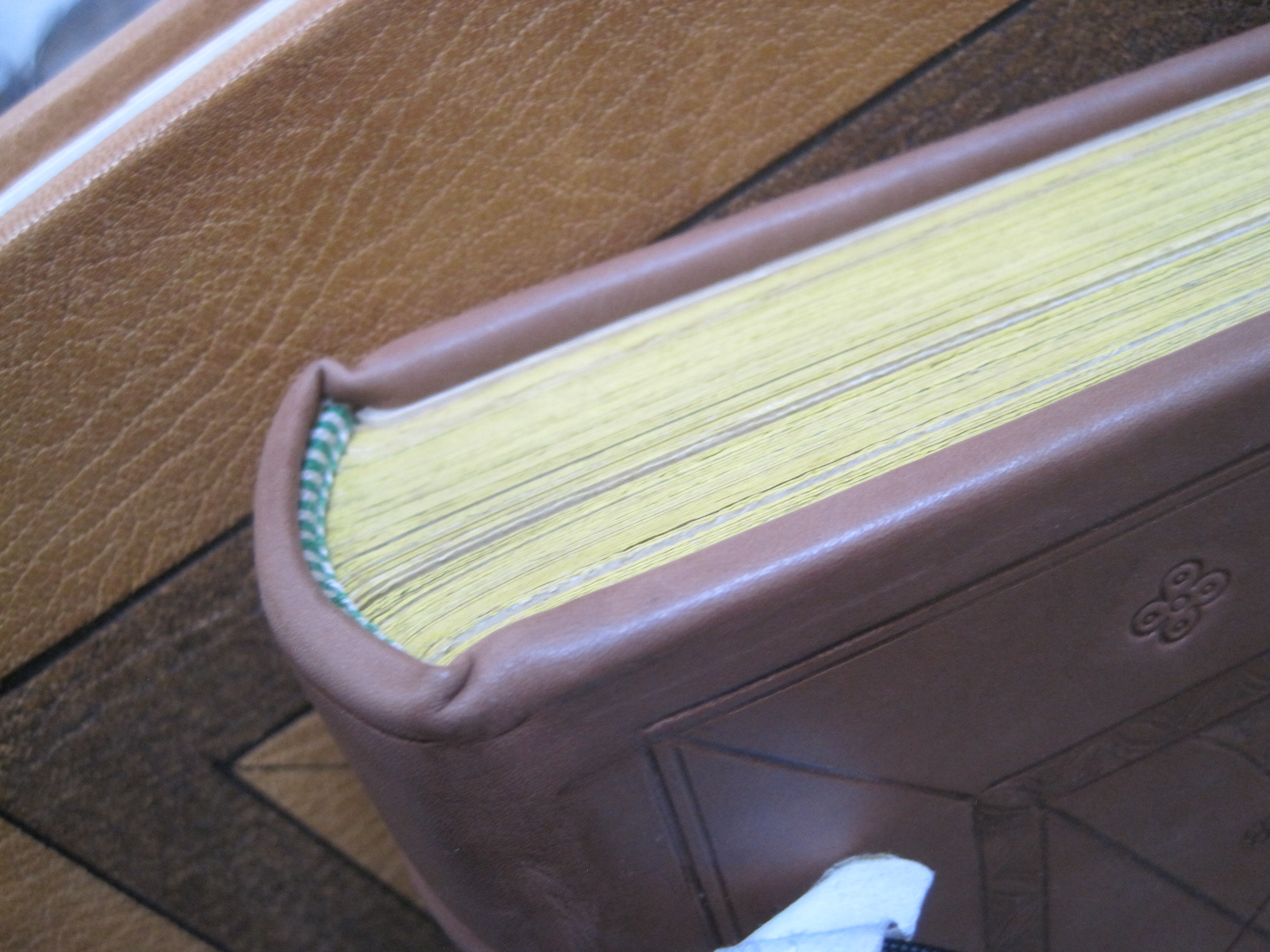
It was normal in the trade to plough the edges after re-binding, to give a smooth finish but this often went too far and it is common to find books where the ‘headline’ to the pages is partly cut away. Even if it isn’t, as in the above picture, the proportions of the page are spoilt. Obviously I did not cut the edges again, and wherever possible I avoid doing so. In the pictures below the sections were re-sewn after pulling the book apart for re-binding but all edges were left untouched.

Careful positioning of each section as the sewing proceeds gives a sufficiently smooth edge, without the need for the guillotine or plough.
Same again.

But in this case I did plough the edges as the book had very generous page margins.

But I’m not sure it looks any better!

Sometimes one’s design idea forces the issue: when I bound up the unbound sheets of the catalogue of the Anthony Dowd Collection I wanted bright colours to echo those of most of his commissioned bindings so I coloured each section of the text differently. Hence, cutting the edges was out, and careful sewing was required.

Binders should bear in mind that all private press books, and many simply well laid-out publishers’ editions, have margins that are part of the aesthetic of the book and should not be changed at all.

When in doubt, don’t!

From time to time I am asked to quote for rebinding a worn, tatty, stained book which the owner values because of its sentimental value, or because it is a first edition, or signed copy. But the wear and stains are part of its history and, though tatty, the covers are original and therefore part of its essential character. Quite often I suggest a box instead of a rebind, and very occasionally, if the box suggestion is declined, I decline doing the job at all.

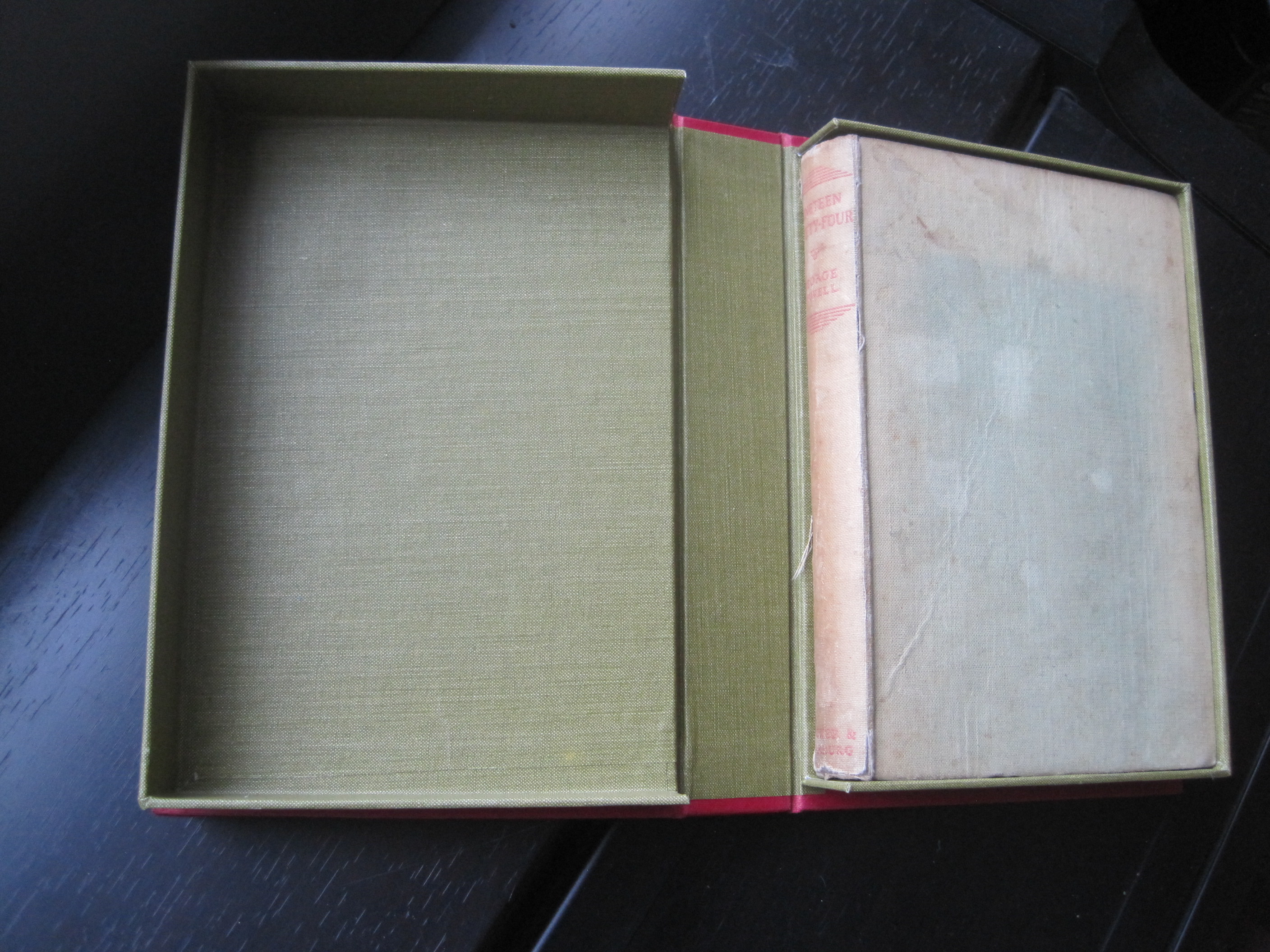
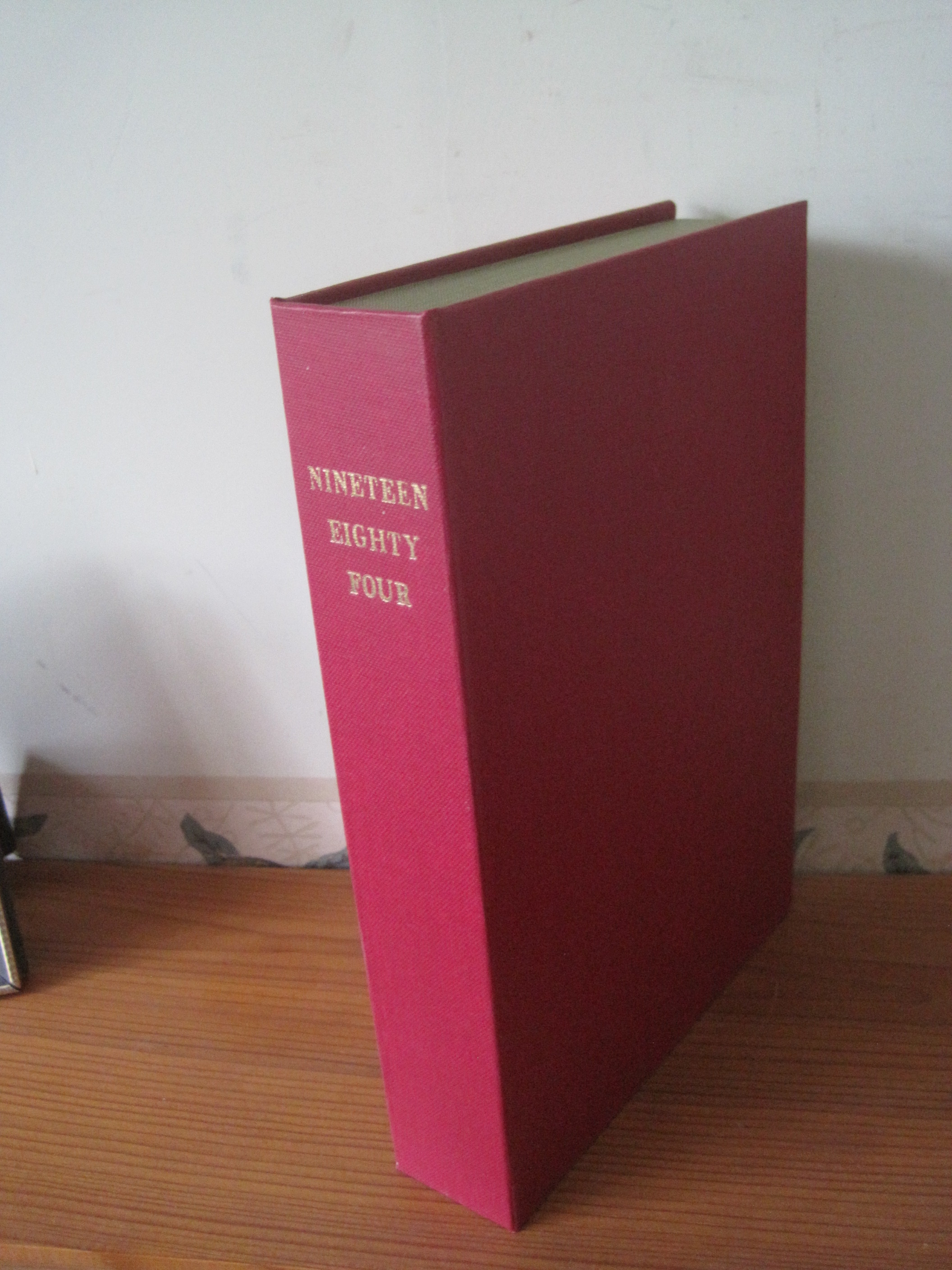
Here is a case in point: a first edition of George Orwell’s ‘Nineteen Eighty Four’, published by Secker and Warburg in 1949 in pale green cloth in a maroon or dark green dust jacket. The dust jacket is missing and the covers are faded and marked with small splashes of tea or coffee. The spine is browned from sunlight, the hinges are frayed and the head and tail worn. The foredge has a small string mark. All these blemishes record its history – the spine is browned because it lost its dust jacket early on, the string mark suggests it has been tied in a bundle at some stage, perhaps in a move from house to house. And the splashes show that it has not always been regarded as a precious ikon of modern English literature.

I decided on a box, so as to keep its character but make it fit for a bookshelf. And also to enable a future owner to make their own decision about rebinding, because however attractive and original, a rebind is by definition irreversible.

P.S. A fitted box like this is about £50 – a full rebind a lot more.

More about blind tooled decoration

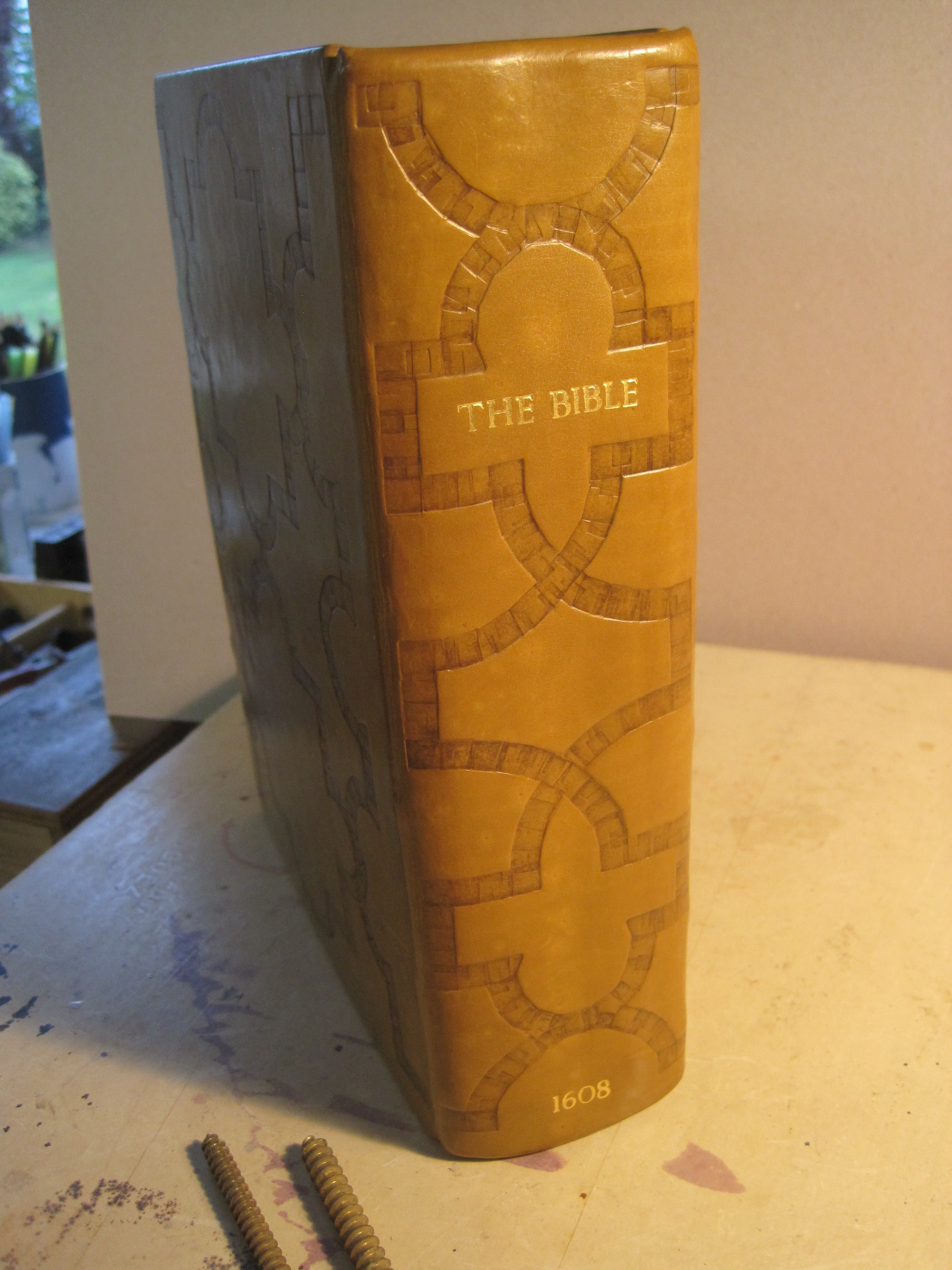
After posting the piece about the Kelmscott Chaucer I remembered that one of my first bindings, around 1978, had blind tooled decoration, chiefly because I then had no means of doing anything else. I had no decorative tools, no gold leaf or foil and no knowledge of gold work anyway. But I did have a workbench, some files and some large brass screws. So I filed the heads into two simple shapes, polished the faces and used them on an old bible I had bought in an antique shop in Warwick for £18, with no covers and needing repair, but, surprisingly, complete.

The bible is dated 1608 (a ‘Breeches’ bible) so a design based on Jacobean strapwork seemed appropriate. I think I had seen a Grolier binding from 50 years before which had a similar ‘interlace’ design. The two tools used were made from brass screws.
The gilt title and date were done in an evening class at Leicester Polytechnic using their letters and numbers in a typeholder
Double headbands and leather ‘clasps’.

Other blind work

Left: on a Folio Society copy of Ovid’s Metamorphoses, so a theme of shape-shifting
Centre: an exercise in traditional Gothic style
Right: Virgil’s Works, printed by Jacob Tonson, 1701

Just finished

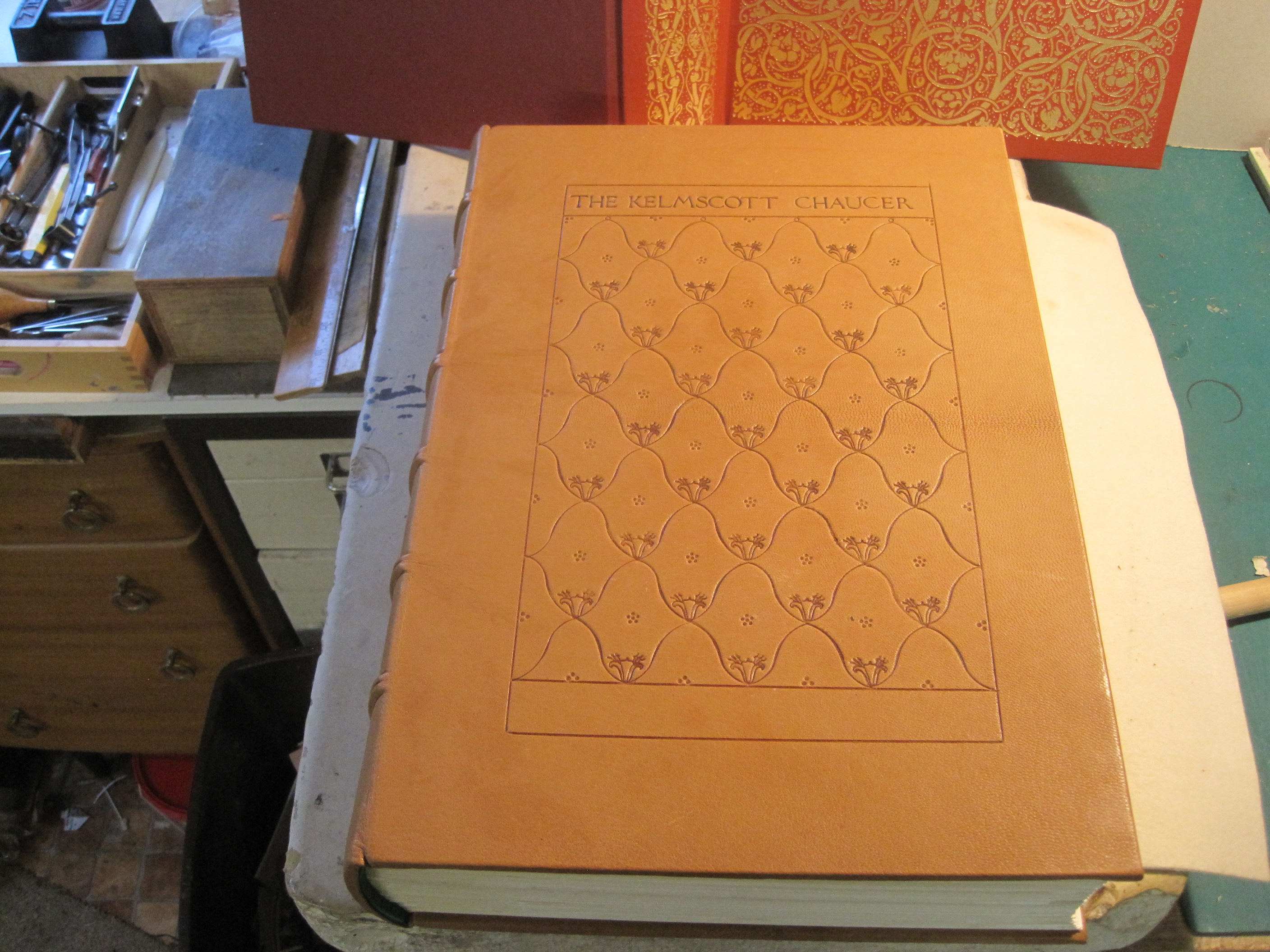
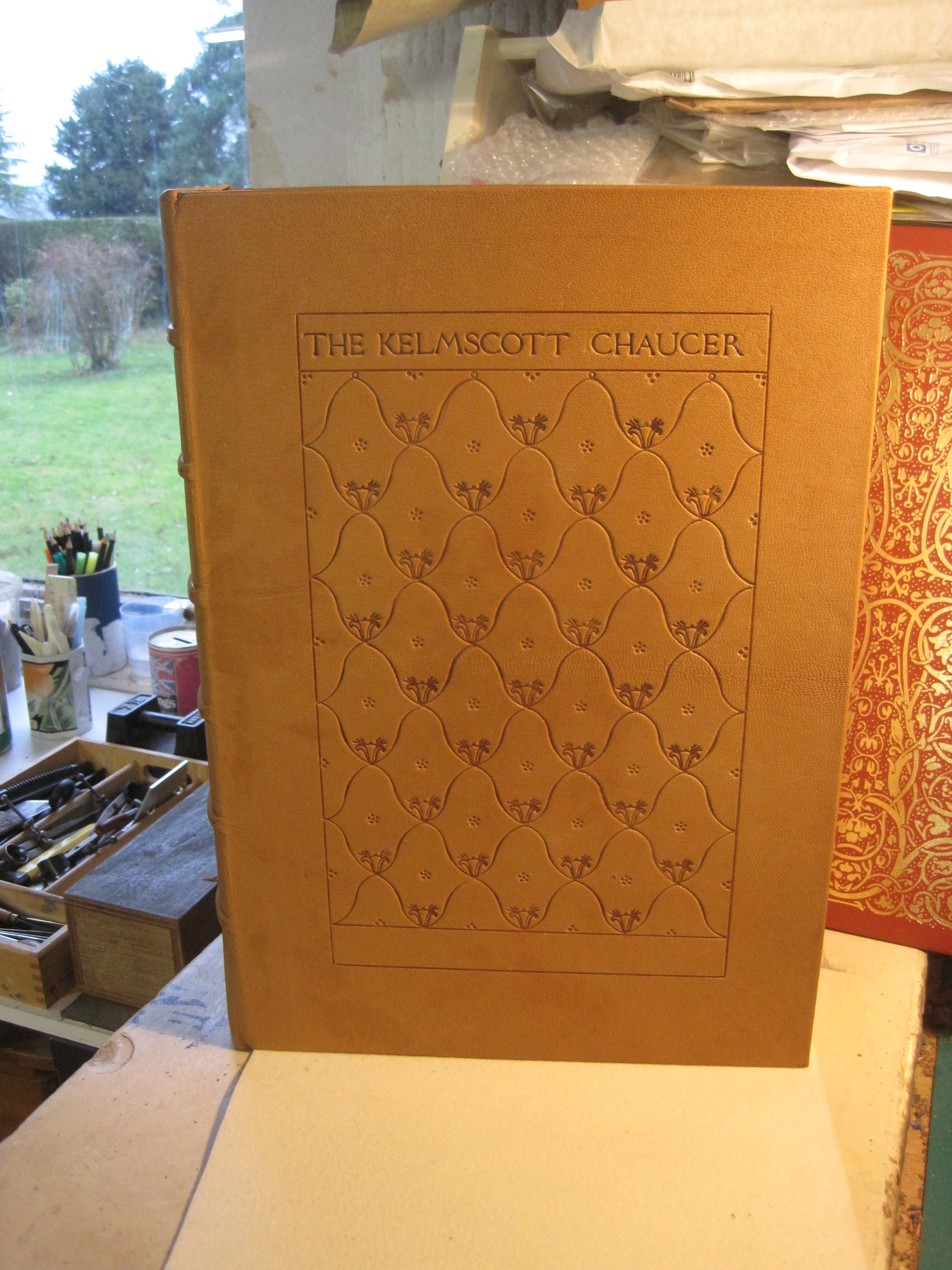
For the past year I have been rebinding (in gaps between paid work!) my own copy of the 2008 reprint of the Folio Society facsimile of the Kelmscott Chaucer, bought at auction for a lot less than its initial cost. The covers of this edition were, in my view, vulgar and cheap, but the text was identical to that of the 2002 edition which had a full leather binding reproducing one of the Cobden Sanderson bindings on the original 1896 edition.

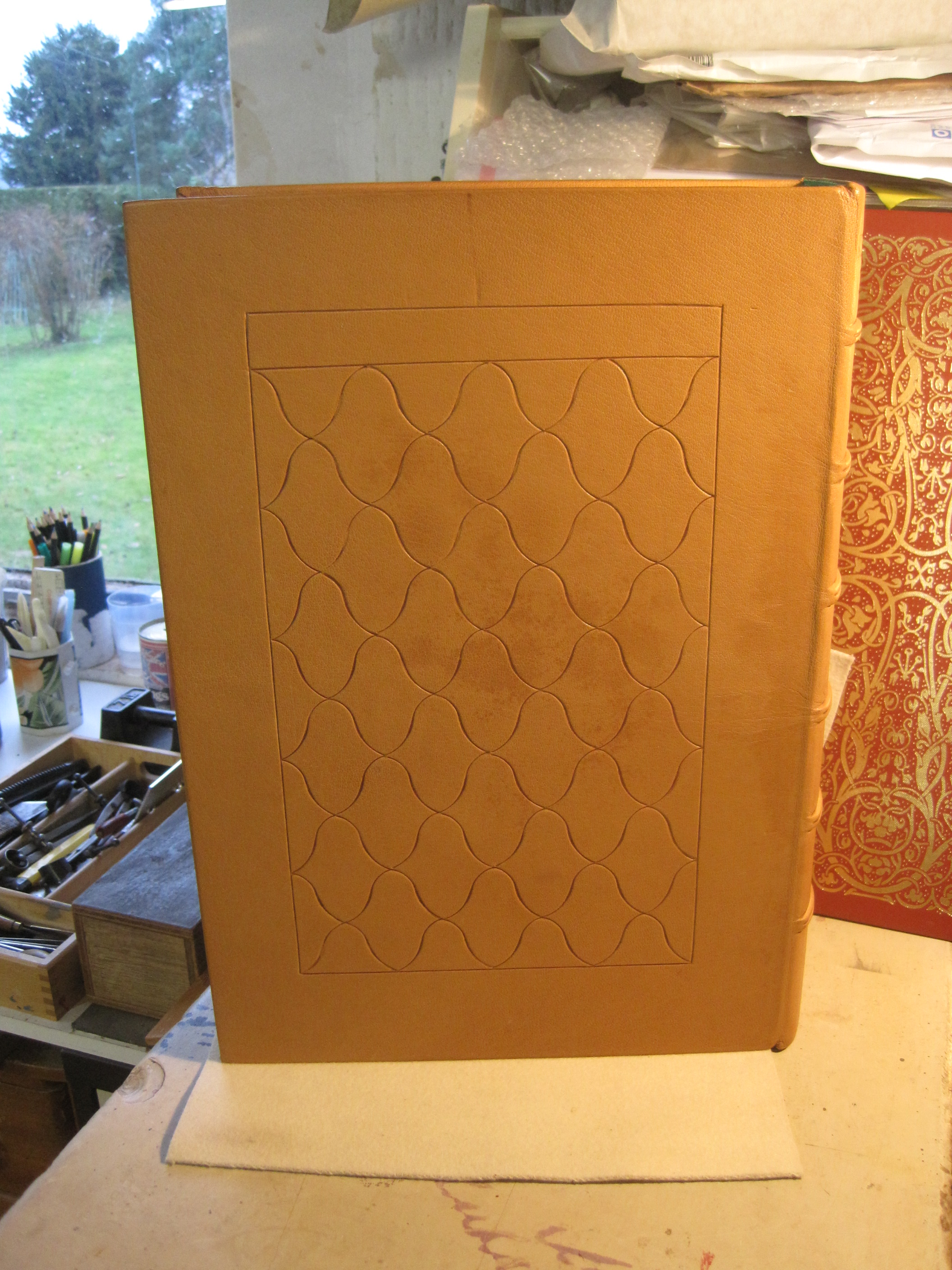
I have a few tools identical to ones Cobden Sanderson used, made by the same toolmaker (Knights and Cottrell) so I devised a design that echoed his work, without copying a specific design. I also used a pair of elegant ‘S’ curves made for me by the multi-talented Tom McEwan and two sets of 36 point hand letters, all tooled in blind as a nod to Morris’s preference for Gothic style.

Here are some pictures:

The back cover has a simple lattice design. Behind is the Folio Society binding – bright brown cloth over thin boards. Not good enough!
Front cover
Back cover again. The blotches are in the tanning – regrettable but authentic.
And, of course, the text. Hollow back, with green sewn endbands.

Some current work

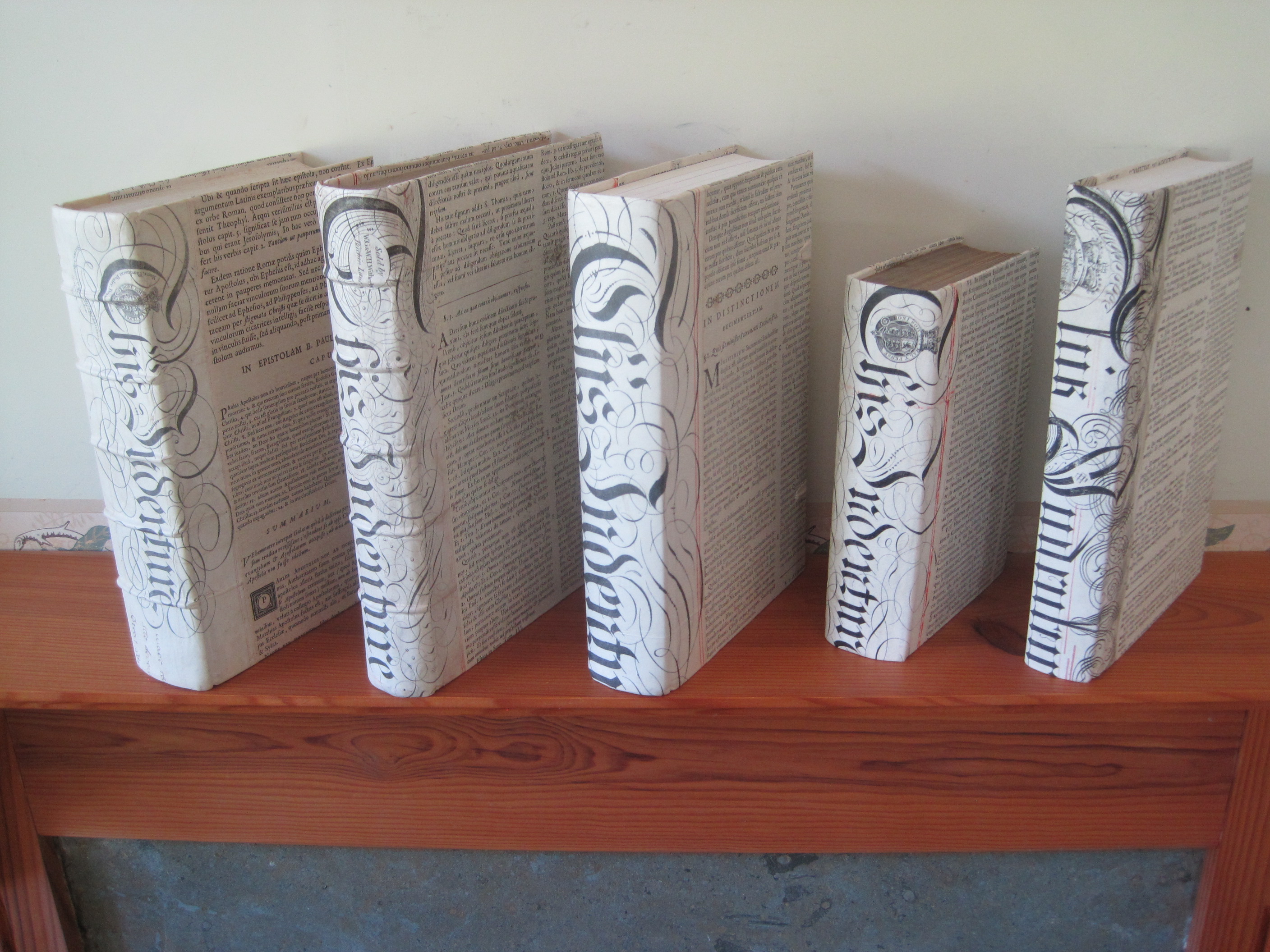
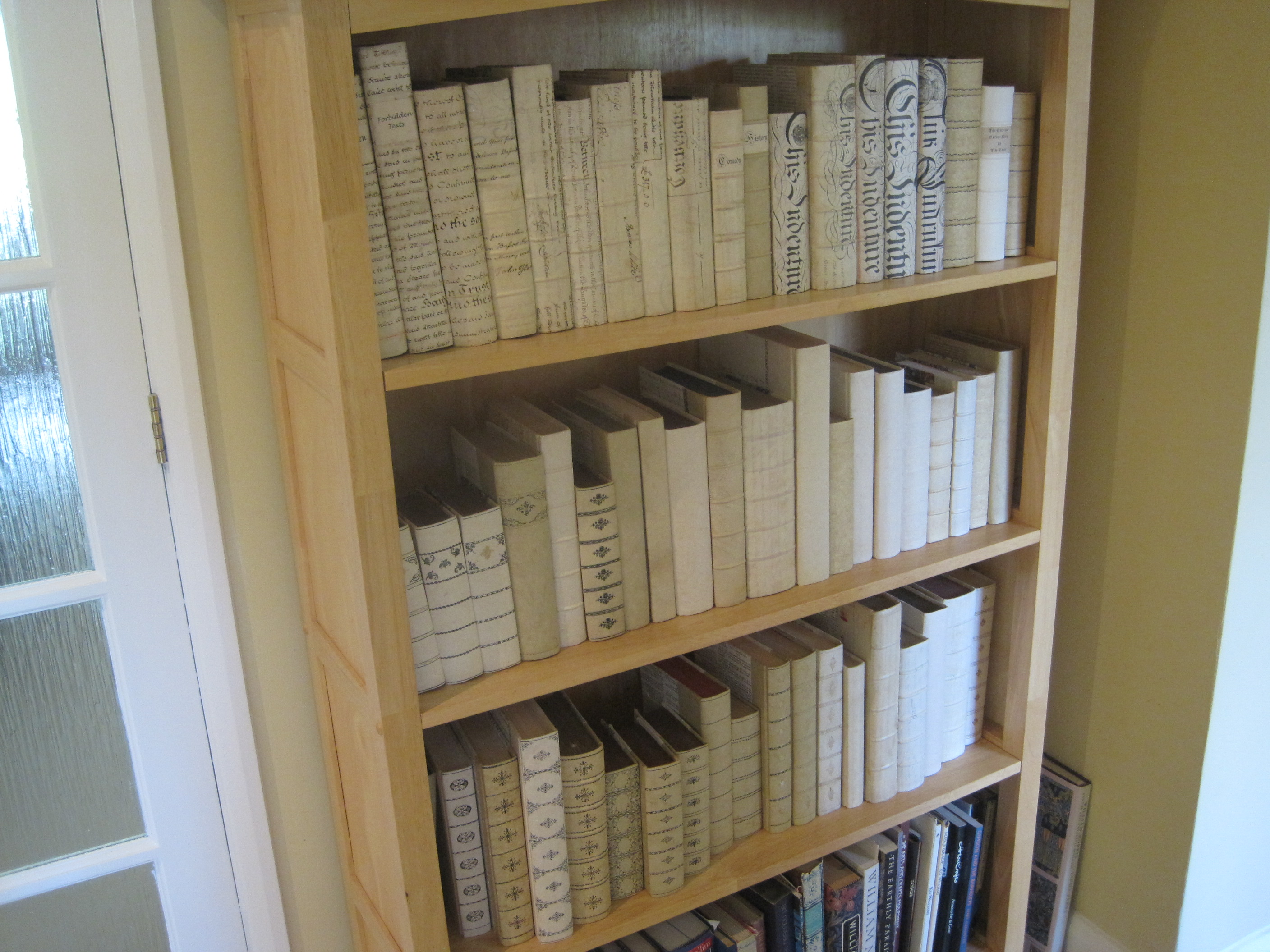
In the past year I have ‘re-covered’, in both senses of the word, about 100 reject hardbacks in a combination of reclaimed parchment and rescued old pages with some decorative feature. The parchment is from old deeds, mainly land conveyances, which have no other value. Here are some examples.

They make good display pieces for antique shops or, lying flat, for jewellers.
A couple of shelves make an interesting interior design feature.

A bit of background

I started bookbinding as a hobby more than 40 years ago. I took evening classes at Leicester Polytechnic (which had recently taken over the Leicester School of Printing, along with its specialist bookbinding staff) in 1976 and continued for five years. Trevor Hickman was the tutor – sadly, I learned recently that he had died, aged 84, and is greatly missed by all his students.

Over the next 25 years I gradually acquired all the tools, equipment and materials necessary to tackle any repair or new binding job, and I joined the UK-based Designer Bookbinders, and later the Society of Bookbinders. Their weekend courses and conferences were important to developing my skills.

Initially I bound or repaired just my own books, but people began to ask me to do repairs at which , with practice, I became quite proficient. When I retired from full-time work I took on more repair work and now, fifteen years later, my work book has over 2000 entries, including some new bindings for clients.

Now I would like to share some of the techniques and methods I have developed with other binders, however new they may be to the craft, and that is the chief aim of this Blog.

Here are some images of previous work….

My re-bind of Ben Jonson’s ‘The Alchemist’: full goatskin, black calf inlay, gilt title to spine
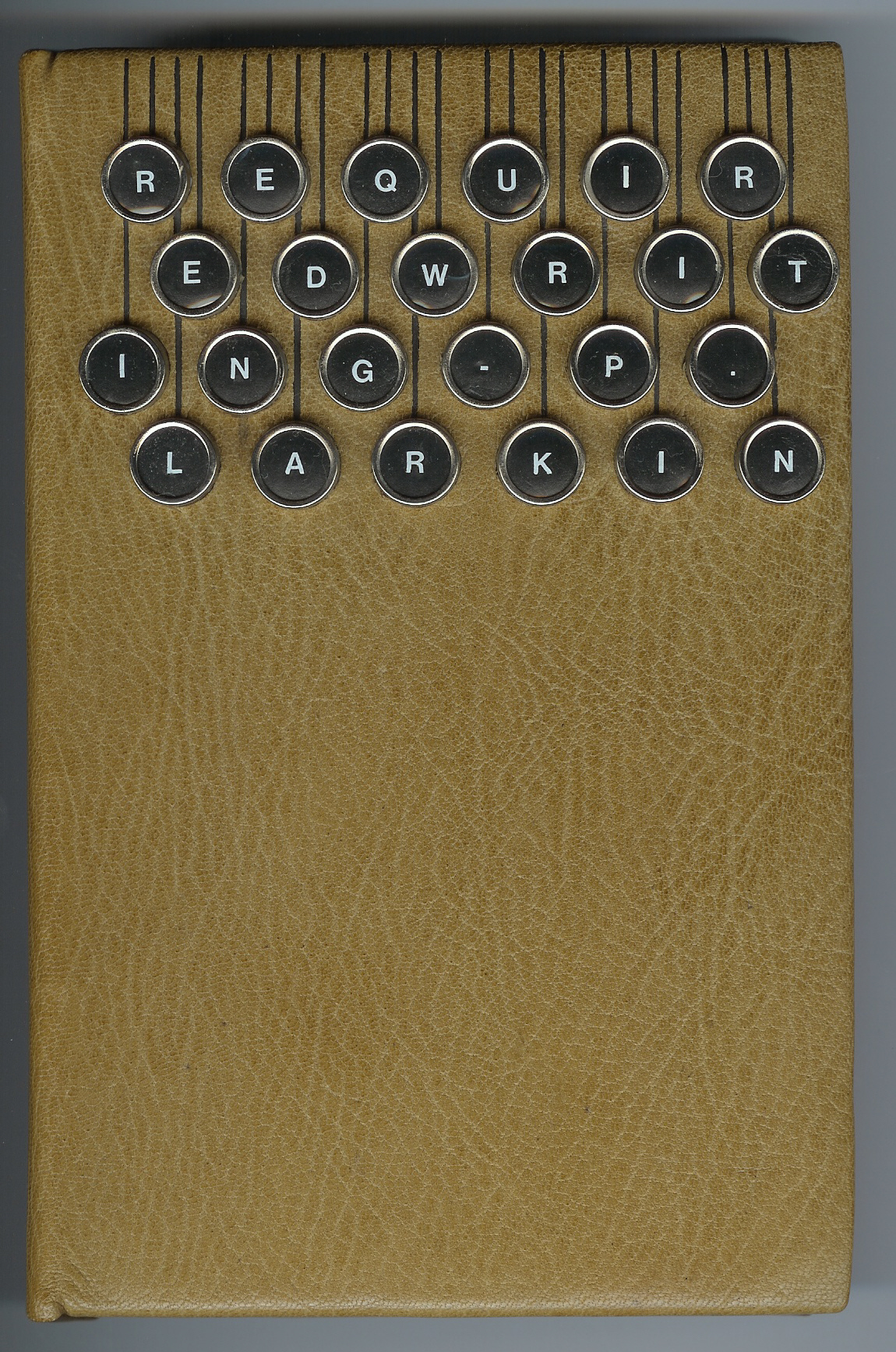
Made for a competition in about 1982. ‘Required Writing’ is a collection of Philip Larkin’s journalism pieces, so I used old typewriter keys to spell out the title and author
I re-bound my college copy of ‘Beowulf’ in alum-tawed pigskin with blind tooling in imitation of stamps on 13th century bindings
My first attempt at a Cambridge Panel binding – probably around 1985