‘Let’s get this straight…’

It often happens that an old book has become distorted through use or neglect. If it is to be repaired satisfactorily the text has to be re-shaped so that head and tail are square and the back and foredge are neatly and evenly rounded. This can of course be achieved by separating all the sections, cleaning off the backs of the folds and re-sewing, but that is expensive – at least a couple of hours’ work for an ordinary octavo.

Quite often it is found that the sewing is pretty sound, merely a bit loose and that the distortion is caused by the spine linings being cracked and partly separated from the text. As stated in earlier posts, old back linings should be removed dry where possible, and that is greatly helped if the paper liner is scraped off first and then the mull-and-glue layer sharply tapped all over with the back edge of a lifting knife. This cracks the dry old glue away from the backs of the sections, enabling it, with the old mull which will certainly be weak if not rotten, to be picked off.

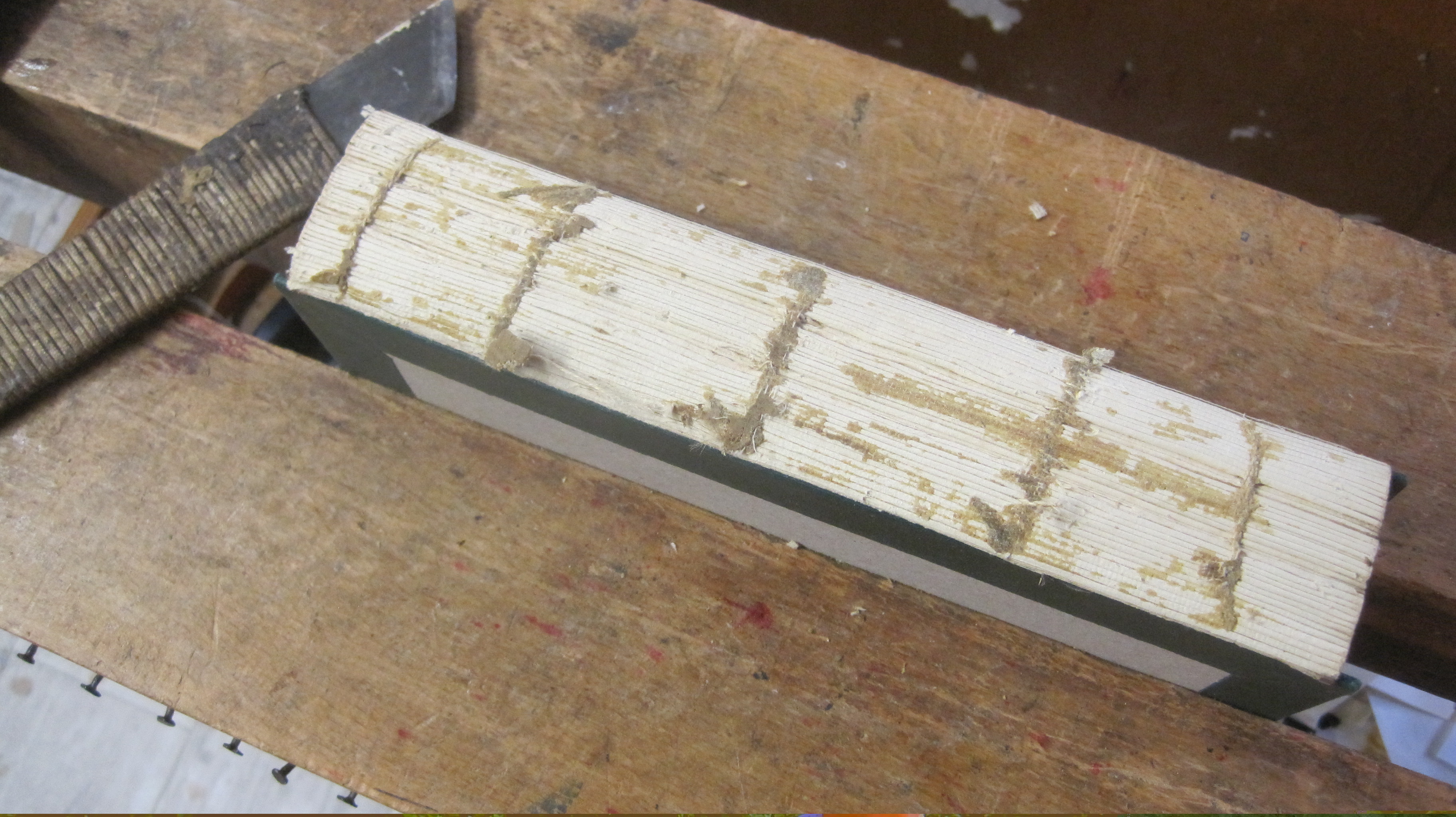
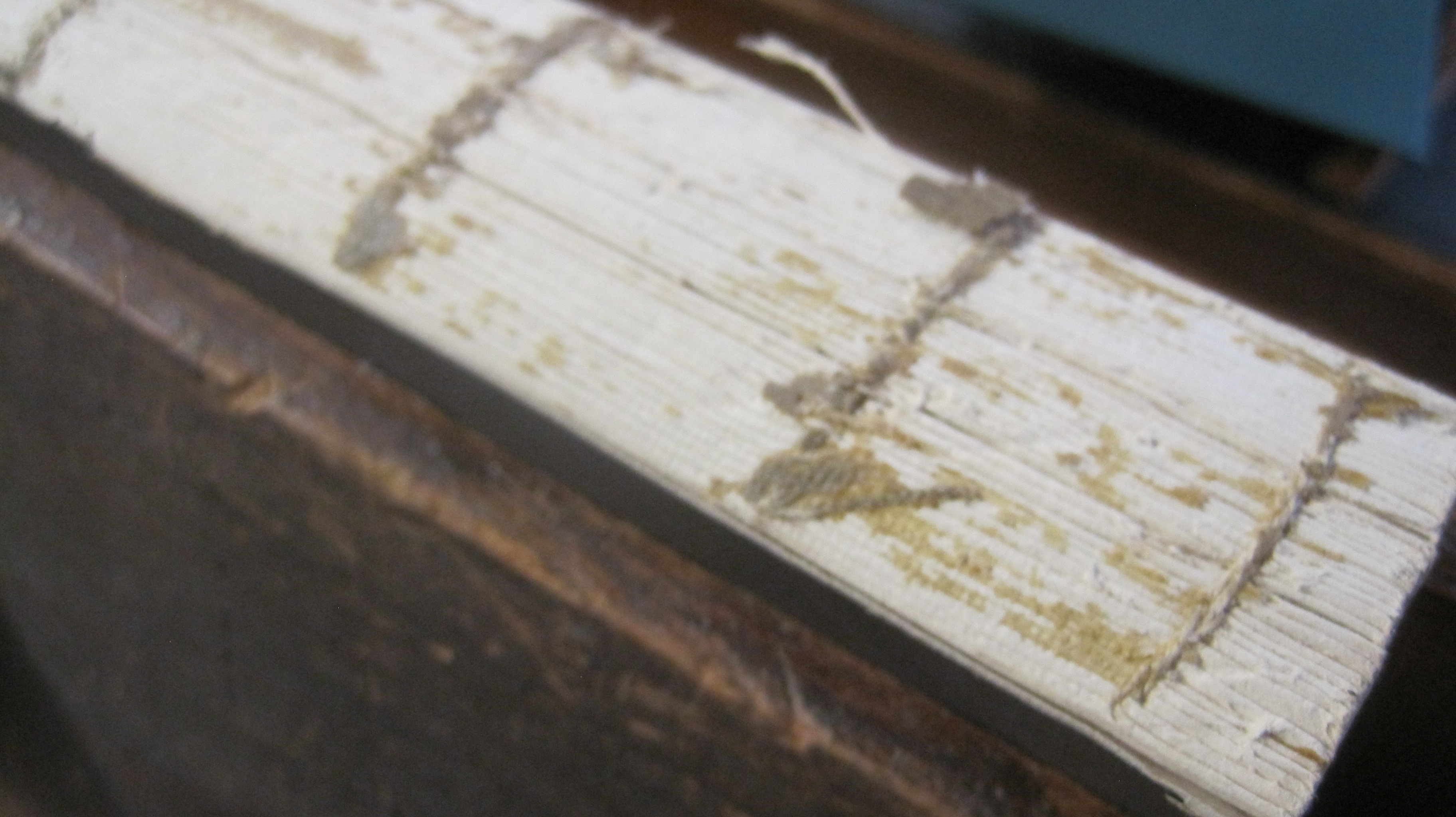
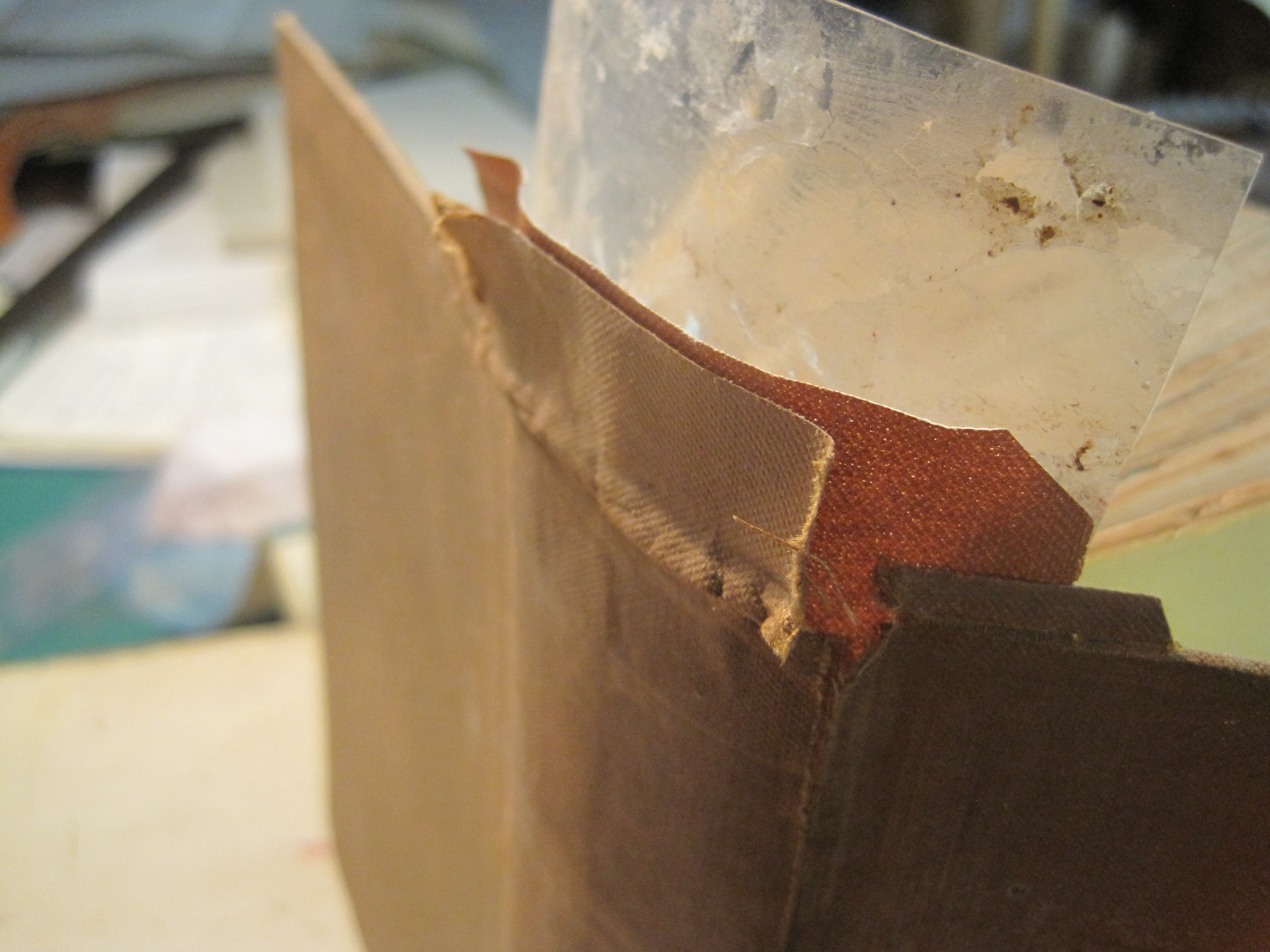
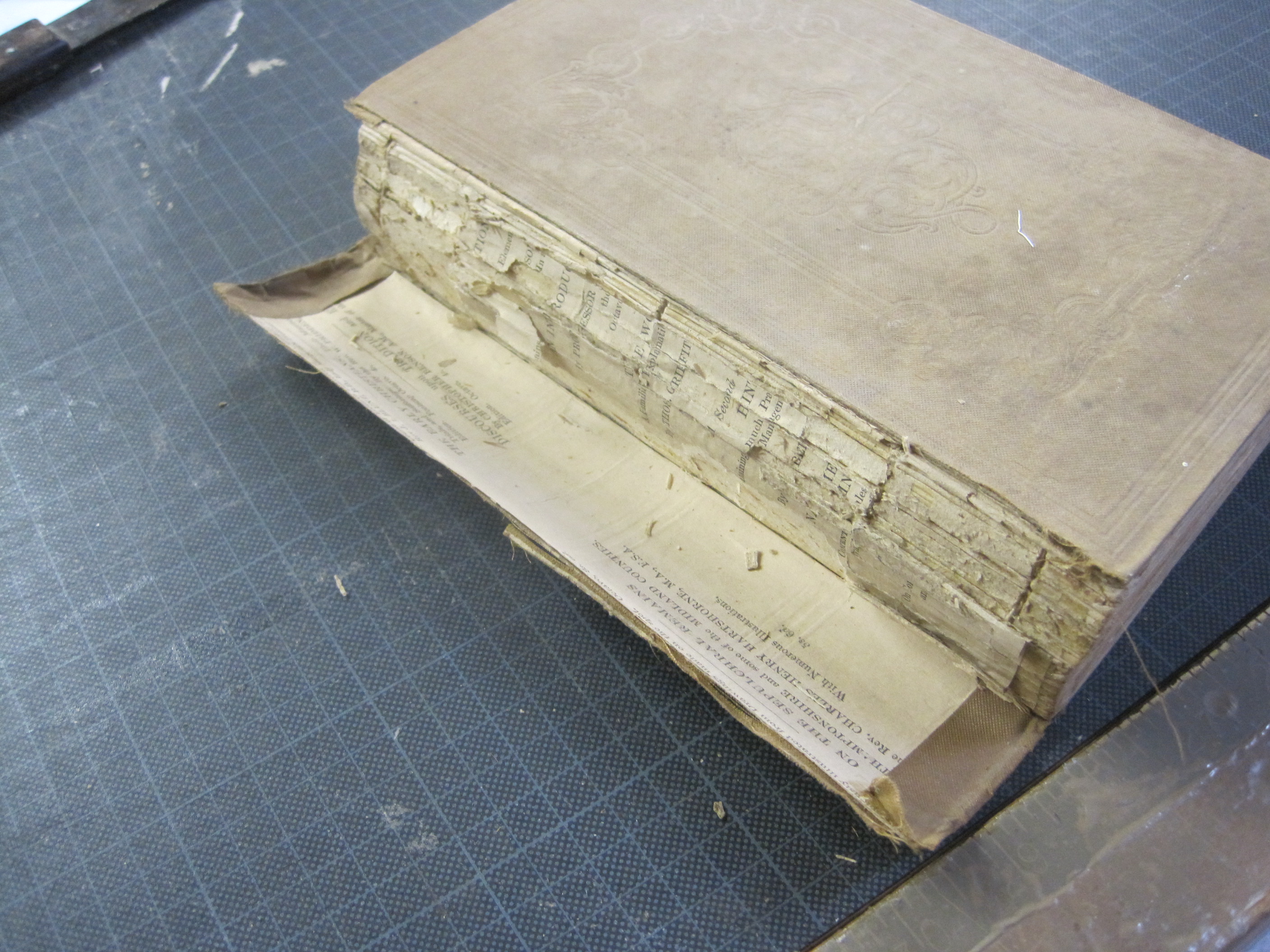
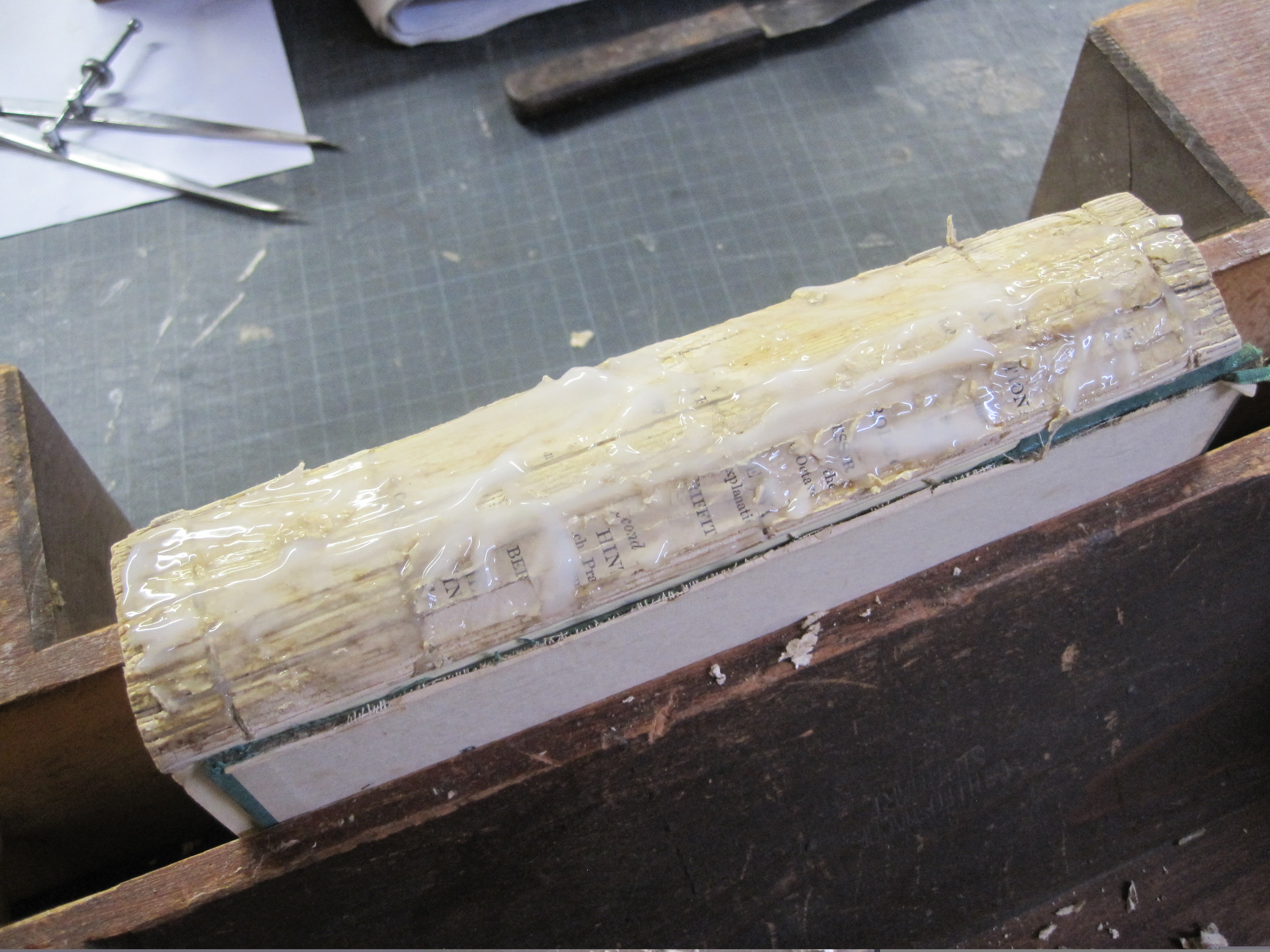
This picture shows the back after most of the lining has been removed.

Any remaining glue can be picked or gently scraped off. The sewing is pretty intact but the sections of text are uneven. Note also the ends of the sewing cords which have been snipped short and turned back onto the book and glued down. Leave them where they are!


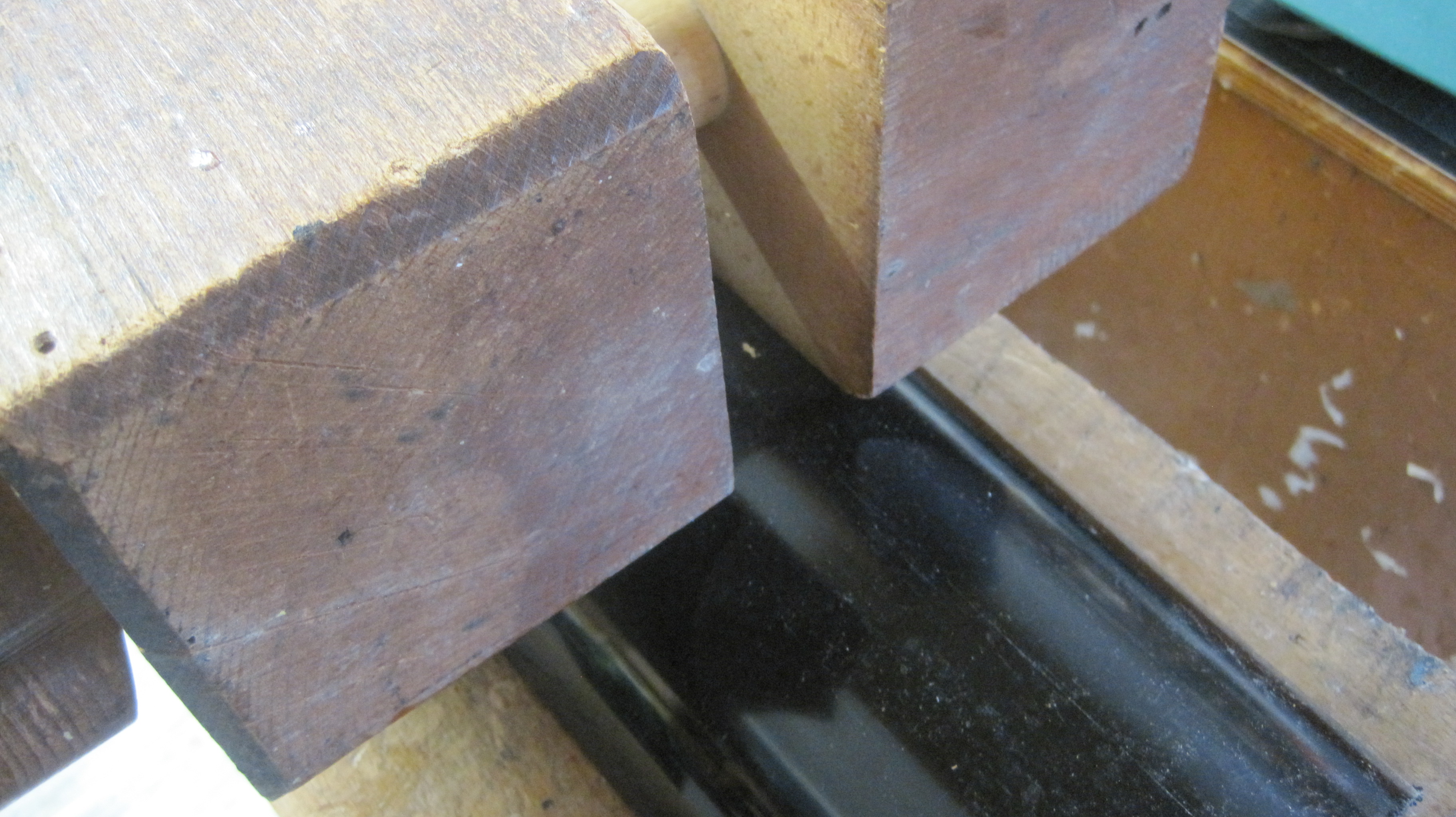
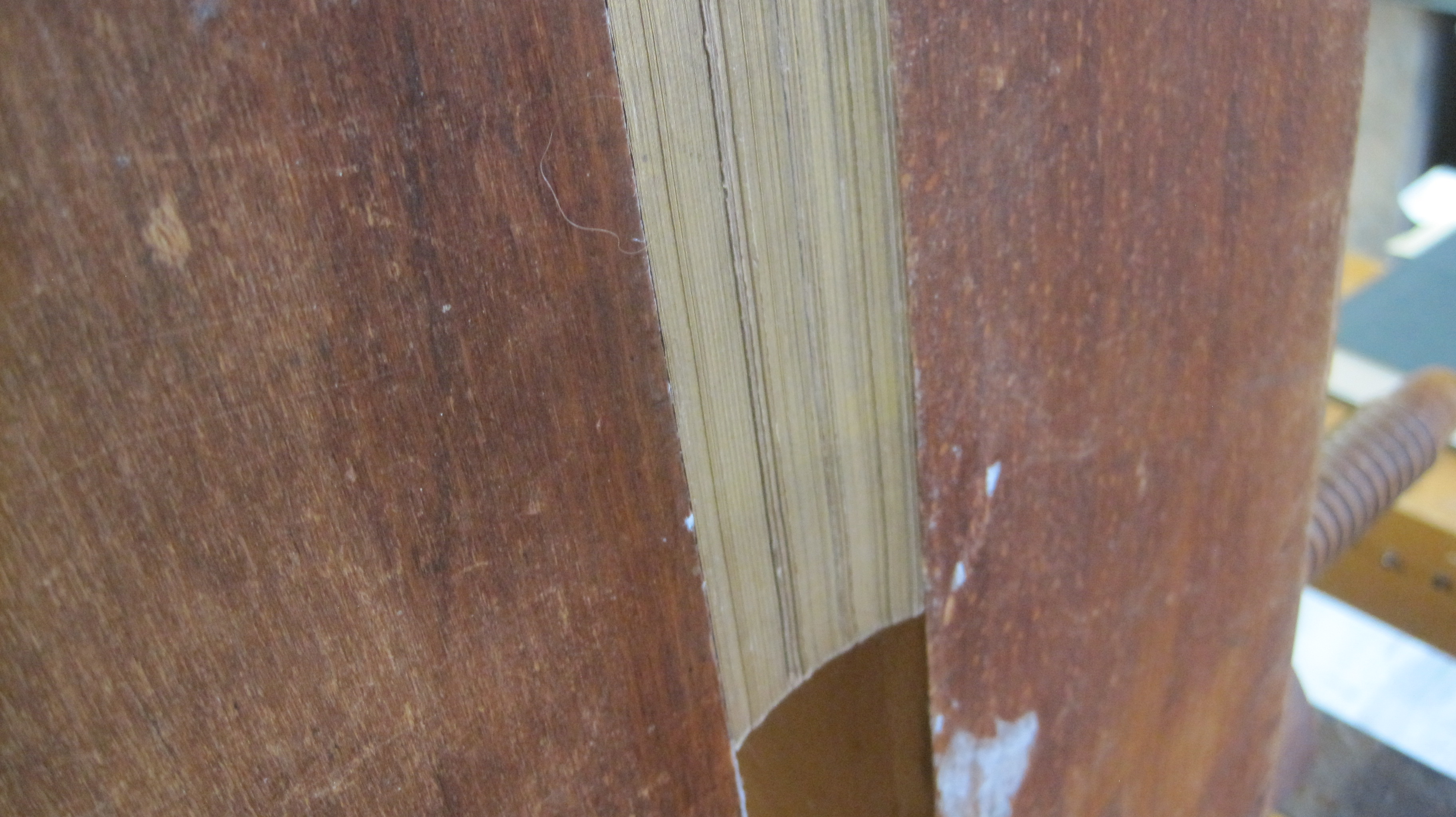
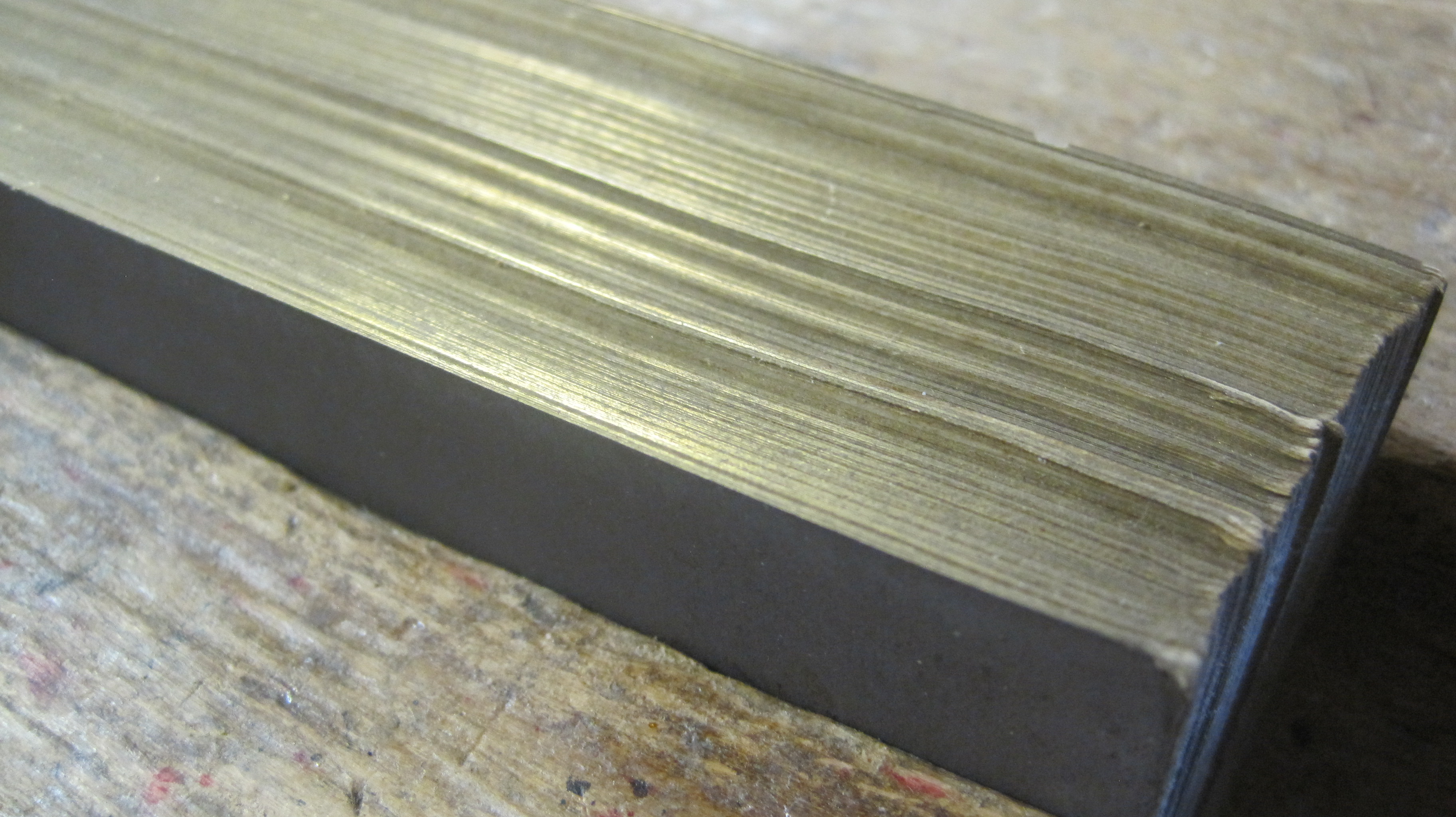
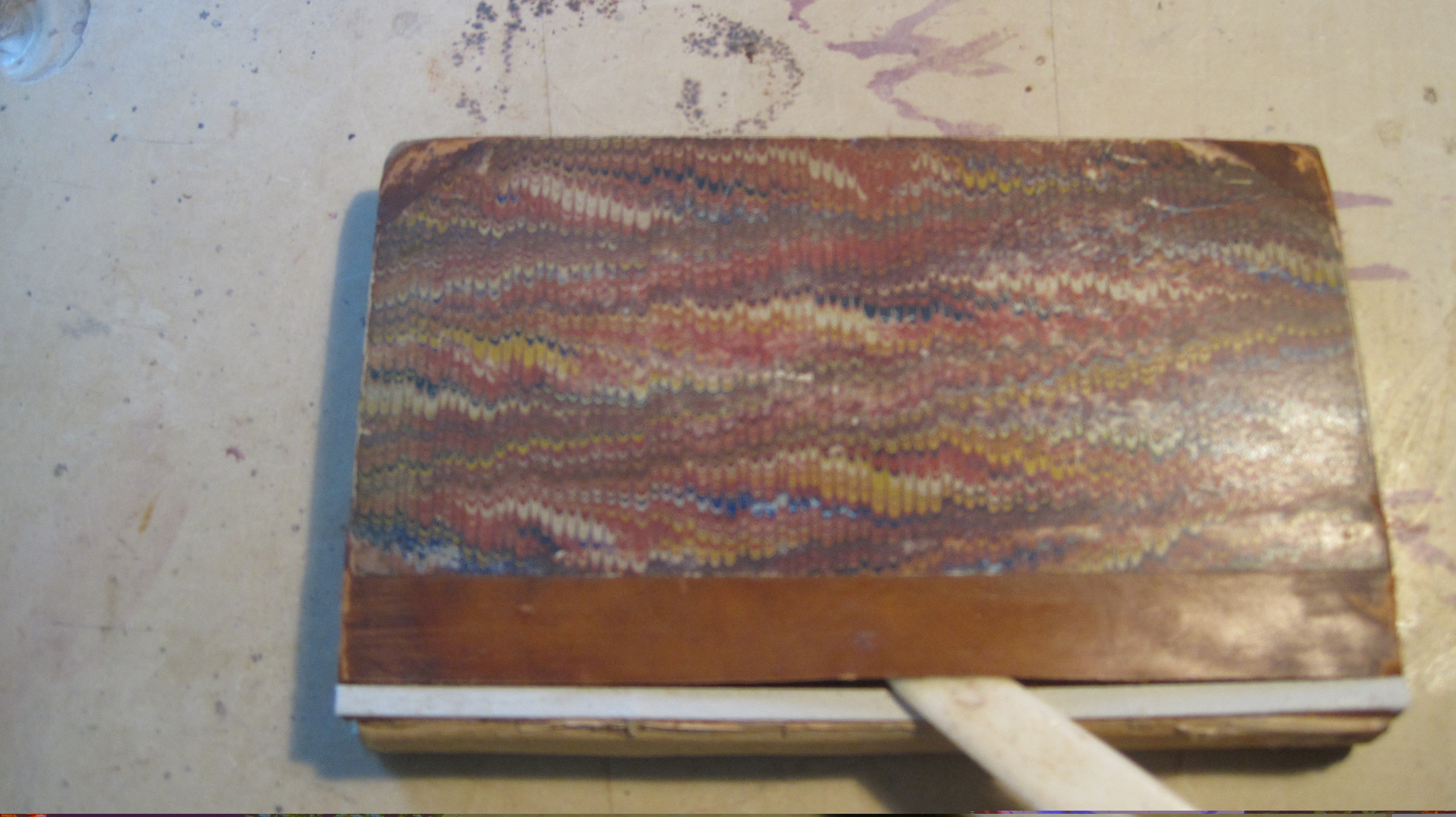
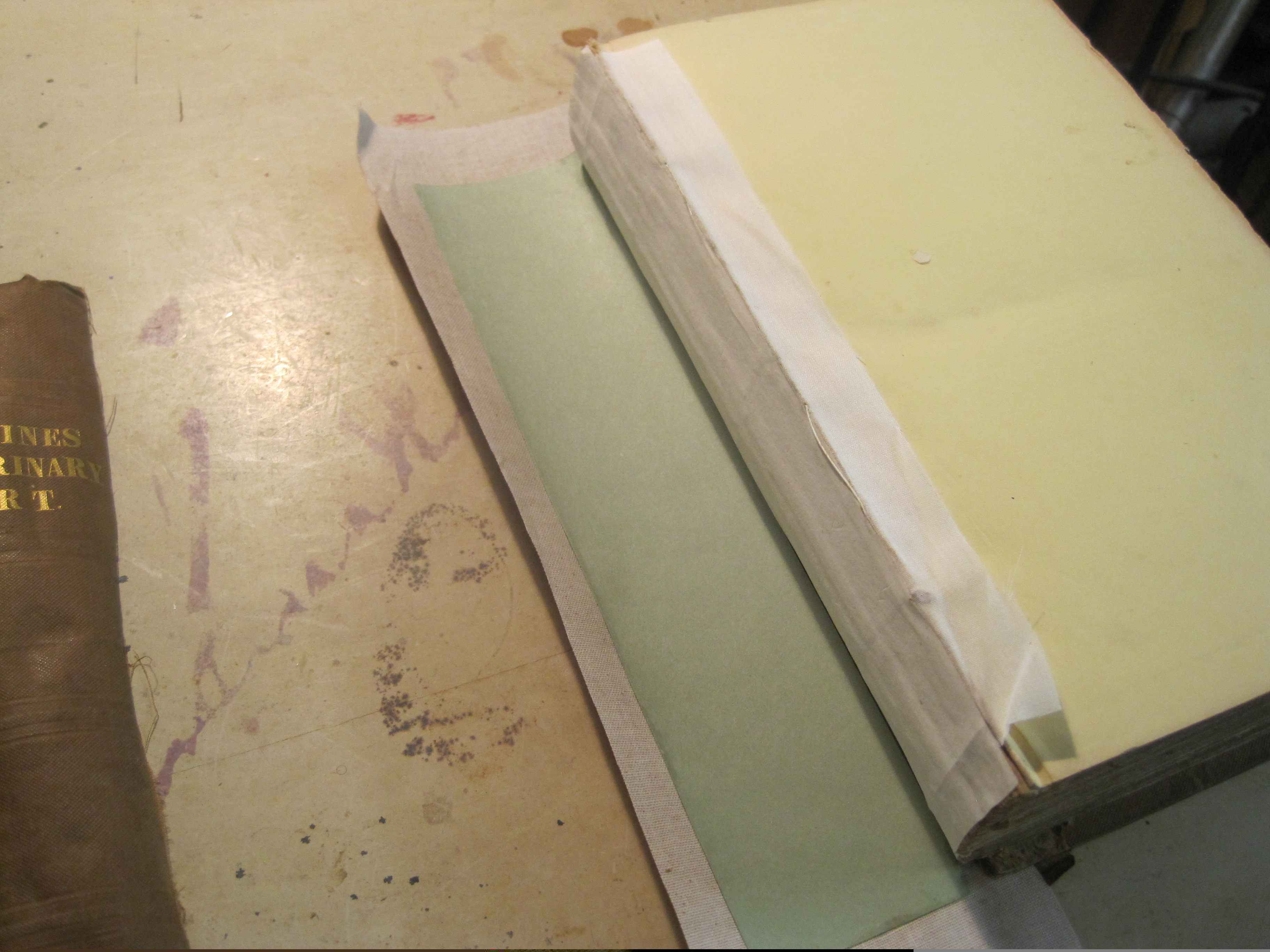
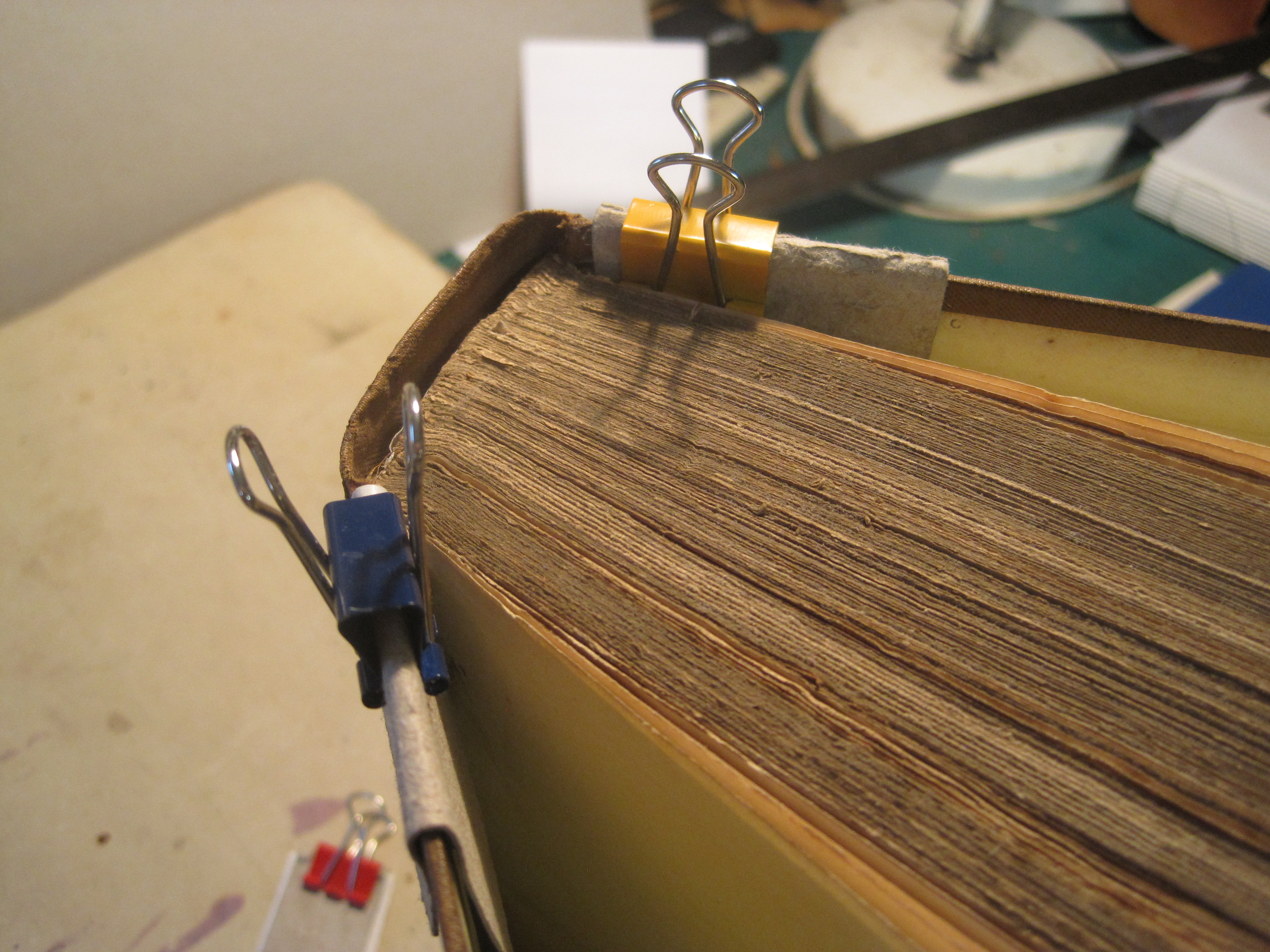
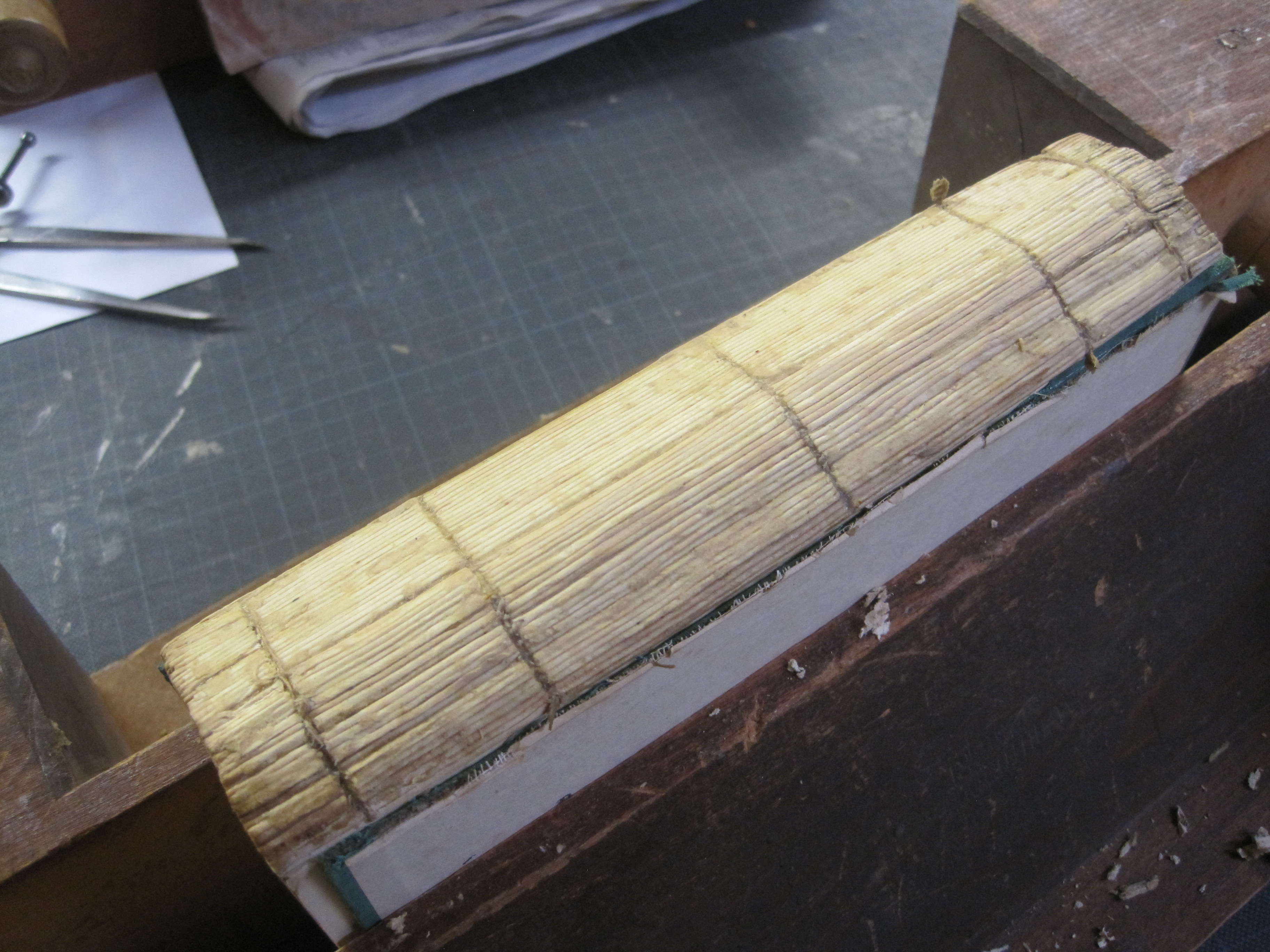
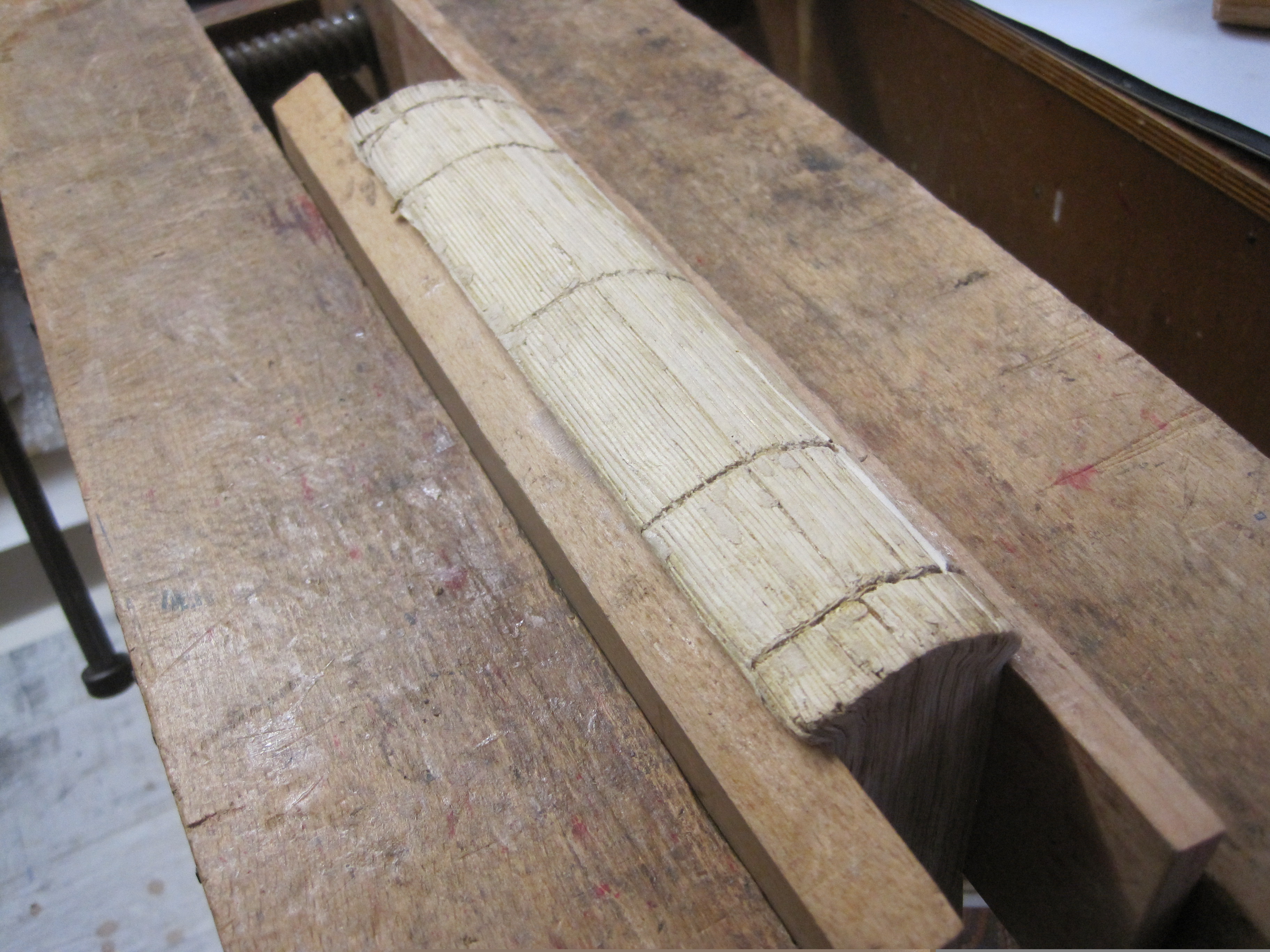
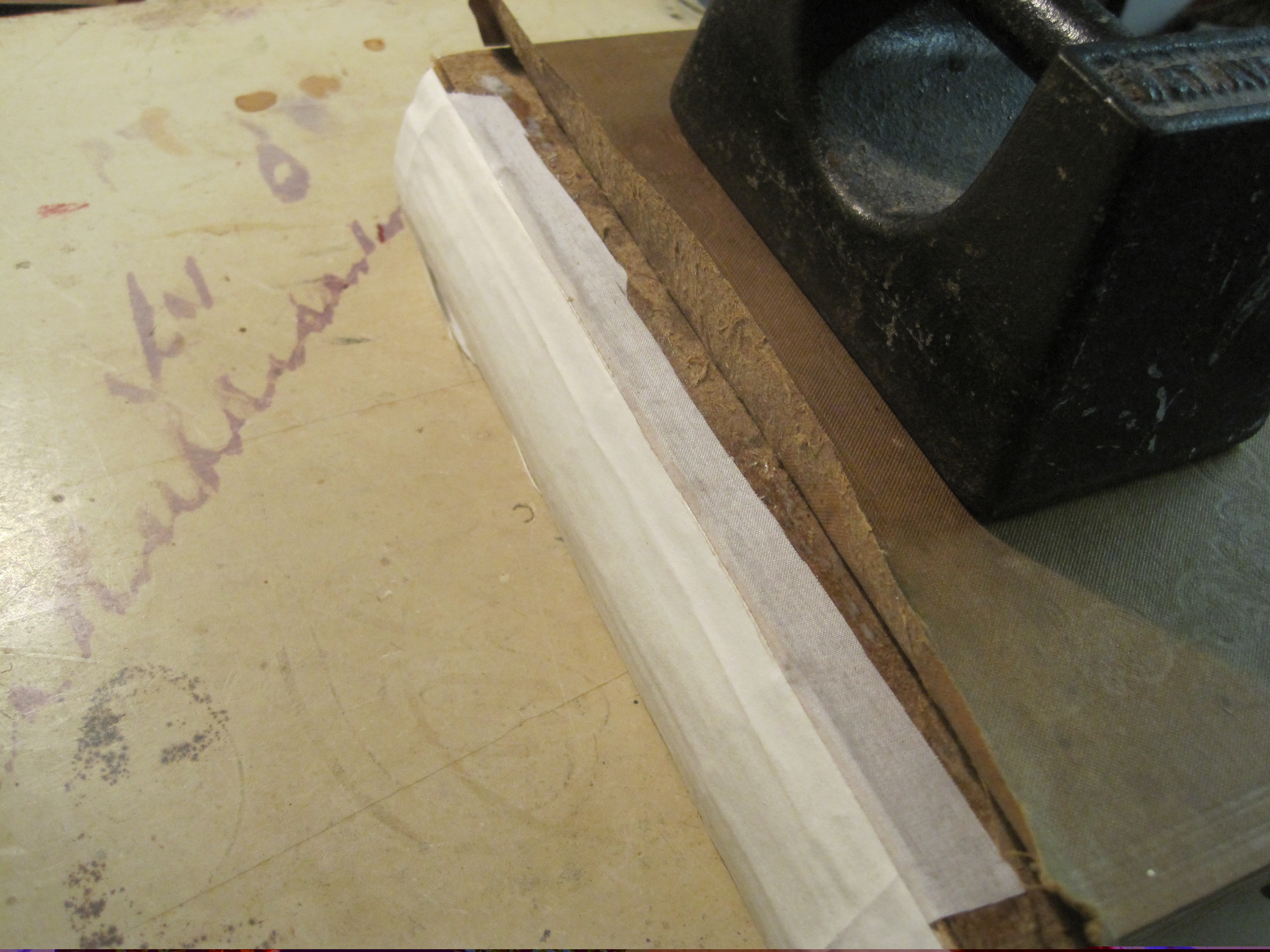
The problem now is to re-position the sections so none are indented at the back and therefore sticking out at the foredge, and to give the back a nice even round. It can be done by manipulation with the fingers but it’s a lot easier to put a section of plastic gutter under a finishing press and press the book down and wriggle it till it forms a smooth shape, at the same time evening up the head and tail, thus:

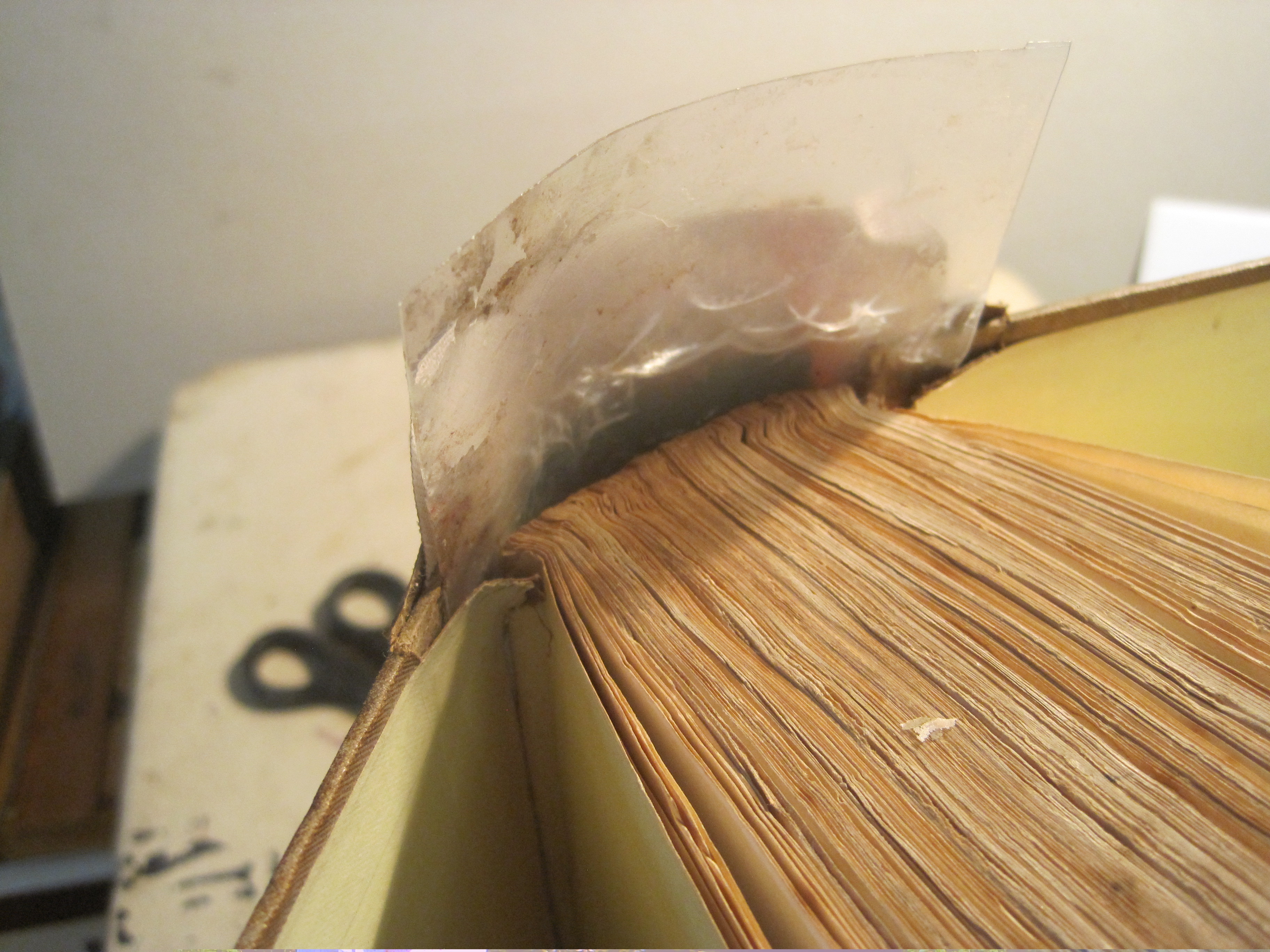
Compare the picture above with this, the foredge before re-shaping:

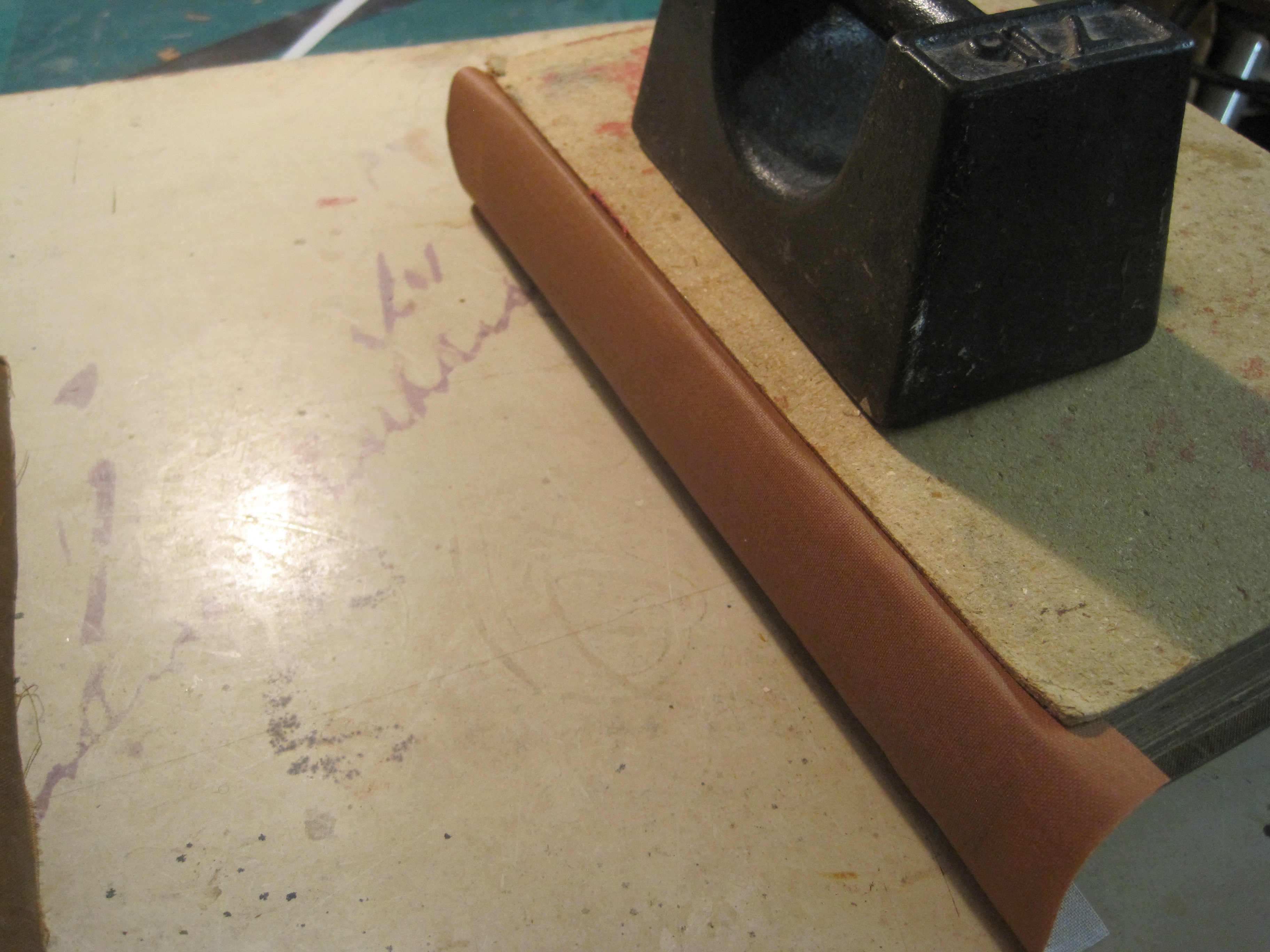
With the re-shaped book still in the finishing press, tighten it up and glue the back to set the new shape, sharpen the backing joints a bit and proceed to re-back as shown my earlier ‘Bread and butter stuff..’ post. The work has taken barely half an hour so far.

Another little echo of Bernard Middleton

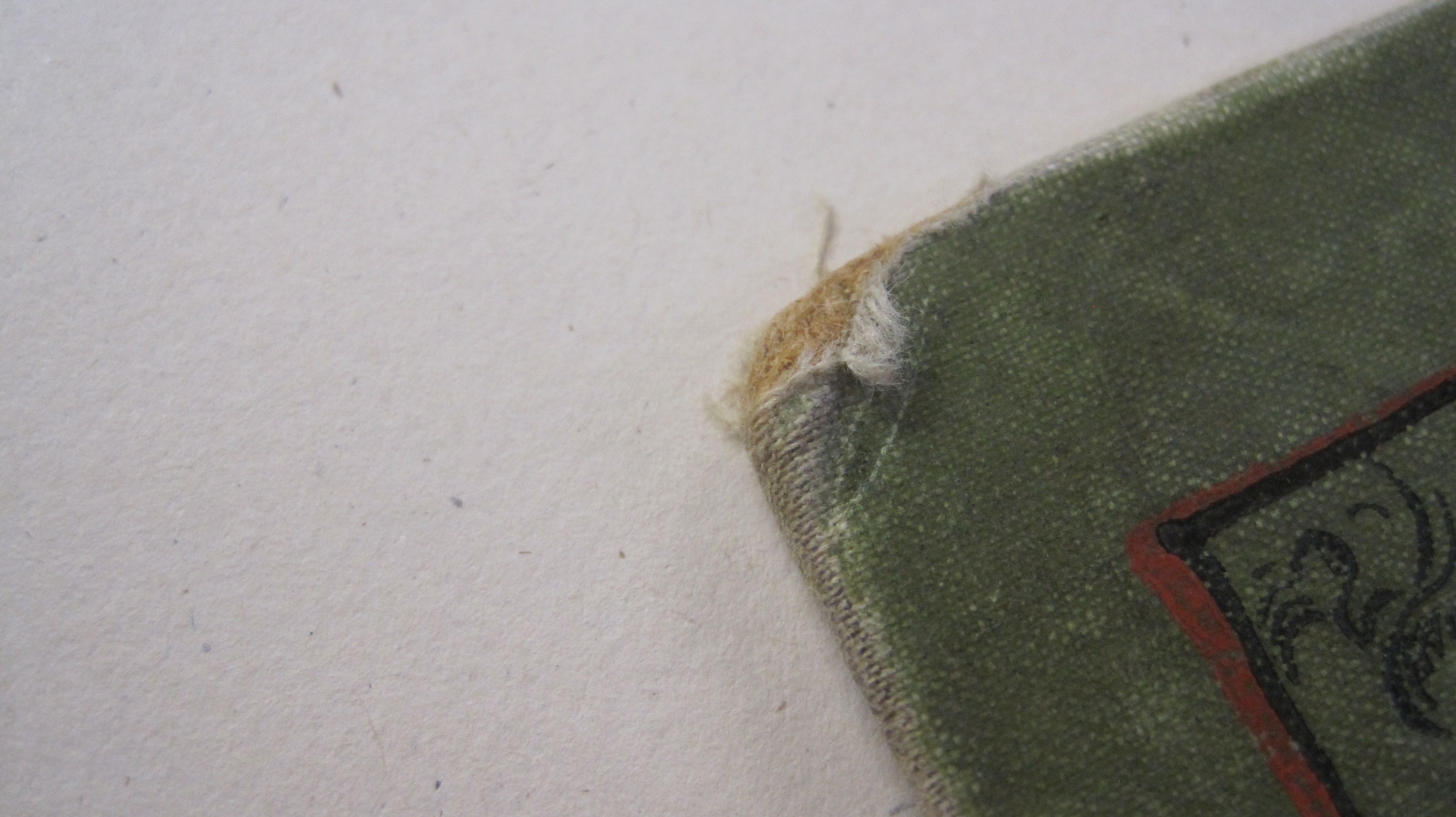
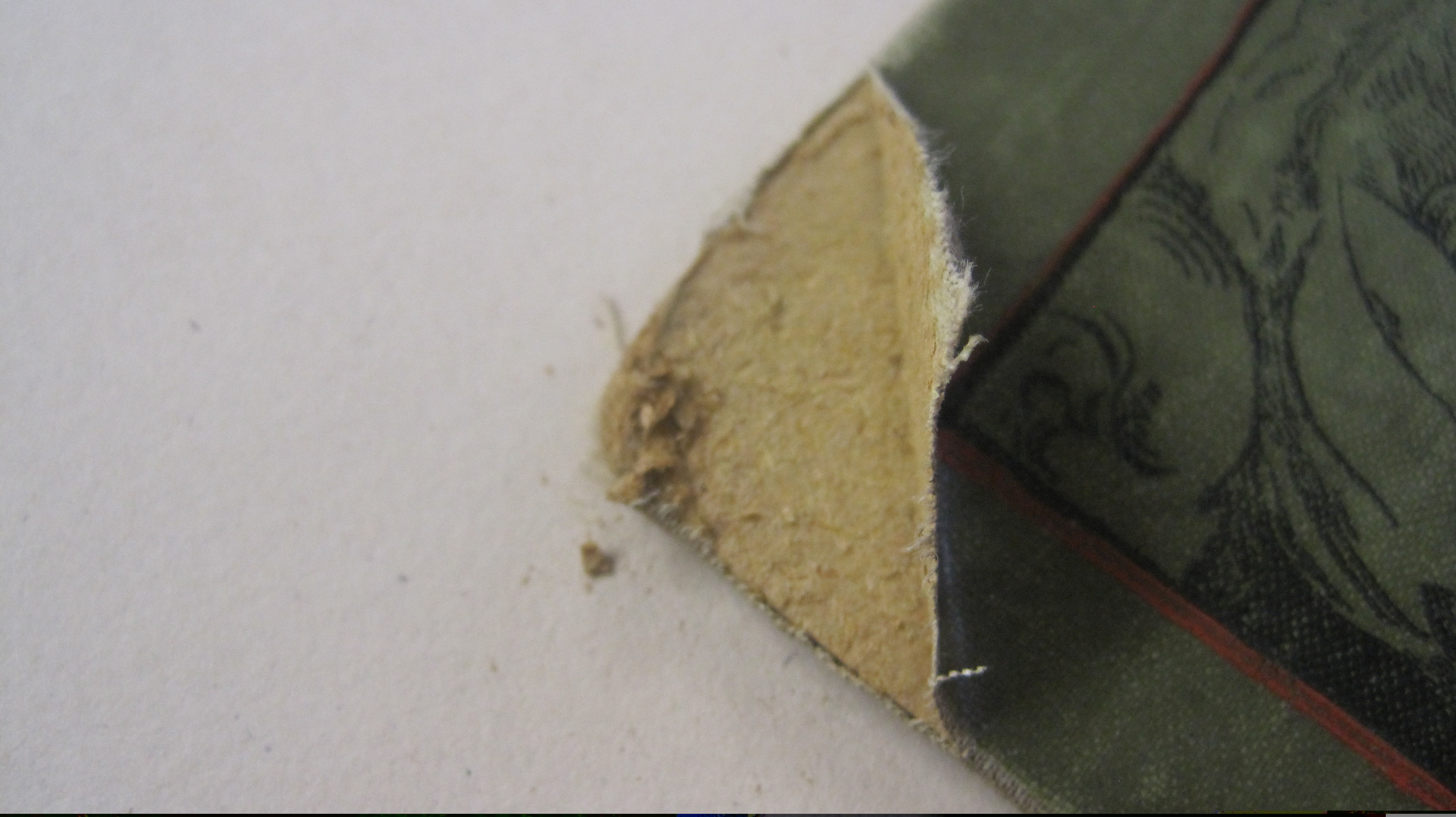
I happen this morning to be working on a small quarter-calf re-back, where the spine leather is completely missing and the first few millimetres of the side leather is also fragile and discoloured. Standard method would be to cut into the side leather where it is still sound and use a lifting knife to create a slot into which new leather can be tucked and glued.

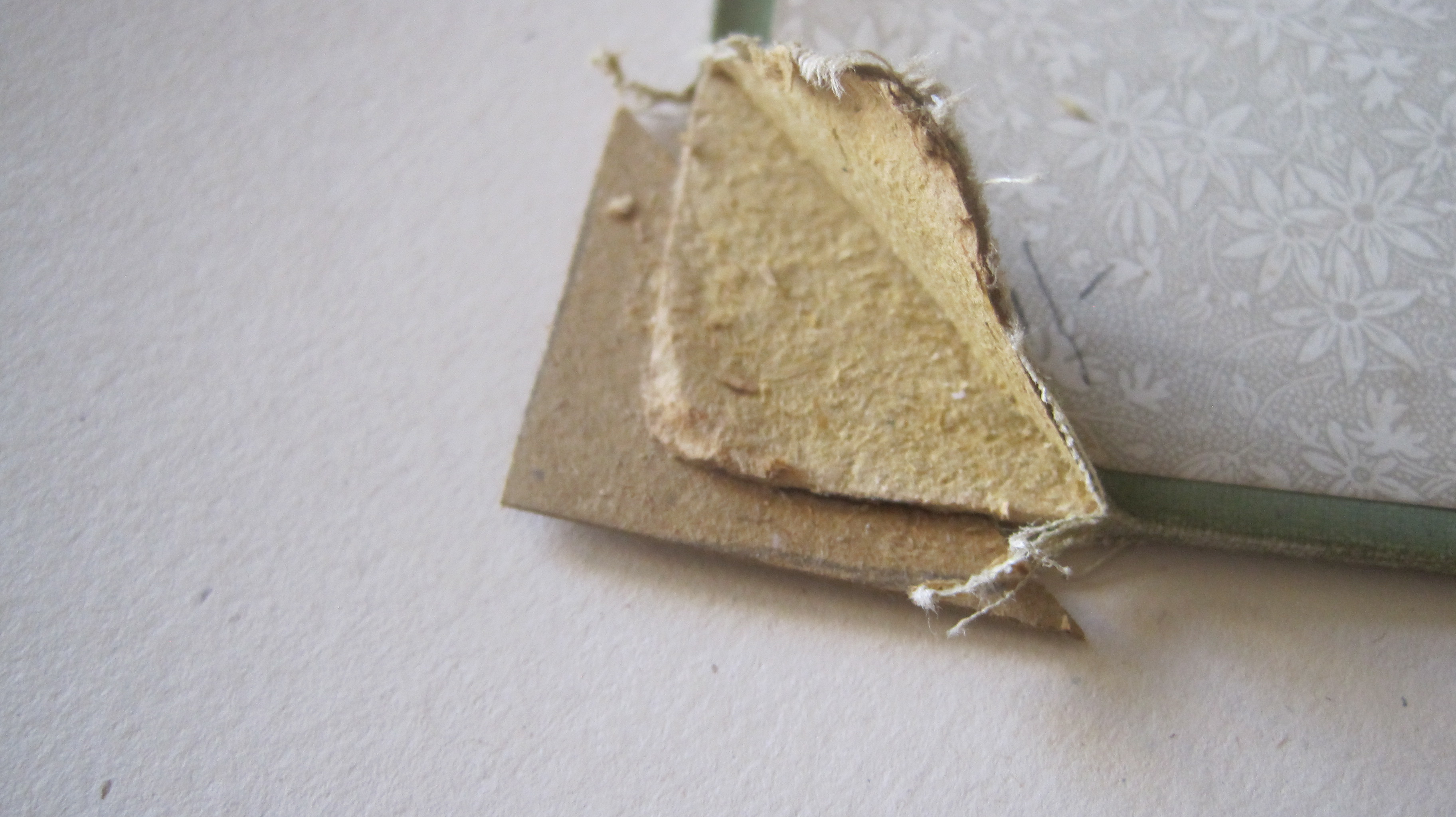
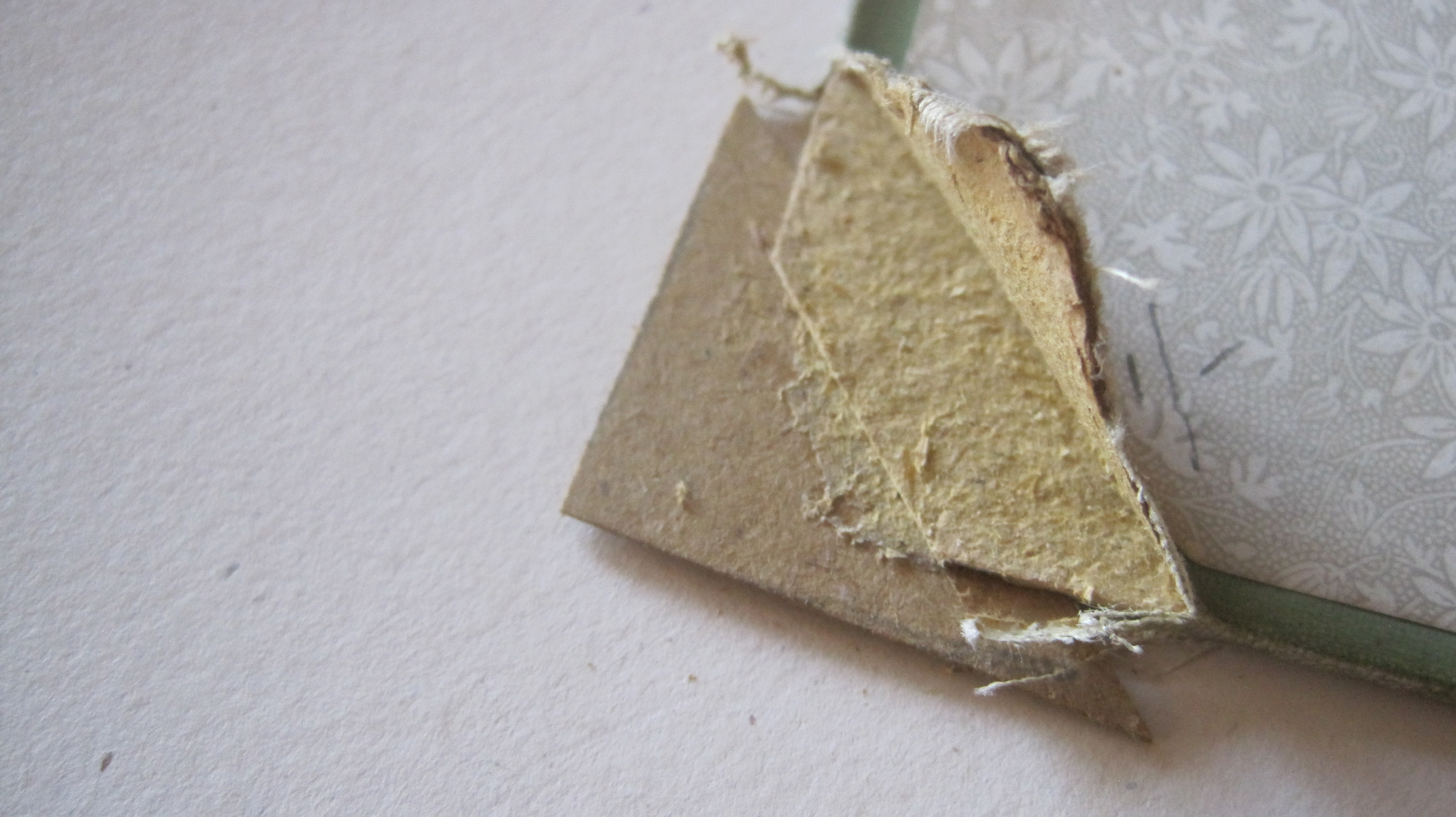
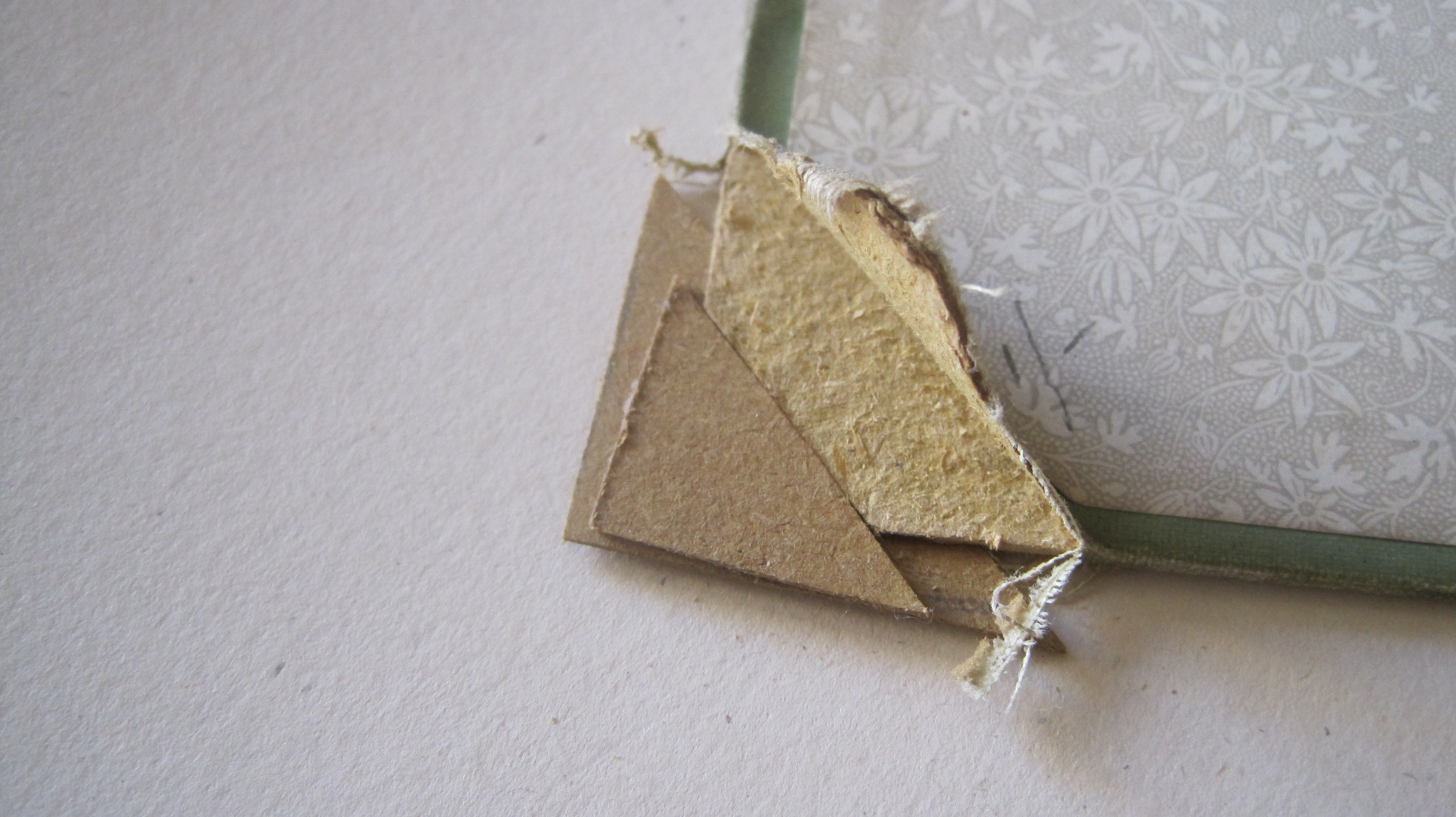
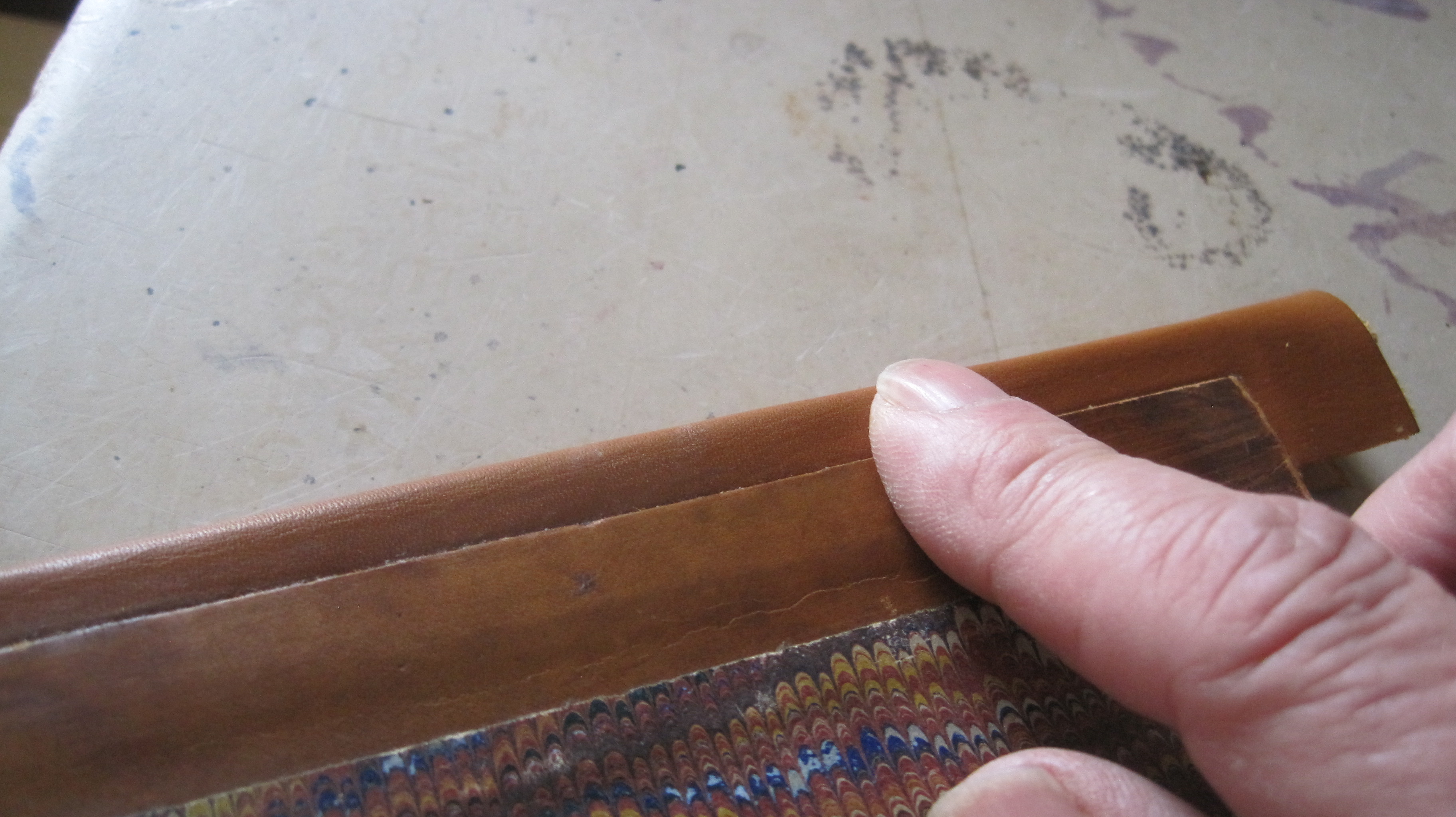
But that means that at the hinge the new leather will be glued down on to degraded old leather before being tucked under the side leather. Not a good idea to glue something on to a flaky or powdery base. Bernard Middleton’s method, as set out in his ‘Restoration of Leather Bindings’, is to remove the degraded strip and replace it (so as to avoid a step or lip at the edge of the ‘good’ side leather) with a strip of thin card the same thickness as the side leather, thus:

Jim Brockman once told me that this was known in his workshop as ‘the Bernie Strip’. I make a point of passing that phrase on to anyone who ask how I do my repairs.

After the new leather spine strip has been glued and tucked into the slot and well pressed down you get a perfectly flat surface with a neat join.

The result is a hinge that will hold and last. As will Bernard’s legacy.

A fresh slant on Grolier

Some years ago a client wanted a very plain cloth-bound set of Shakespeare’s plays ‘enhanced’ by re-covering them in faux parchment ‘in a sixteenth century style’. I suggested having a block made from an image of a classic Grolier-style binding, and then blocking it in gold on the front and with a plain spine with a title label. He agreed the design and was pleased that it provided a space in the centre for his initials.

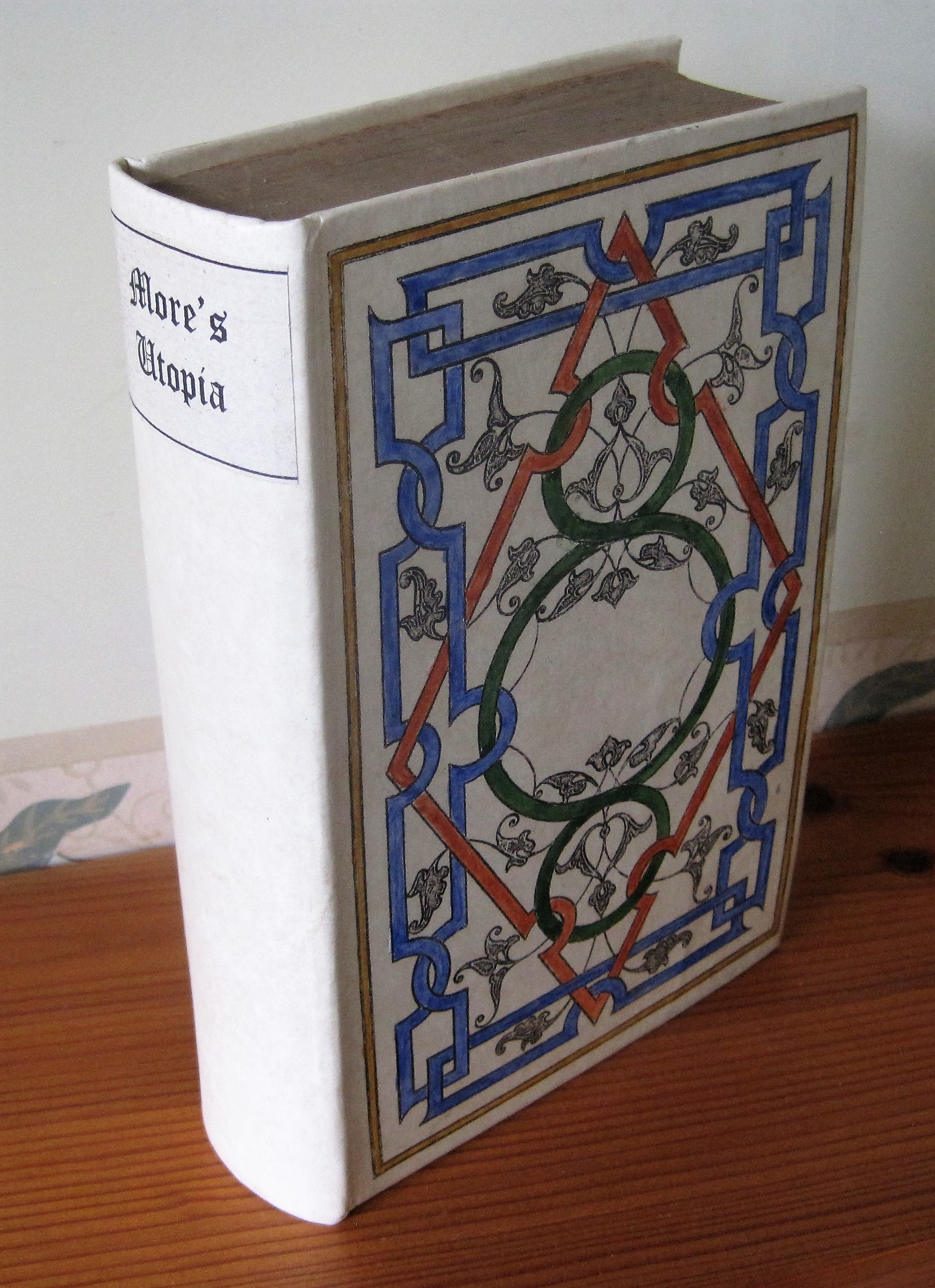
He liked the result, though I thought that the gold on the off-white background did not have much visual contrast. But I kept the block – made from a scan of a page in a book on historic bindings by the excellent Metallic Elephant company in Chelmsford – and realised I could use it on my own copy of More’s ‘Utopia’ as its proportions exactly fitted the front cover.

But in the meantime I had been experimenting with tooling designs using carbon paper to transfer ink to a tool and stamp it on to a pale background. [Try it – warm/hot tool on the face of the carbon to pick up the ink, apply straight away to pale leather, parchment or vellum – produces a crisp sharp and permanent impression]. So I attached the block to the chase of my blocking press, inked it from a sheet of carbon paper placed on top of the book which was fixed with tape in place on the platen, removed the carbon paper and stamped the block straight on to the book cover.

Careful positioning and firm fixing was necessary, but the result was pretty good. Then I added colour to the strapwork design, in exactly the same way as it was done in the 16th century for Grolier, Maioli, Wotton and others.

Then a simple computer-printed paper label on the spine. The cover material is the wonderfully-named ‘elephant-hide’ paper made by Zanders in Germany, of which I have a small and cherished stock.

The result is bright and cheerful, and entirely appropriate for a book which was first printed in English in 1556 at exactly the time Grolier was having his books bound in this style. A happy marriage!

….. another slice of the same…

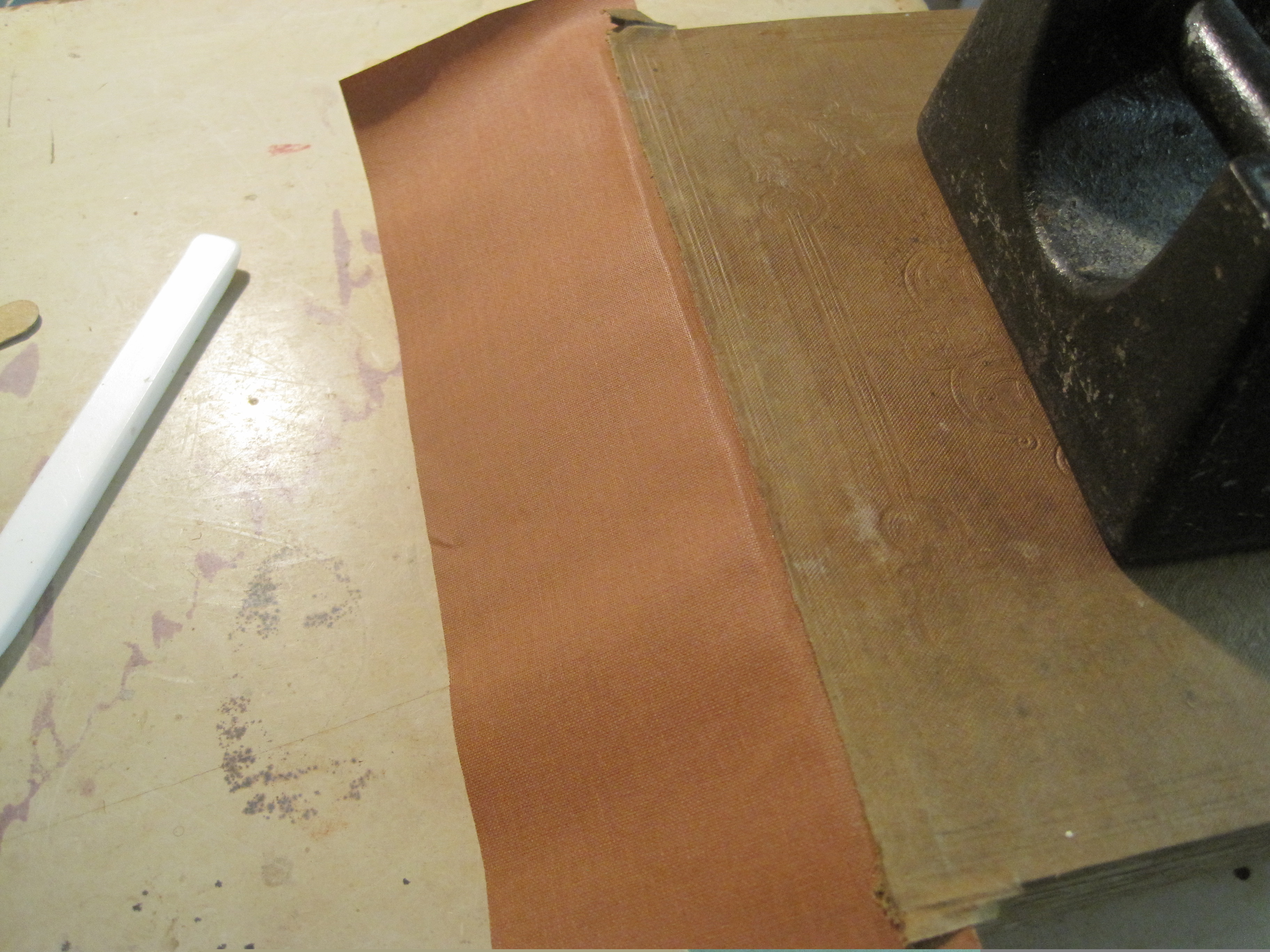
So the fraynot fabric is glued on to the cover board; now the new bookcloth strip is glued straight on to it. The width of the glued down strip is important – it has to be enough to create a sufficient turn-in at the head and tail and also the edge should coincide with an impressed line on the cover cloth where there is one (and there very often is).

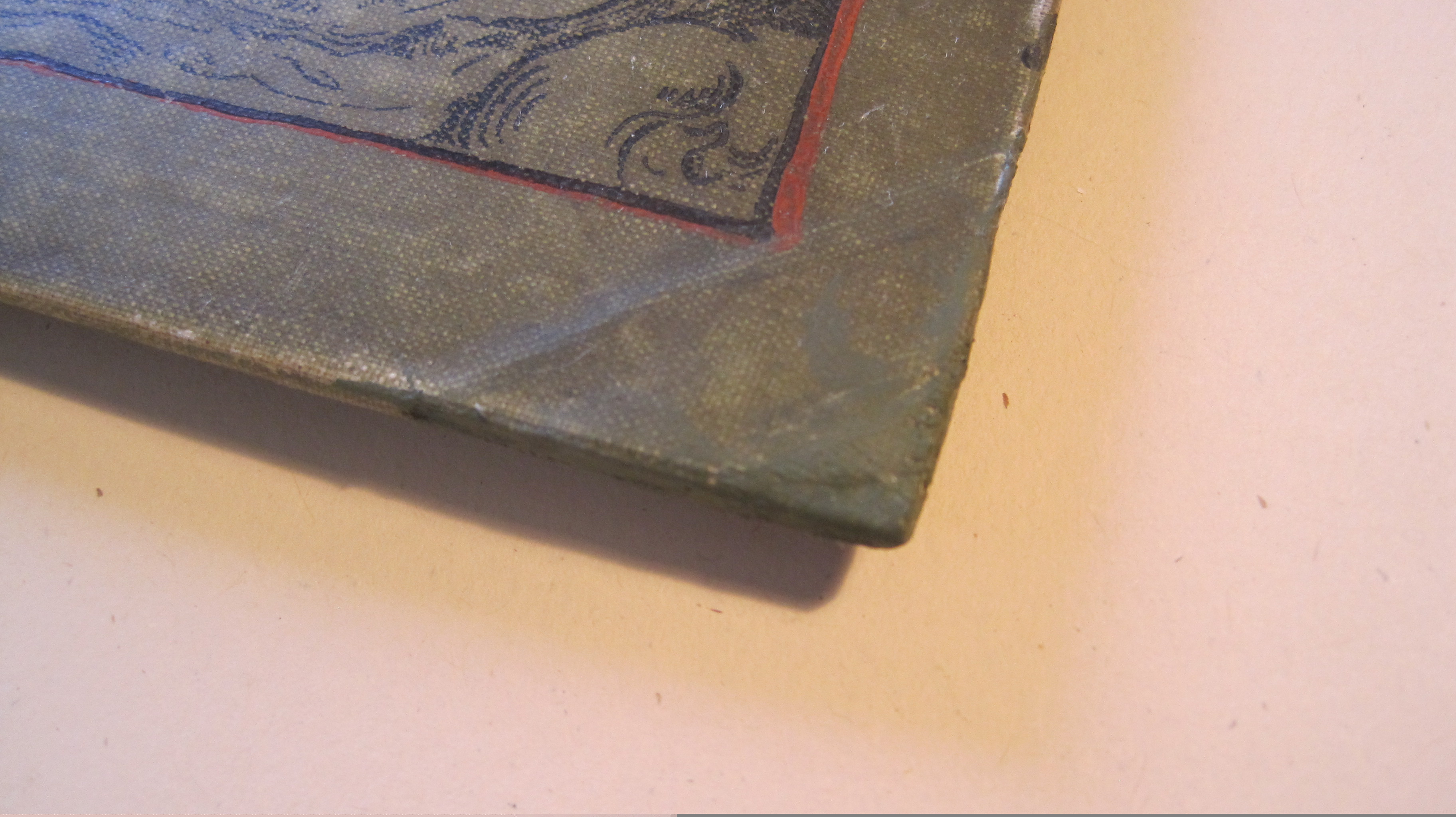
Lining up the edge of the new piece of cloth with an impressed line on the original board masks the extra thickness created by the new material.

Now the new cloth has to be lined, as normal for a cloth spine. Use stiff paper or thin card but thinner that the old liner you took off at the beginning. You want to replicate the stiffness of the original, but after the repair there will be two layers of cloth on the spine, not one, so make the liner a bit thinner to compensate. Make sure the grain of the liner is up the spine.

As soon as you have glued the liner in place fold it round the back and hold it in place for a few minutes – this will set it in the shape you want.

Attach the other board as before – fraynot fabric and new cloth on top, under the lifted edge of the old cloth.

Now glue down the lifted edges or the original cloth on to the new cloth – use glue (sparingly) not paste as paste will penetrate the cloth and may stain. Then do the same with the flap of the old spine strip.

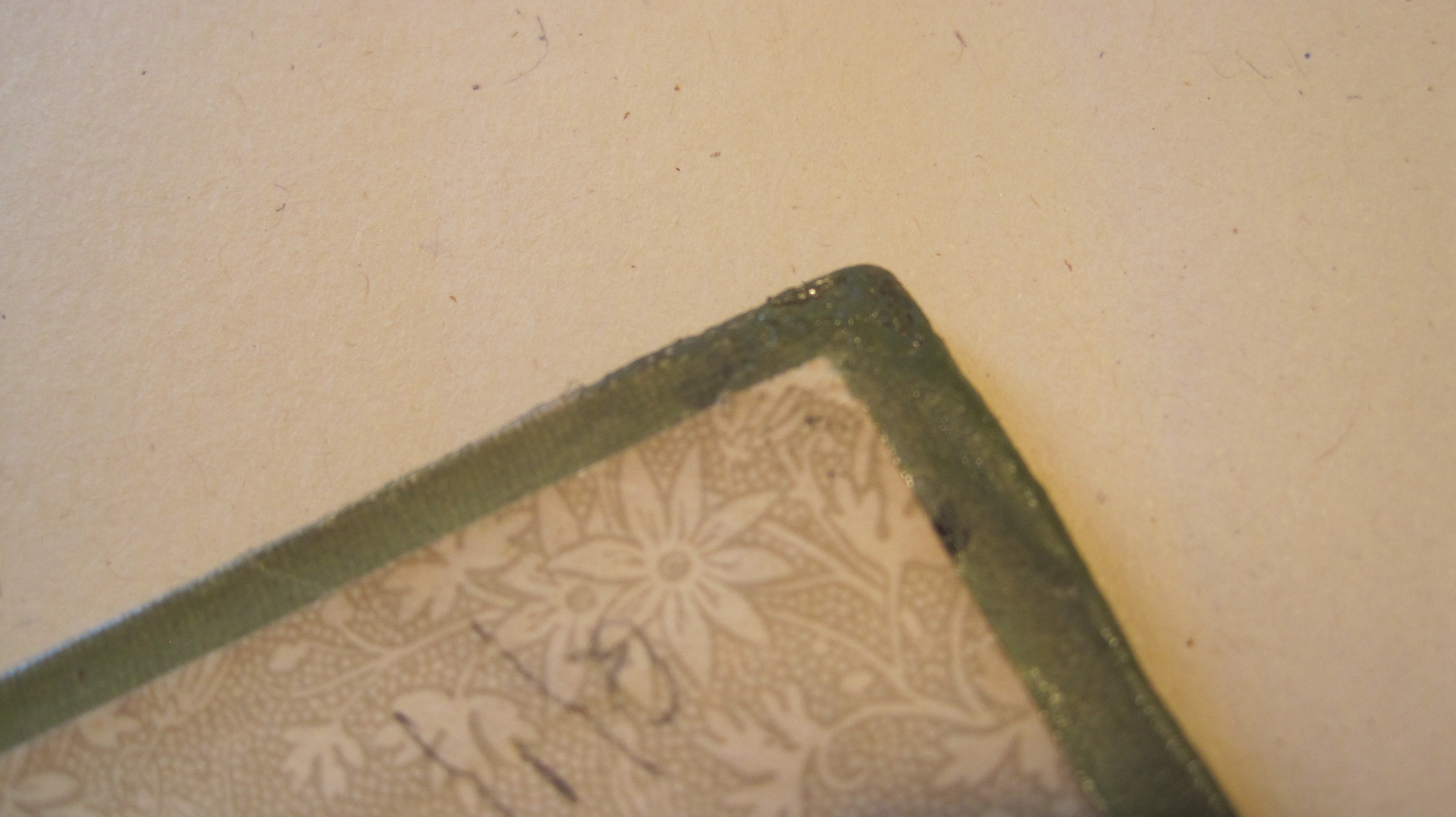
The difference in colour is just age – the spine gets more sun and pollution than the sides, so choose a repair bookcloth that matches the spine, not the sides.

Next, the head and tail of the spine need to be turned in. There is a risk of getting glue on to the surface of the pages at top and bottom as you try to fold glued flaps into the hollow and to avoid this I use a piece of flexible acetate (a piece of thin card will do just as well but the acetate is better as it can be wiped clean each time and re-used indefinitely).

Note that the acetate goes into the ‘pockets’ between the endpapers and the boards you previously made to take the turn-ins.
Apply glue sparingly inside the new bookcloth and the old and fold into the hollow – a finger and a bodkin to work the cloth over and then a thin bone folder to flatten the turned-in cloth inside the pockets under the endpapers.

Then fold the little flaps at the top corners of the boards over to meet the top edges of the endpapers and set in place with a fold of release paper, a fold of thin card and a small butterfly clip.

All that remains is to colour frayed or rubbed areas with acrylic paint, paste down any odd frayed bits and polish the whole thing.

NB In this case the corners were OK – I will show how to improve bent or damaged corners another time.

A reminder! This is a repair, not a restoration, so there will be small lumps or creases and the colour match will not be exact. But it will work as a book and will not be harmed by normal use.

Bread and butter stuff

I have just completed a repair that is typical of most of my work, and which, I think, is a good example of what earns the daily bread of most hand bookbinders – a worn and damaged cloth binding from the mid-nineteenth century. If its done well and pleases the client the cost charged may put a little butter on that bread as well.

So, plain cloth, spine half detached, sewing shaken and a section loose.

First, agree with the client about the extent of the work – repair or full restoration to original condition? The difference in cost is considerable because the time taken to eliminate all signs of wear, fading and use is much greater – certainly more than twice as long, perhaps five times as long.

In this case the client wanted a straightforward repair: attach loose board, re-position detached section, re-line spine and re-back with suitable bookcloth and then re-attach spine strip. The book will then be firm to handle, open easily, stand straight on the shelf and have no frayed or loose edges.

First, clean off all the material that no longer serves its purpose – the decayed and powdery spine linings and the dry and cracked glue on the back. Plain starch paste does the job on the back, but the lining of the cloth spine should be lifted dry, as paste may stain the cloth.

I use an artist’s palette knife as the blunt edge reduces the risk of cutting through the old cloth. Following the palette knife an emery board (for your nails) will remove any scraps of paper lining remaining.

Scrape off all the old glue on the back of the text block and wipe clean.

The sewn sections can now be re-shaped into their original even round, and the loose section re-set so its back edge is where it should be – it gets sewn into the new lining later. Then put the book between backing boards and sharpen the backing joints.

The back of the book is now evenly rounded, with well-defined shoulders for the boards to sit in.

With the book still in the press, line the spine with ‘fraynot’ – a strong but light cotton fabric. Handkerchief fabric will do just as well. Then sew the first and last sections through the fraynot and also the loose inner section.

Now glue on a new lining strip. I make sure both the fraynot and the lining are well working on to the text block by tamping down with a stiff bristle brush. It works better than just rubbing with a bone folder.

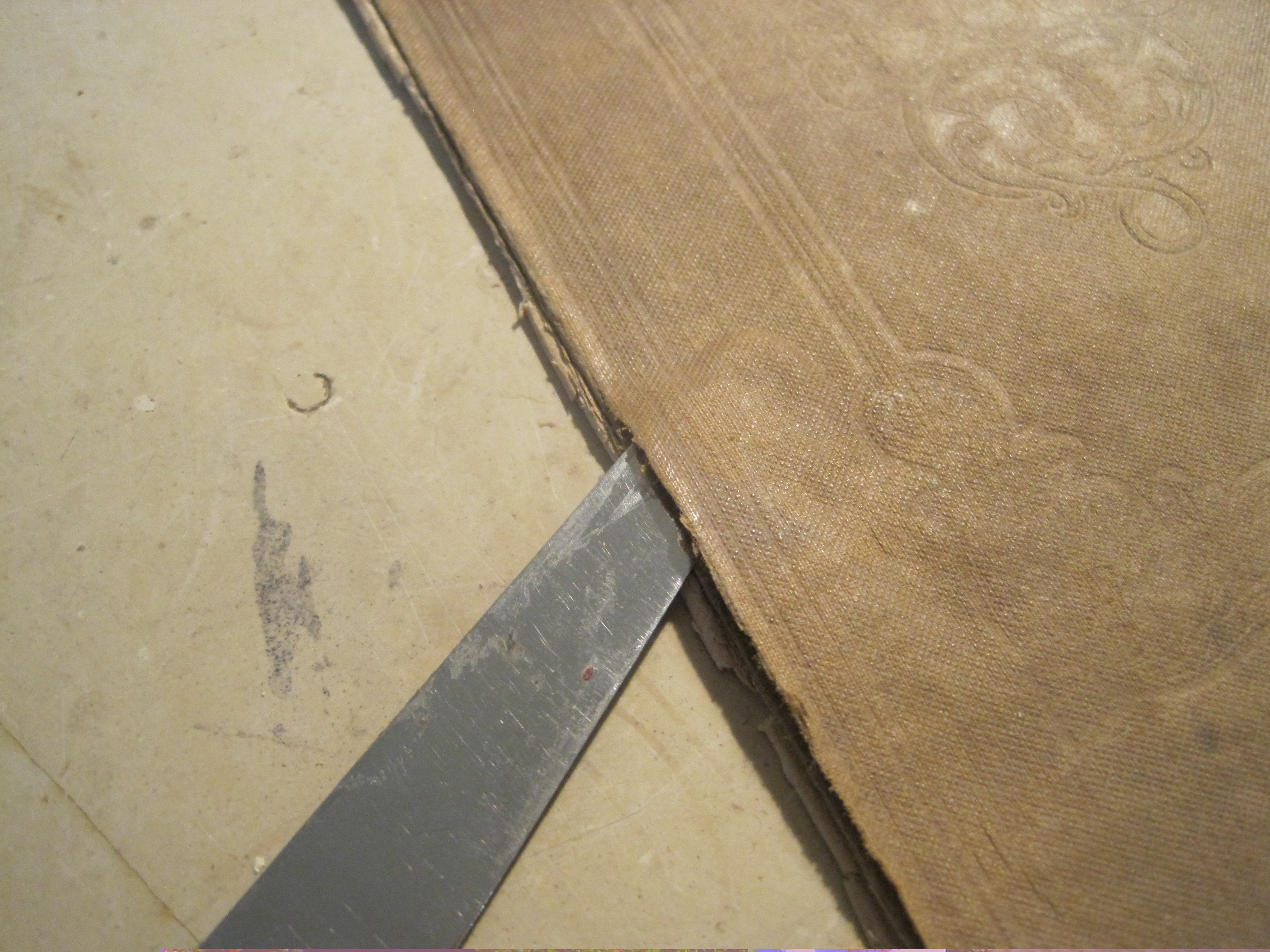
The new spine lining should not be too thick or stiff so the book will still open easily. Here the edge of the cover cloth has already been lifted with a palette knife: strictly speaking the next image should come before this.

Now the cloth on the covers must be lifted up so the the new lining cloth as well as the new spine bookcloth can be glued down. I do this on the outside of the cover board, not the inside. You get a neater inner joint that way.

That’s about halfway through the process: each step only takes a few minutes so the aggregate bench time so far is perhaps half an hour. While paste is softening old glue, or new glue is drying, the next book is got underway.

To be continued…..

“After the Lord Mayor’s Show…

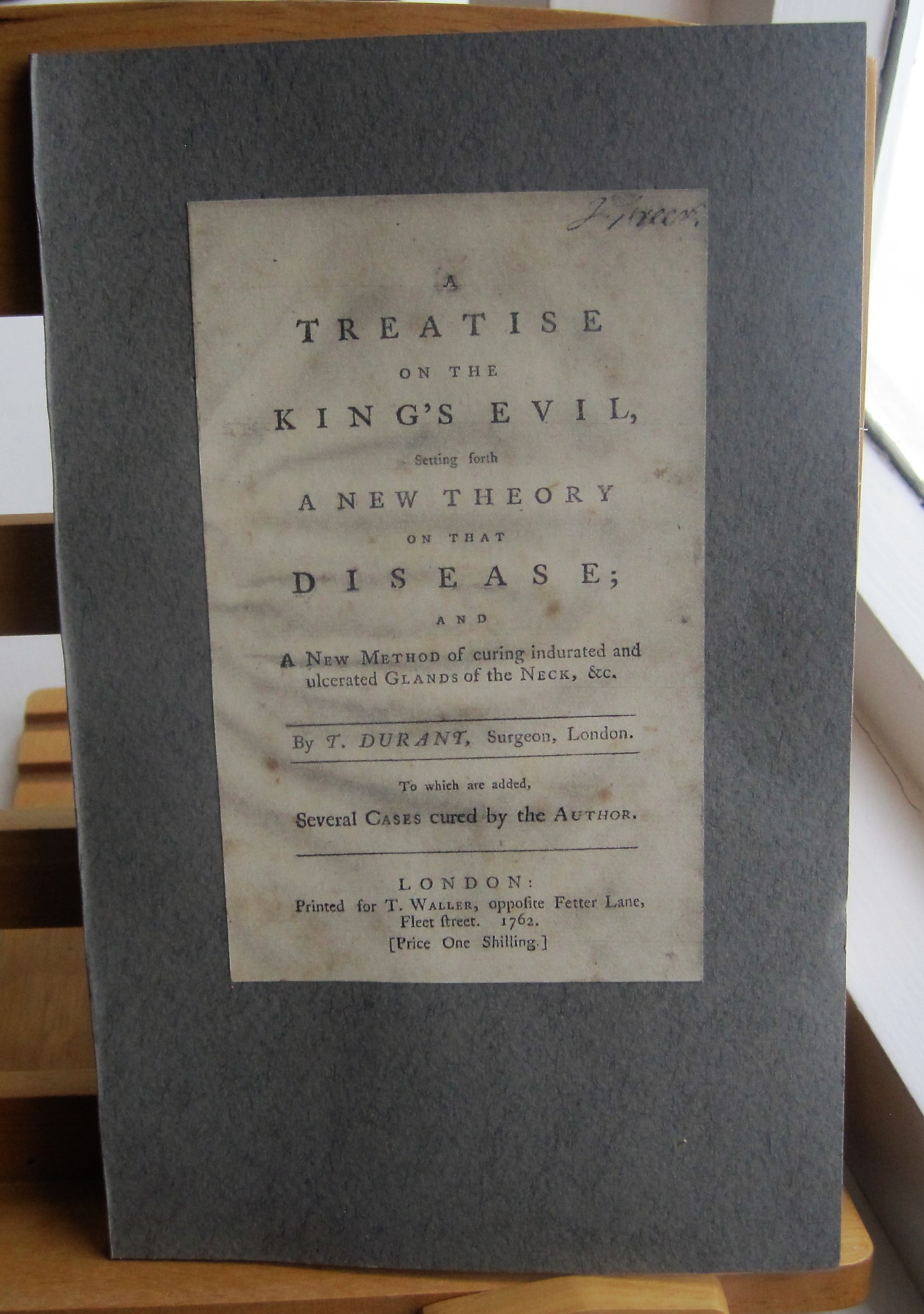
….. comes the dung-cart”, as my South London grandmother would say. So, after my very large box for a very large (and quite valuable) book, comes a small cheap pamphlet. The problem of what to do with ephemeral or disbound items faces every bookseller and collector. It may have little market value, but is too good to throw away. One such passed (quite quickly) across my workbench yesterday: “A Treatise on the King’s Evil, setting forth A New Theory on that Disease;…” by T Durant, Surgeon, London. 1762. 52 pages, small octavo. No covers or remains of endpapers.

Its bookseller owner simply wanted it to be made ‘presentable’, by which he meant saleable.

So, glue up the back of the sections to secure a little looseness in the sewing, cover with a piece of grey Daler Rowney Murano paper, 160 gsm, glued down the spine and well rubbed down; photocopy the title page at 70% and print on to old paper and glue on to front. Half an hour on the bench; £12 to the client.

The apparent wrinkle in the label is in the photocopy, not the gluing down. Gives an authentic look.

A big problem

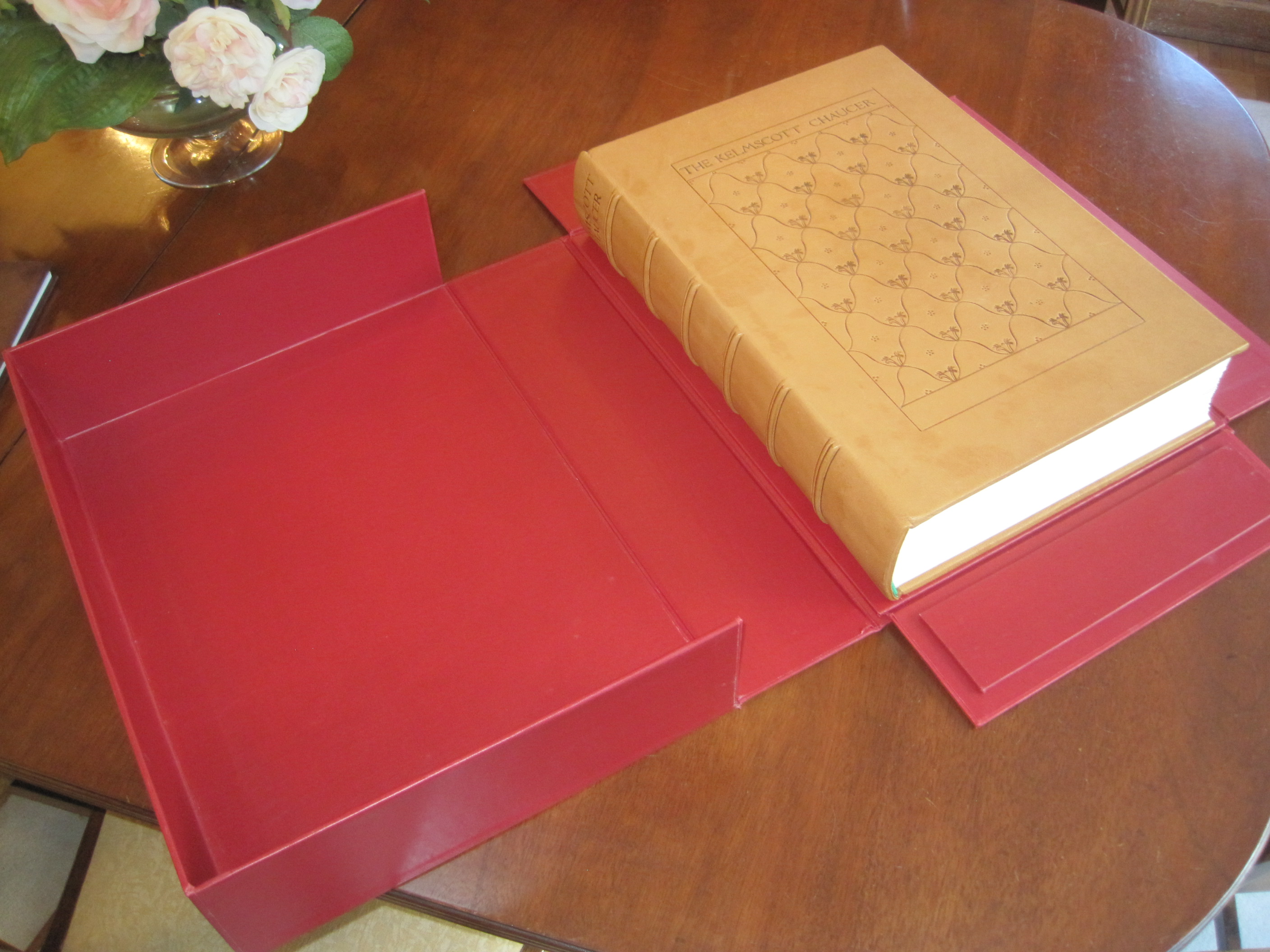
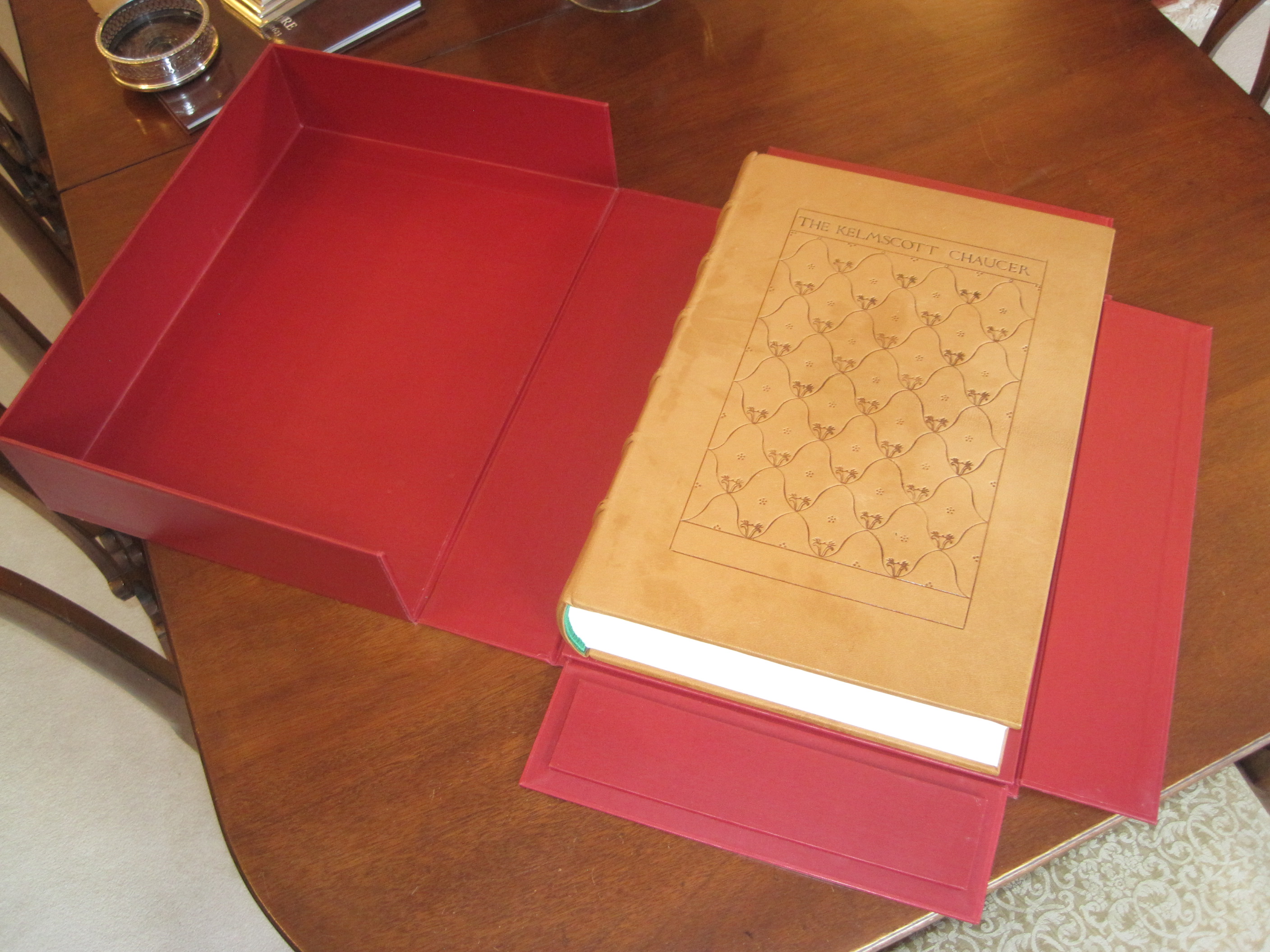
The Folio Society Kelmscott Chaucer that I wrote about a few days ago presents particular problems because of its sheer size – it weighs 7 kg (about 16 lbs) and measures 17 inches by 12.5 by 3.5 (43 cm by 32 cm by 9 cm). The Kelmscott original was a little thinner and weighed a little less in linen-backed boards, but about the same in its pigskin binding. Such a book is technically portable, of course, but awkward and therefore susceptible to abrasion or worse. I reckon Morris intended it to be a lectern item, for display and admiration, to be opened and closed but not moved about much. Some copies were provided with oak caskets which no doubt provided good protection but made portability even more difficult.

Clearly a strong drop-back box would provide protection and many of the copies recorded in the Peterson Census are described as having one. But even a box for a book this size presents some difficulties. Lifting the heavy book out of the inner tray is awkward: the only ‘hold’ you can get on it when the box is open lying flat is with the fingers under the spine. That will lead to scratches from finger nails on the leather and, in time, staining from the natural oil in our skin – what an old colleague of mine used to call ‘finger-fat’. Furthermore, the weight of the text will, over time, cause the tail-edge to drop and the head to lose its curve. That can be solved with a supporting pad on the inside of the inner tray under the tail edge, but that makes it even more difficult to lift the book out.

Here is my solution: the inner tray is three flaps that fall down when the lid is lifted.

Simple drop-back box, made from plywood covered with buckram.


But inner tray is three flaps, the lower one with a supporting pad for the tail edge.
Book can now be lifted and handled much more easily.

When closed the whole thing goes under one arm , just!

Sad news today

Very sad to hear today that Bernard Middleton has died, aged 94. There will be many obituaries over the next few days, longer and more informative that this, because he was a major figure in British bookbinding for the past 60 years, and had a wide influence on the whole world of the book through his writing and research.

My contact with him was brief but profound. First, I attended his ‘master class’ on leather book repairs at Bolt Court in London in the mid 1980s. At one point he completed a two-colour headband (about an inch long) in less than 5 minutes, explaining all the while how it had been done ‘in the trade’ in the 18th century, though then always by women. His theme was always ‘economy of effort’.

Years later I found myself bidding against him at auctions of old bookbinding tools at Dominic Winter’s saleroom near Cirencester. He usually prevailed, holding his hand up throughout the bidding until he either won the lot or decided some idiot was clearly prepared to pay too much. He once told me ‘you can never have too many tools’ – he meant finishing tools, and of course he was right as regards his specialism of restoring antiquarian books where having the right tool to match the style of any book from 1500 to 2000 was pretty important.

To say he will be sorely missed is a cliche that in this case happens to be absolutely apt.

Another ‘find’ put in a new/old binding

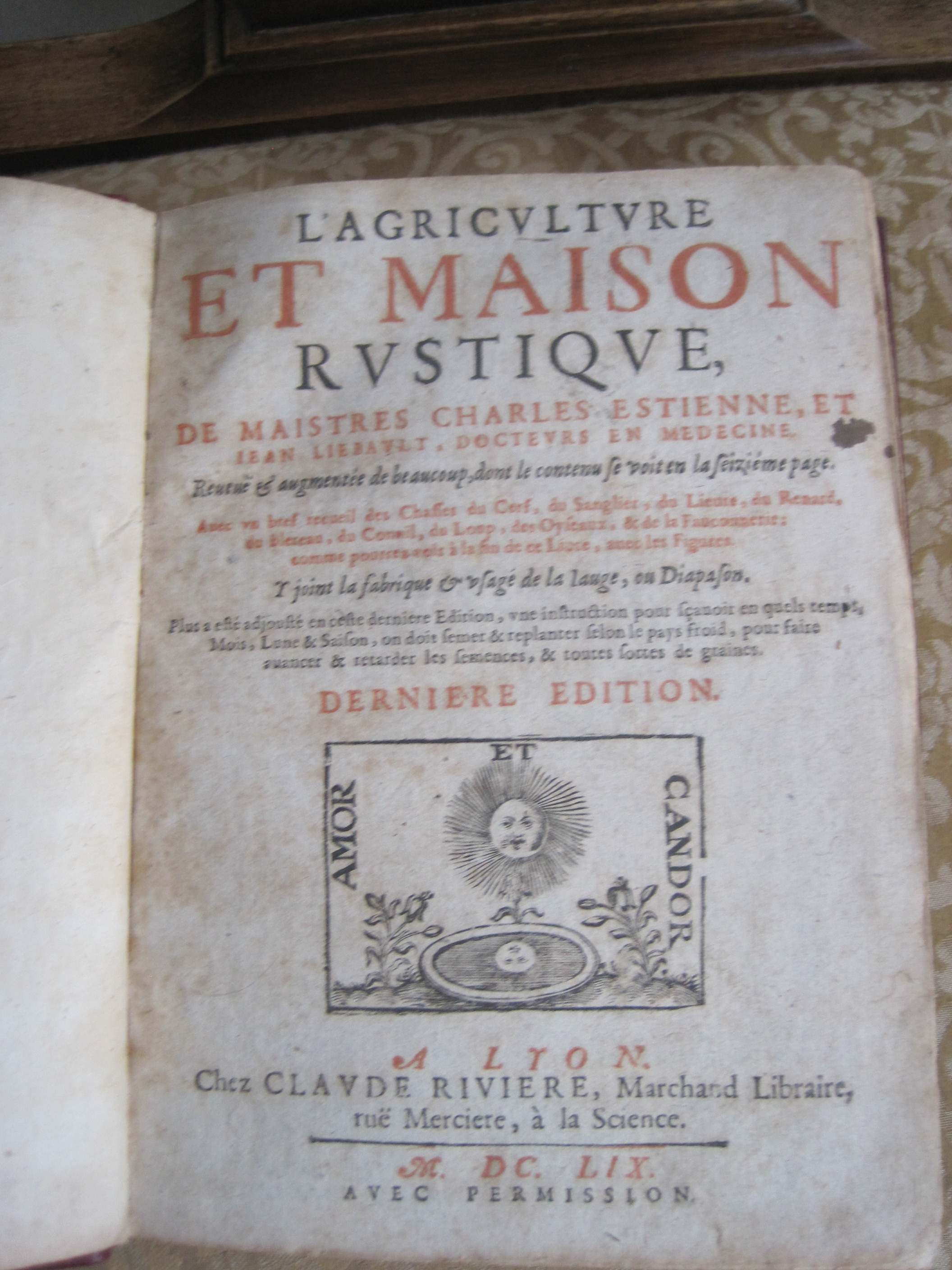
In my last blog I mentioned Dominic Winter’s auction house. It was there that I found a very shabby copy of ‘L’Agriculture et La Maison Rustique’, 1659, by Charles Estienne and Jean Liebault.

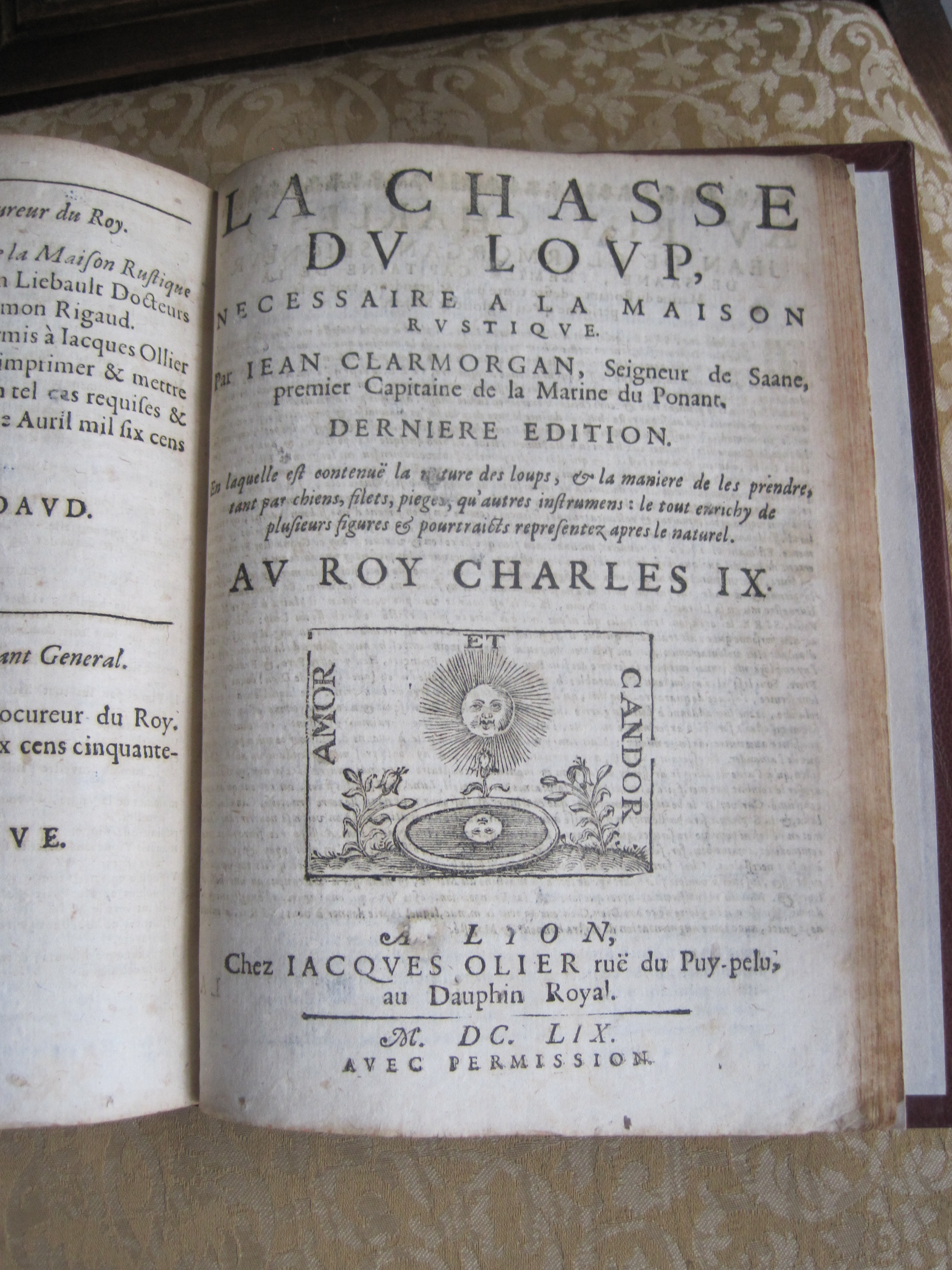
Not a rare book as it was so popular amongst the landowners of both Britain and France that it ran into many editions, some of them certainly pirated. But the text was complete – it even had the blank leaves at both the front and the back – and all the woodcut engravings of garden designs and how to catch a wolf were present. The wolf-catching part is in fact a separate publication:

Also printed in Lyon in the same year, but by a different publisher

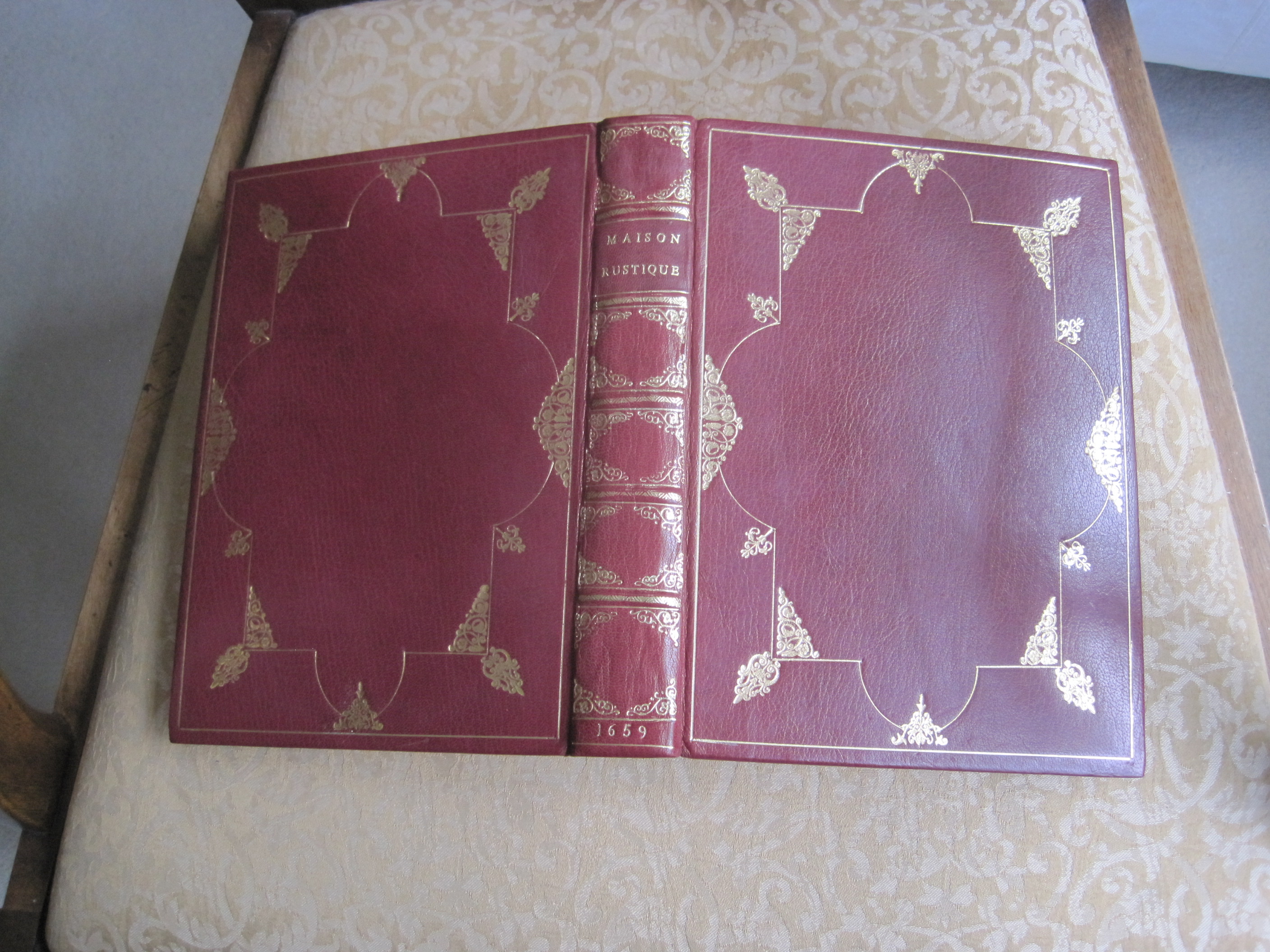
So it seemed worth while to give it a new dress, in a suitable style. Red morocco would be right for a country gentleman’s library in around 1660, decorated in the style of Florimond Badier or Mace Ruette.

Some Badier or Ruette bindings are very elaborate, but many were more restrained, like this. A line fillet wheel for the borders, two pairs of corner tools, two gouges, two line pallets and three other ornaments: once you have set out the pattern the actual tooling only takes an hour on each side and half an hour on the spine.

The leather, from a good Grade II skin about £30, other materials negligible, total bench time 5 hours. So binding cost, say £140, plus 50% ‘mark up’ for sale, plus the initial cost of the book at auction, total sale price £500.

It’s surprising what is ‘rejected’ sometimes

This blog is chiefly about rescuing redundant or rejected books, either for myself or for other people. Now, I am fortunate to live not very far from a specialist book auction firm, Dominic Winter, whose salerooms I have haunted for over 20 years. Their sales always include books rejected by book dealers, or by their owners or inheritors, and I have picked up some good bargains over the years.

A case in point was a very scruffy copy of a facsimile of the First Folio of Shakespeare’s plays. Scruffy as regards the binding, that is, not the Shakespeare text, which is complete. I bought it for about £80 back in 2011, and put it on a shelf in my bindery for attention in due course. ‘Due course’ was several years later (of course!) when I did a bit of research on it and found it was printed in 1866 by Day and Son and was the first ever full-size facsimile of the First Folio, made from zincographic plates from the copy owned by Lord Ellesmere and held in the British Library in London.

It seemed to be worth re-binding properly as there were very few copies listed for sale (there still are very few – only two as at today’s date on the net, both in the US and priced at $1500 and $450 respectively and both in pretty shabby bindings). An on-line check of the catalogue of the Folger Library in Washington DC produced full bibliographical details and showed that my copy lacked the 1866 printer’s title page but was otherwise intact. There were some scattered spots on a few pages at front and back but otherwise the text was clean and fresh and the paper of a good tone for the period – unlike the other full-size facsimile, the Norton Facsimile, printed in 1968 on rather bright white paper.

So, how to bind it? Natural calf would be right for the publication date (1623) and blind tooling appropriate, to a design cribbed from images of contemporary English bindings. Here is what I came up with

The tooling uses two creasers, two decorative rolls, one pair of corner tools (on the spine) and only four other tools from which the centre-piece and corners are made up, plus tiny heart and star tools

The last real First Folio to be sold fetched nearly £3 million, in 2006. Of the estimated 750 copies printed 219 are known to have survived, 82 of them in the Folger Library. 46 are in the UK. There are several copies of the Day facsimile in the UK, mainly in libraries.

I am open to offers for mine!